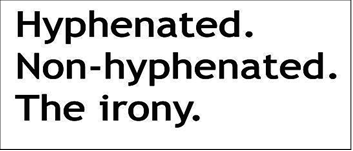
Posted by: Jack Henry | June 2, 2016

Editor’s Corner: It

Today I’m going to talk about it, and no, I’m not referring to the Steven King novel that gave me nightmares. I’m talking about the pronoun it. Actually, it can be a bit of a nightmare trying to figure out which noun the pronoun it is referring to in a sentence that contains multiple nouns.

These examples are from an article called Do Your Readers a Favor: Cut ‘It’ Out, by Grammar Girl.

· When we updated that feature in the app, we messed it up. (Did we mess up the feature or the app?)

· Take the gyroscope out of the device, and fix it. (Do I fix the gyroscope or the device?)

· For anyone who has used this CMS, it’s obvious that it’s not easy to learn. (The first it is an expletive—a filler word, and the second it is the pronoun for CMS.)

· Although the company made a profit, it made poor use of it. (You can figure this one out, but you probably had to think about it.)

Although you may know which noun your pronoun is referring to, it may not be clear to your reader and could cause confusion.

The next time you use it as a pronoun, make sure the reference to the noun is clear, or this clown will get you!

Jackie Solano | Technical Editor | Symitar®

8985 Balboa Ave. | San Diego, CA 92123 | Ph. 619.542.6711 | Extension: 766711

Symitar Documentation Services

Posted by: Jack Henry | June 1, 2016

Editor’s Corner: Neologisms

My dear coworker Jane sent me an interesting tweet from Grammar Girl about two neologisms: teamish and brown baggery. A neologism is a newly coined word that makes its way into everyday usage. Unfortunately, Grammar Girl didn’t explain what either of these terms meant and they aren’t that common. Here’s a little of what I found on the Internet. I don’t think either item is what she meant:

· teamish – An anagram of atheism. As a personal guess, I’d say “like a team.”

· brown baggery; brown bagger – A woman with a great body but an ugly face (that gets a brown bag over it). In my world, it is someone who brings their own lunch, but brown baggery? Just bringing your lunch to work?

Instead of focusing on those, here is an article from Grammar Monster, which explains some neologisms and their definitions. In the meantime, if any of you know what Grammar Girl might mean by teamish and brown baggery mean, please share!

Neologisms

Some neologisms are formally accepted into mainstream language (at which point, they cease to be neologisms), and some wither until they can no longer be considered everyday terms. A neologism can be:

· A completely new word (e.g., oversharers)

· A new combination of existing words (e.g., digital detox)

· A new meaning for an existing word (e.g., sick)

Examples of Neologisms

The following are examples of neologisms at the time of writing (2014):

· Oversharers: People who post too much information (which is often boring or embarrassing) about themselves on line.

· Digital Detox: Abstaining from electronic devices to re-engage with the physical world, typically to lower stress levels.

· Sick: Good.

Examples of Old "Neologisms"

The following former neologisms have been formally accepted into mainstream language (this usually means appearing in a respectable dictionary). As a result, they can no longer be classified as neologisms.

· D’oh!: An exclamation meaning damn (usually after a mistake by the speaker).

· Wicked: Good or cool.

· To Google: To look up information on the internet.

Note: The term "old neologism" is an oxymoron (i.e., a self-contained contradiction).

Examples of Neologisms under Transition

The following neologisms can be considered under transition. In other words, they are still neologisms, but it is likely they will be accepted into mainstream language soon.

· Metrosexual: A heterosexual man who likes the interests traditionally associated with women or homosexual men (e.g., shopping, fashion, his appearance).

· Noob: A person new to an online gaming community.

· Staycation: A vacation at home or near home (usually due to financial constraints preventing a holiday abroad).

· Troll: A person who posts obnoxious comments to an online community.

KC – All of the transitional neologisms, except noob, are now in the Merriam-Webster dictionary; however, the alternate spelling newb is in the dictionary.

More Contest Photos

From Tom Ha at AmeriChoice Federal Credit Union:

Kara Church

Technical Editor, Advisory

Symitar Documentation Services

Posted by: Jack Henry | May 31, 2016

Editor’s Corner: Complete

Complete vs Completed

Judging from the number of times I’ve been asked whether to use the word complete or completed in a sentence, I thought maybe I’d spend a few minutes on this topic.

Complete can be tricky because sometimes it is used as an adjective and other times it is used as a transitive verb. Before I show examples of the different uses, however, let’s look at their definitions (from Merriam-Webster) so you can see more clearly how they are different:

· complete (adjective): possessing all necessary parts, items, components, or elements: not lacking anything necessary: entire, perfect

· complete (transitive verb): to bring to an end often into or as if into a finished or perfected state: to execute (a forward pass) successfully

Now, let’s look at some examples of the two uses.

Adjective

· Joey has a complete set of Iron Man comic books: from the first one published to the one from this month.

· The process of renewing her driver’s license is complete.

Transitive Verb

· After three hours, the backup was completed.

· Slim completed the pass to the new receiver, Bobo, who scored his first touchdown.

You may notice that a sentence like “After three hours, the backup was completed” could also sound fine as “After three hours, the backup was complete.” In this case, consider the different uses of complete and what message you are trying to get across. If you want to emphasize that the backup is finished, use past tense of the transitive verb, completed. If you want to emphasize that the backup contains all the necessary information and that it is whole, then you may want to say it is complete.

Contest Photo

Thanks to my Coloradan buddy, Richard, for this photo.

Kara Church

Technical Editor, Advisory

Symitar Documentation Services

Posted by: Jack Henry | May 27, 2016

Editor’s Corner: Memorial Day

I was just sitting here thinking about the holiday on Monday and I thought that maybe I should look into Memorial Day. I found this brief explanation on Wikipedia, which I found interesting:

Memorial Day is a federal holiday in the United States for remembering the people who died while serving in the country’s armed forces. The holiday, which is observed every year on the last Monday of May, originated as Decoration Day after the American Civil War in 1868, when the Grand Army of the Republic, an organization of Union veterans founded in Decatur, Illinois, established it as a time for the nation to decorate the graves of the war dead with flowers. By the 20th century, competing Union and Confederate holiday traditions, celebrated on different days, had merged, and Memorial Day eventually extended to honor all Americans who died while in the military service.

From there, I looked up the etymology for memorial on the Etymology Online site, and I thought the collection of words they had grouped together was more interesting than their etymologies. Here are a few of the words and definitions that came up:

· memorial (noun): “fame, renown, reputation,” also “commemorative gesture, monument, or rite,” in general, “something by which the memory of a person, thing, or event is preserved.”

· memorial (adjective): “memorable, excellent; remembered, committed to memory.”

· immemorial (adjective): “old beyond memory,” or “ancient beyond memory.”

· immemorable (adjective): “something not worth remembering.”

· festschrift (noun): "volume of writings by various scholars presented as a tribute or memorial to a veteran scholar," 1898, from German Festschrift, literally "festival writing."

Whether you put flowers on a memorial or read a festschrift, I hope you have a memorable weekend.

Kara Church

Technical Editor, Advisory

619-542-6773 | Ext: 766773

Symitar Documentation Services

NOTICE: This electronic mail message and any files transmitted with it are intended
exclusively for the individual or entity to which it is addressed. The message,
together with any attachment, may contain confidential and/or privileged information.
Any unauthorized review, use, printing, saving, copying, disclosure or distribution
is strictly prohibited. If you have received this message in error, please
immediately advise the sender by reply email and delete all copies.

Posted by: Jack Henry | May 26, 2016

Editor’s Corner: Write Positively

The editors often talk about ways to avoid ambiguity in your writing. One way to do that is to write positively. Negative words can make sentences difficult for readers to understand.

Here are some examples:

Original sentence:

· Do not install the software until you check that your computer does not have conflicting programs.

This sentence contains the negative word not in both clauses and can confuse readers.

Revised sentence:

· Before you install the software, check your computer for conflicting programs.

The revised sentence removes the negative words from both clauses and opens up the dialog so you can provide information on what to do if the user’s computer has conflicting programs.

Original sentence:

· The Due Day 2 field cannot have a value on or before the value in the Due Day 1 field.

This sentence focuses on what the field cannot be set to.

Revised sentence:

· The value in the Due Day 2 field must be greater than the value in the Due Day 1 field.

The revised sentence clearly states what the field must be set to.

Use positive terms when possible (JHA folks, using positive language is a standard in the JHA Style Guide for Technical Communication and Training). Keep in mind that some negative terms are necessary to be effective. For example, “Do not talk on your cell phone while driving; you will crash your beautiful station wagon.”

Jackie Solano | Technical Editor | Symitar®

8985 Balboa Ave. | San Diego, CA 92123 | Ph. 619.542.6711 | Extension: 766711

Symitar Documentation Services

Posted by: Jack Henry | May 25, 2016

Editor’s Corner: Arabic Etymologies, Part II

Today I have part two of the Arabic Etymologies article for you. Etymologies supplied by the Online Etymology Dictionary.

checkmate: mid-14c., from Old French eschec mat (Modern French échec et mat), which (with Spanish jaque y mate, Italian scacco-matto) is from Arabic shah mat "the king died" (see check (n.1)), which according to Barnhart is a misinterpretation of Persian mat "be astonished" as mata "to die," mat "he is dead." Hence Persian shah mat, if it is the ultimate source of the word, would be literally "the king is left helpless, the king is stumped."

cipher: late 14c., "arithmetical symbol for zero," from Old French cifre "nought, zero," Medieval Latin cifra, with Spanish and Italian cifra, ultimately from Arabic sifr "zero," literally "empty, nothing," from safara "to be empty;" loan-translation of Sanskrit sunya-s "empty." The word came to Europe with Arabic numerals.

nadir: late 14c., in astronomical sense, from Medieval Latin nadir, from Arabic nazir "opposite to," in nazir as-samt, literally "opposite direction," from nazir "opposite" + as-samt "road, path" (see zenith). Transferred sense of "lowest point (of anything)" is first recorded 1793.

orange: c. 1300, of the fruit, from Old French orange, orenge (12c., Modern French orange), from Medieval Latin pomum de orenge, from Italian arancia, originally narancia (Venetian naranza), alteration of Arabic naranj, from Persian narang, from Sanskrit naranga-s "orange tree," of uncertain origin. Not used as a color word until 1540s.

Loss of initial n- probably due to confusion with definite article (as in une narange, una narancia), but perhaps influenced by French or "gold." The name of the town of Orange in France (see Orangemen) perhaps was deformed by the name of the fruit. Orange juice is attested from 1723.

Photo Contest

I received this wise photo from three or four different people. Amen, brothers and sisters!

Kara Church

Technical Editor, Advisory

Symitar Documentation Services

Posted by: Jack Henry | May 24, 2016

Editor’s Corner: Arabic to English

Hello!

A coworker and friend of the Editor’s Corner, Robert Trescott, sent me an interesting article about the Moors in Spain, which led to a conversation about Arabic words that made it into our English vocabulary, and ended with me doing some research on some of the words in the article. I’ll share a few of these with you today and a few tomorrow.

The etymologies are from one of my favorite websites, the Online Etymology Dictionary.

alchemy: mid-14c., from Old French alchimie (14c.), alquemie (13c.), from Medieval Latin alkimia, from Arabic al-kimiya, from Greek khemeioa (found c.300 C.E. in a decree of Diocletian against "the old writings of the Egyptians"), all meaning "alchemy." Perhaps from an old name for Egypt (Khemia, literally "land of black earth," found in Plutarch), or from Greek khymatos "that which is poured out," from khein "to pour," related to khymos "juice, sap" [Klein, citing W. Muss-Arnolt, calls this folk etymology]. The word seems to have elements of both origins.

Mahn … concludes, after an elaborate investigation, that Gr. khymeia was probably the original, being first applied to pharmaceutical chemistry, which was chiefly concerned with juices or infusions of plants; that the pursuits of the Alexandrian alchemists were a subsequent development of chemical study, and that the notoriety of these may have caused the name of the art to be popularly associated with the ancient name of Egypt. [OED]

The al- is the Arabic definite article, "the." The art and the name were adopted by the Arabs from Alexandrians and thence returned to Europe via Spain. Alchemy was the "chemistry" of the Middle Ages and early modern times; since c. 1600 the word has been applied distinctively to the pursuit of the transmutation of baser metals into gold, which, along with the search for the universal solvent and the panacea, were the chief occupations of early chemistry.

alcohol: 1540s (early 15c. as alcofol), "fine powder produced by sublimation," from Medieval Latin alcohol "powdered ore of antimony," from Arabic al-kuhul "kohl," the fine metallic powder used to darken the eyelids, from kahala "to stain, paint." The al- is the Arabic definite article, "the."

algebra: 1550s, from Medieval Latin algebra, from Arabic al jabr ("in vulgar pronunciation, al-jebr" [Klein]) "reunion of broken parts," as in computation, used 9c. by Baghdad mathematician Abu Ja’far Muhammad ibn Musa al-Khwarizmi as the title of his famous treatise on equations ("Kitab al-Jabr w’al-Muqabala" "Rules of Reintegration and Reduction"), which also introduced Arabic numerals to the West. The accent shifted 17c. from second syllable to first. The word was used in English 15c.-16c. to mean "bone-setting," probably from Arab medical men in Spain.

Contest Photo

I guess this Ryder truck is listed on the wonderful World Wide Web. Thank you for the photo, Yreka!

Kara Church

Technical Editor, Advisory

Symitar Documentation Services
Posted by: Jack Henry | May 23, 2016

Editor’s Corner: Concept Nouns

Good Monday morning, everyone. My subject today is a little bit dry, so take a sip of coffee (or whatever gets you going in the morning), and put on your thinking cap.

We have talked about the importance of avoiding passive voice (for example, you should avoid writing “The lunch was eaten,” and instead, you should write, “They ate lunch.”). One problem with passive voice is that it leaves out the subject of the sentence so the reader doesn’t know who is performing the action. Experts agree that passive voice weakens your writing and bores (and confuses) your reader.

The following information about concept nouns is from William Zinsser’s book, On Writing Well (Zinsser 1998, 76). Zinsser comes at the topic of passive voice from a different angle, which I thought might be helpful.

Concept Nouns

Nouns that express a concept are commonly used in bad writing instead of verbs that tell what somebody did. Here are three typically dead sentences:

· The common reaction is incredulous laughter. [dbb – Who is laughing?]

· Bemused cynicism isn’t the only response to the old system. [dbb – Whose response are we talking about?]

· The current campus hostility is a symptom of the change. [dbb – Who is hostile? Professors? Students? Administration? Everyone?]

What is so eerie about these sentences is that they have no people in them. They also have no working verbs—only “is” or “isn’t.” The reader can’t visualize anybody performing some activity; all the meaning lies in impersonal nouns that embody a vague concept: “reaction,” “cynicism,” “response,” “hostility.” Turn these cold sentences around. Get people doing things:

· Most people laugh with disbelief.

· Some people respond to the old system by turning cynical; others say…

· It’s easy to notice the change—you can see how angry all the students are.

My revised sentences aren’t jumping with vigor, partly because the material I’m trying to knead into shape is shapeless dough. But at least they have real people and real verbs. Don’t get caught holding a bag full of abstract nouns. You’ll sink to the bottom of the lake and never be seen again.

OK, you can take your thinking cap off now and enjoy the rest of your day.

Donna Bradley Burcher | Senior Technical Editor | Symitar®

8985 Balboa Ave. | San Diego, CA 92123 | Ph. 619.278.0432 | Ext: 765432

Posted by: Jack Henry | May 20, 2016

Editor’s Corner: Greek Words, Part II

Happy Friday and happy weekend to you!

Today, my gift to you is the second half of the 12 Greek Words You Should Know, from Daily Writing Tips.

7. Dogma

Dogma refers to the established belief or set of principles held by a religion, ideology or by any organization. Dogmas are also authoritative and undisputed. Outside of the religious context, therefore, the term tends to carry a negative connotation. Notice that the plural is either dogmata or dogmas.

8. Eureka

The exclamation Eureka is used to celebrate a discovery, and it can be translated to “I have found!”. It is attributed to the famous Greek mathematician Archimedes. While taking a bath, he suddenly realized that the water displaced must be equal to the volume of the part of his body he had submerged. He got so excited with the discovery that he left his home and started to run and shout “Eureka!” through the streets of Syracuse.

9. Genesis

Genesis means birth or origin. There are many synonyms for this word, including beginning, onset, start, spring, dawn and commencement. Genesis is also the name of the first book of the Bible.

10. Phobia

Many people wrongly think that a phobia is a fear. In reality, it is more than that. Phobia is an irrational and exaggerated fear of something. The fear can be associated with certain activities, situations, things or people.

11. Plethora

You have a plethora when you go beyond what is needed or appropriate. It represents an excess or undesired abundance.

12. Kudos

Kudos means fame or glory, usually resulting from an important act or achievement. It is interesting to notice that in Greek and in the Standard British English, Kudos is a singular noun. Inside the United States, however, it is often used in a plural form (e.g., You deserve many kudos for this accomplishment!)

The town of Korthi (on the island of Andros); view from our friends’ house.

Kara Church

Technical Editor, Advisory

Symitar Documentation Services

Posted by: Jack Henry | May 19, 2016

Editor’s Corner: Greek Words You Should Know

We’re just about done with the articles I’ve set aside that are about Greece. I hope you’ve been able to enjoy a little vicarious getaway with me. Today I have the first half of the 12 Greek Words You Should Know, from Daily Writing Tips.

Along with Latin, Greek is probably the language that most influenced other languages around the world. Many English words derive directly from Greek ones, and knowing their origin and meaning is important.

1. Acme

The highest point of a structure. The peak or zenith of something. One could say that Rome reached the acme of its power on 117 AD, under the rule of Trajan.

2. Acropolis

Acro means edge or extremity, while polis means city. Acropolis, therefore, refers to cities that were built with security purposes in mind. The word Acropolis is commonly associated with Greece’s capital Athens, although it can refer to any citadel, including Rome and Jerusalem.

3. Agora

The Agora was an open market place, present in most cities of the ancient Greece. Today the term can be used to express any type of open assembly or congregation.

4. Anathema

Anathema is a noun and it means a formal ban, curse or excommunication. It can also refer to someone or something extremely negative, disliked or damned. Curiously enough, the original Greek meaning for this word was “something offered to the gods.”

5. Anemia

Anemia refers to a condition characterized by a qualitative or quantitative deficiency of the red blood cells (or of the hemoglobin). Over the years, however, the term started to appear in other contexts, referring to any deficiency that lies at the core of a system or organization.

6. Ethos

Translated literally from the Greek, ethos means “accustomed place.” It refers to a disposition or characteristics peculiar to a specific person, culture or movement. Synonyms include mentality, mindset and values.

Hadrian’s Library (in Athens, below the Acropolis)

Kara Church

Technical Editor, Advisory

Symitar Documentation Services

« Newer Posts - Older Posts »

Categories