Posted by: Jack Henry | March 3, 2017

Editor’s Corner: National Grammar Day

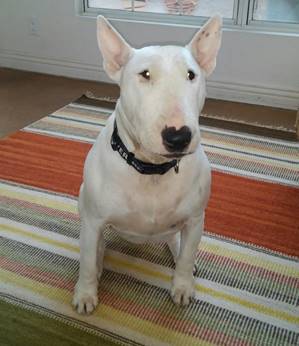
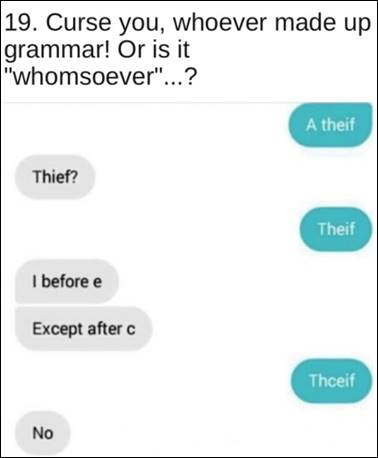
Tomorrow, March 4, is National Grammar Day. While my plan is to celebrate by going to visit a dog adoption event and check out the available playmates for my dog Bella, other people have some more exciting things they want to share with you. Mignon Fogarty, the original Grammar Girl, suggests you enter the Grammar Day Haiku Contest. She also provides links to some of the most frequently asked questions about which word to use. Some of these descriptions are lengthy, so I’m just providing the links in case you are interested.

· Affect versus effect

· Lay versus lie

· Sit versus set

· Who versus whom

· Toward versus towards

Whatever you decide to do for your weekend, I hope it is enjoyable!

Kara Church

Technical Editor, Advisory

619-542-6773 | Ext: 766773

Symitar Documentation Services

NOTICE: This electronic mail message and any files transmitted with it are intended
exclusively for the individual or entity to which it is addressed. The message,
together with any attachment, may contain confidential and/or privileged information.
Any unauthorized review, use, printing, saving, copying, disclosure or distribution
is strictly prohibited. If you have received this message in error, please
immediately advise the sender by reply email and delete all copies.


Posted by: Jack Henry | March 2, 2017

Editor’s Corner: Words Added to Merriam-Webster, Part 2

Today I’ll share some of the technology-related terms recently added to Merriam-Webster.

net neutrality: the idea, principle, or requirement that internet service providers should or must treat all internet data as the same regardless of its kind, source, or destination

abandonware: software that is no longer sold or supported by its creator

botnet: a network of computers that have been linked together by malware

binge-watch: to watch many or all episodes (of a TV series) in rapid succession

photobomb: to move into the frame of a photograph as it is being taken as a joke or prank

NSFW (abbreviation):not safe for work; not suitable for work—used to warn someone that a website, email attachment, etc., is not suitable for viewing in most places of employment

listicles:an article consisting of a series of items presented as a list

And the word ghost now includes this definition:

ghost: to abruptly cut off all contact with someone (such as a former romantic partner) by no longer accepting or responding to phone calls, instant messages, etc.

Jackie Solano | Technical Editor | Symitar®

8985 Balboa Ave. | San Diego, CA 92123 | Ph. 619.542.6711 | Extension: 766711

Symitar Documentation Services

NOTICE: This electronic mail message and any files transmitted with it are intended
exclusively for the individual or entity to which it is addressed. The message,
together with any attachment, may contain confidential and/or privileged information.
Any unauthorized review, use, printing, saving, copying, disclosure or distribution
is strictly prohibited. If you have received this message in error, please
immediately advise the sender by reply email and delete all copies.
When we were kids, my mom often took us to the Volunteer Park Conservatory in Seattle.

Volunteer Park Conservatory, Seattle, Washington

Later in life, I was referring to a conservatory, but then I had that sinking feeling that I was using the wrong word. Isn’t a conservatory a place where music is played? Isn’t it a room in the game Clue where you might be murdered with a candlestick or lead pipe?

Well, I received one of my weekly newsletters on this exact topic, so I’d like to share the answers with you from the Grammarist.

Conservatory, solarium or sunroom

The words conservatory, solarium, and sunroom are often used interchangeably, though there are slight differences in meaning. We will look at the difference between conservatory, solarium, and sunroom, where the terms come from and some examples…

A conservatory is a room or small outbuilding built with glass walls and a glass roof in order to let in great amounts of sunlight. A conservatory is primarily built for horticultural purposes, to grow tropical plants in a climate that is not tropical or to grow plants and vegetables out of season. In North America, the word conservatory is also used to describe a college that teaches music or other arts. The plural form is conservatories.

A solarium is also a room with glass windows and sometimes a glass roof built in order to let in great amounts of sunlight. A solarium is built as a recreation area, a place for people to enjoy the sun on cold days. Solariums were common features in tuberculosis sanatoriums. The plural of solarium may be rendered as either solariums or solaria.

Solarium

Sunroom is a North American word that describes a room that has large windows in order to allow the sun to shine in. Sunrooms are also recreation areas, often converted porches. The plural is sunrooms. Remember, the difference between a conservatory and a solarium is the purpose for which it is used. A sunroom differs from a conservatory and a solarium in that it is simply a room with large windows, not a structure made of glass.

Sunroom

Kara Church

Technical Editor, Advisory

Symitar Documentation Services

Posted by: Jack Henry | February 28, 2017

Editor’s Corner: Copycat

Dear Editrix,

Why is the term copycat? Cats don’t copy anything; they just sit and stare. Dogs try to copy. Why isn’t the term copydog?

Thanks!

Linda T.

Dear Linda,

I thought this might be easy to research, but I had a tough time finding any in-depth explanations. Some people said it should be copy-monkey because of the phrase “monkey see, monkey do.” One site said that the phrase has been in use since 1896, in the book The Country of Pointed Firs, by Sarah Orne Jewett.

Here is Merriam-Webster’s official definition of copycat:

1: one who imitates or adopts the behavior or practice of another

2: an imitative act or product — often used before another noun <copycat board games>

According to another scrap of information, the writer says the expression may come from the habits of kittens and how they imitate the actions of their mothers. Watch this, and you be the judge!

Copycat and copykitten

Kara Church

Technical Editor, Advisory

619-542-6773 | Ext: 766773

Symitar Documentation Services

NOTICE: This electronic mail message and any files transmitted with it are intended
exclusively for the individual or entity to which it is addressed. The message,
together with any attachment, may contain confidential and/or privileged information.
Any unauthorized review, use, printing, saving, copying, disclosure or distribution
is strictly prohibited. If you have received this message in error, please
immediately advise the sender by reply email and delete all copies.

Posted by: Jack Henry | February 27, 2017

Editor’s Corner: Coal, cole, and kohl

Way back in the day, maybe five or six years ago, I wrote a series of articles on different homonyms (words pronounced the same way, but with different definitions and spellings). I am pretty sure I didn’t cover these three, so I thought I’d share this article from the Grammarist with you.

Coal, Cole, and Kohl

Coal is a rock that is mined from underground and used as a combustible fuel. The word coal is also used to describe the glowing pieces of wood that burn in a fire, a shortened form of the word charcoal. The word coal is derived from the Old English word col which meant charcoal or a live coal.

Cole is a type of cabbage. Most English speakers are familiar with the word coleslaw, which is a type of salad made of raw shredded cabbage. The word cole is derived from the Old English word crawel which means cabbage. [KC – Cole was also the name of a boy I had a crush on in the sixth grade. Luckily, he
did not smell like cabbage.]

Kohl is a black powder that is usually used as eye makeup. Kohl was known to have been used in Ancient Egypt, and most probably before that time. It is said that kohl was originally used in that desert environment in order to repel flies and cut glare from the sun. It is probably one of the oldest cosmetics still in use today. The word kohl is derived from the Arabic word kuhl.

Examples

Officials said that this was being done “consciously” to project Jharkhand as a state that had to offer much more than coal mining or heavy industries, a perception created for the state over the years. (The Indian Express)

Among bacteria, fungi and insects, there are plenty of organisms eager to tear into broccoli, cabbage, and their cole crop cousins. (Lancaster Farming)

Life was so much simpler back in the days when our eye makeup consisted of bucketloads of black kohl and *maybe* one or two brown shades. (Look Magazine)

Kara Church

Technical Editor, Advisory

619-542-6773 | Ext: 766773

Symitar Documentation Services

NOTICE: This electronic mail message and any files transmitted with it are intended
exclusively for the individual or entity to which it is addressed. The message,
together with any attachment, may contain confidential and/or privileged information.
Any unauthorized review, use, printing, saving, copying, disclosure or distribution
is strictly prohibited. If you have received this message in error, please
immediately advise the sender by reply email and delete all copies.

Posted by: Jack Henry | February 24, 2017

Editor’s Corner: Lively Southern Expressions

Today I have a great expression from one of you that is something you might say when you’re extremely happy: “Grinning like a possum eating a sweet potato.” I’ve seen many a possum in my time, but they always look more scary than smiley. I have never, however, seen a possum eating a sweet potato. While I was researching this idiom, I found a list of nine other “lively Southern expressions” from the Huffington Post that I thought you might enjoy. I have to admit that several of you mentioned the grasshopper, molasses, and the cat on the hot tin roof in your submissions, too!

“All hat no cattle”
Imagine the would-be ranching magnate, flush with cash earned elsewhere, who blows into town with a ten-gallon lid, a fresh pair of boots — and a much too loud mouth.

“Fine as frog’s hair split four ways”
What’s that? You’ve never seen hair on a frog? Exactly. Split it four ways and it becomes awfully fine indeed.

“Drunker than Cooter Brown”
As legend has it, Cooter Brown was a man who did not see fit to take up with either side during the Civil War, and so remained so staggeringly drunk throughout the entire conflict that he avoided conscription.

“Grinning like a possum eating a sweet potato”
For a scavenger accustomed to a diet of bugs, slugs, and roadkill, having a fat, juicy sweet potato to gorge on is like winning the lottery.

“Happy as a dead pig in the sunshine”
Deceptively complex, this one contains a built-in lesson in postmortem porcine physiology. As a dead pig’s body lies out in the sunshine, see, its lips begin to pull back from its teeth, creating the illusion of a wide grin. The expression describes a similarly oblivious (though quite alive) person who smiles away when in reality things aren’t going so hot.

“Knee-high to a grasshopper”
Most often used to denote growth, as in: “I haven’t seen you since you were knee-high to a grasshopper!”

“Slower than molasses running uphill in the winter”
Things don’t get much slower than molasses. Uphill in winter? You get the picture.

“Ran like a scalded haint”
The opposite meaning of the previous phrase. A haint, in old Southern terminology, is a ghost, and according to tradition, scalding one will send it running right quick.

“Like a cat on a hot tin roof”
Cats are jumpy enough in a comfortable living room. The expression describes someone in an extreme state of upset and anxiety, and, of course, it was used by Tennessee Williams as the title of his Pulitzer-winning 1955 play.

“Enough money to burn a wet mule”
Why a person might choose to burn a soaking wet thousand-pound mule is anybody’s guess, but the expression was made famous (in some circles) when legendary Louisiana governor Huey Long used it in reference to deep-pocketed nemesis Standard Oil.

Kara Church

Technical Editor, Advisory

619-542-6773 | Ext: 766773

Symitar Documentation Services

NOTICE: This electronic mail message and any files transmitted with it are intended
exclusively for the individual or entity to which it is addressed. The message,
together with any attachment, may contain confidential and/or privileged information.
Any unauthorized review, use, printing, saving, copying, disclosure or distribution
is strictly prohibited. If you have received this message in error, please
immediately advise the sender by reply email and delete all copies.

Posted by: Jack Henry | February 23, 2017

Editor’s Corner: How to Describe Keys, Part 2

Special Character Keys

Excluding the number keys, there are 11 special character keys on a standard keyboard:

· the Grave Accent key (`)

· the Hyphen key () or the Minus Sign key ()

· the Equals Sign key (=)

· the Open Bracket key ([)

<![if !supportLists]>· the Close Bracket key (])

· the Backslash key ()

· the Semicolon key (;)

· the Quotation Mark key ()

· the Comma key (,)

· the Period key (.)

· the Forward Slash key (/)

The IBM Style Guide gives us the following rule for writing about special character keys:

“If a key has a symbol printed on it, at first reference, use the descriptive name of the key followed by the symbol in parentheses. For later references, you can use only the symbol if no ambiguity or confusion would result.”

Example: To move to the next page, press the Backslash key (). Press again.

However, the Microsoft® Manual of Style lists five special character names that should always be spelled out:

“Because special characters could be confused with an action (such as +) or be difficult to see, always spell out the following special character names: Plus Sign, Minus Sign, Hyphen, Period, and Comma.”

Next Time

When I started writing about keyboards, I thought that two posts would be enough to describe all 104 keys. Boy, was I wrong!

In my next post, I’ll explain how to combine modifier keys with special character keys. Then I’ll finish with a discussion of function keys, cursor keys, and command keys. Stay tuned.

Ben Ritter | Technical Editor | Symitar®
8985 Balboa Avenue | San Diego, CA 92123
619-682-3391 | or ext. 763391 | www.Symitar.com

Symitar Documentation Services

NOTICE: This electronic mail message and any files transmitted with it are intended
exclusively for the individual or entity to which it is addressed. The message,
together with any attachment, may contain confidential and/or privileged information.
Any unauthorized review, use, printing, saving, copying, disclosure or distribution
is strictly prohibited. If you have received this message in error, please
immediately advise the sender by reply email and delete all copies.

Posted by: Jack Henry | February 22, 2017

Editor’s Corner: Alpha, Bravo, Charlie

The other day as I was reading my car’s vehicle identification number to the insurance company over my cell phone, I came to some letters that I wanted to make clear over the static. I was okay with some of the letters, like “M as in Mike,” or “Z as in Zulu,” but when I got to U I said, “U as in, well, underwear.” He read it back to me and said, “U as in Uniform.” We both started cracking up when I said, “I guess U includes a little bit more than just the underwear.”

That got me wondering about the military alphabet. Actually, here is a better description from Military.com:

“Currently, the U.S. military uses the same phonetic alphabet adopted by NATO. More accurately, the alphabet is known as the International Radiotelephony Spelling Alphabet (IRSA).”

I thought this historical chart of the phonetics and Morse code was pretty cool, so I’ve included it for your enjoyment.

Over and out,

Kilo Alpha Romeo Alpha

Letter 1957-Present Morse Code 1913 1927 1938 World War II
A Alfa (or Alpha) . _ Able Affirmative Afirm Afirm (Able)
B Bravo _ . . . Boy Baker Baker Baker
C Charlie _ . _ . Cast Cast Cast Charlie
D Delta _ . . Dog Dog Dog Dog
E Echo . Easy Easy Easy Easy
F Foxtrot . . _ . Fox Fox Fox Fox
G Golf _ _ . George George George George
H Hotel . . . . Have Hypo Hypo How
I India . . Item Interrogatory Int Int (Item)
J Juliett . _ _ _ Jig Jig Jig Jig
K Kilo _ . _ King King King King
L Lima . _ . . Love Love Love Love
M Mike _ _ Mike Mike Mike Mike
N November _ . Nan Negative Negat Negat (Nan)
O Oscar _ _ _ Oboe Option Option Option (Oboe)
P Papa . _ _ . Pup Preparatory Prep Prep (Peter)
Q Quebec _ _ . _ Quack Quack Queen Queen
R Romeo . _ . Rush Roger Roger Roger
S Sierra . . . Sail Sail Sail Sugar
T Tango _ Tare Tare Tare Tare
U Uniform . . _ Unit Unit Unit Uncle
V Victor . . . _ Vice Vice Victor Victor
W Whiskey . _ _ Watch William William William
X X-ray _ . . _ X-ray X-ray X-ray X-ray
Y Yankee _ . _ _ Yoke Yoke Yoke Yoke
Z Zulu _ _ . . Zed Zed Zed Zebra

Kara Church

Technical Editor, Advisory

619-542-6773 | Ext: 766773

Symitar Documentation Services

NOTICE: This electronic mail message and any files transmitted with it are intended
exclusively for the individual or entity to which it is addressed. The message,
together with any attachment, may contain confidential and/or privileged information.
Any unauthorized review, use, printing, saving, copying, disclosure or distribution
is strictly prohibited. If you have received this message in error, please
immediately advise the sender by reply email and delete all copies.

Posted by: Jack Henry | February 21, 2017

French to English, Part Deux

Voila! Here is the second part of the list I’m sharing with you from DailyWritingTips. As I mentioned Friday, here’s how the list goes: first, the French word, followed by the definition we created for it in English, and then in parentheses the French definition of the word.

16. entrée: an entrance, or the main course of a meal (an entrance, or appetizers preceding a meal or before the main course)
17. épée: a specific fencing sword (a sword)
18. exposé: published material pertaining to a fraud or scandal (a report or talk)
19. hors d’oeuvre: a snack (the first course of a meal)
20. outré: unusual (exaggerated or extravagant, or outraged)
21. précis: a summary (accurate, precise; also, an abridged textbook)
22. premiere: a first performance or presentation (first)
23. recherché: obscure, pretentious (sophisticated, studied)
24. rendezvous: a clandestine meeting, or a location for an appointed meeting or reunion or a joining of two spacecraft (an appointment, date, or meeting)
25. reprise: a repetition of a piece of music during a performance (an alternate version or cover version, or rebroadcast)
26. résumé: an employment history with a list of qualifications (a summary)
27. risqué: sexually provocative (risky)
28. seance: a gathering to communicate with spirits (a meeting or session)
29. touché: acknowledgment of a point made, or of a hit in fencing (emotionally touched)
30. vignette: a brief description or scene (a small picture)

Kara Church

Technical Editor, Advisory

619-542-6773 | Ext: 766773

Symitar Documentation Services

NOTICE: This electronic mail message and any files transmitted with it are intended
exclusively for the individual or entity to which it is addressed. The message,
together with any attachment, may contain confidential and/or privileged information.
Any unauthorized review, use, printing, saving, copying, disclosure or distribution
is strictly prohibited. If you have received this message in error, please
immediately advise the sender by reply email and delete all copies.

Posted by: Jack Henry | February 17, 2017

Editor’s Corner: French to English

A few weeks ago, I came home from Mexico and shared some Spanish words we adopted into English. Today, I have some French words that we’ve adopted into English (though these weren’t inspired by any traveling on my part). Today’s half of the list is brought to us by DailyWritingTips. First, you have the word, followed by our definition in English, and then in parentheses the French definitions of the words. Ooh la la!

1. accoutrement: accompanying items or accessories (a ludicrous costume or tasteless attire)

2. après-ski: socializing after skiing (snow boots)

3. auteur: a film director or other artist who artistically dominates a creative endeavor (an author)

4. au naturel: naked (acting or looking natural, unaltered or unadulterated)

5. bête noire: someone or something avoided or disliked out of fear (someone or something hated)

6. boutique: a shop selling designer or distinctive clothing, or, as an adjective, describing a small, exclusive business (a shop)

7. boutonnière: a flower placed in a buttonhole (a buttonhole)

8. chef: a professional cook (a boss)

9. claque: a group of admirers (a group of theatergoers paid either to applaud or to criticize a performance)

10. corsage: flowers worn on a woman’s dress or around her wrist (a woman’s chest, and attire covering this area)

11. coup: a forced change of government (a hit)

12. coup de main: surprise attack (give a hand)

13. debut: a first performance by an artist or entertainer (a beginning)

14. décolletage: a low neckline, cleavage (lowering a neckline, or, in agricultural and technical contexts, cutting)

15. en masse: a group or mass moving as one entity (a collection or crowd)

Kara Church

Technical Editor, Advisory

619-542-6773 | Ext: 766773

Symitar Documentation Services

NOTICE: This electronic mail message and any files transmitted with it are intended
exclusively for the individual or entity to which it is addressed. The message,
together with any attachment, may contain confidential and/or privileged information.
Any unauthorized review, use, printing, saving, copying, disclosure or distribution
is strictly prohibited. If you have received this message in error, please
immediately advise the sender by reply email and delete all copies.

« Newer Posts - Older Posts »

Categories