Posted by: Jack Henry | May 16, 2017

Editor’s Corner: Would you like a second helping?

Dear Editrix,

Where did the term "a helping of food" come from?

Reaching out from Redmond

Dear Redmond Reacher,

What a fantastic question! I was hoping I’d find all kinds of stories and information on this idiomatic phrase, but instead, I mostly found definitions, such as “a portion,” and “a serving.”

Looking a little deeper, I found these two etymologies in the Online Etymology Dictionary, which tell a little bit of the story. I hope this helps!

Editrix

helping (noun)

"aid, assistance," late 13c., verbal noun from help (v.). Meaning "act of serving food" is from 1824; that of "a portion of food" is from 1883.

help (verb)

Old English helpan "help, support, succor; benefit, do good to; cure, amend" (transitive, class III strong verb; past tense healp, past participle holpen), from Proto-Germanic *helpan (source also of Old Norse hjalpa, Old Frisian helpa, Middle Dutch and Dutch helpen, Old High German helfan, German helfen), from PIE root *kelb- "to help" (source also of Lithuanian selpiu "to support, help").

Intransitive sense, "afford aid or assistance," is from early 13c. Recorded as a cry of distress from late 14c. Sense of "serve someone with food at table" (1680s) is translated from French servir "to help, stead, avail," and led to helping "portion of food." Help yourself as an invitation, in reference to food, etc., is from 1894. Related: Helped (c. 1300). The Middle English past participle holpen survives in biblical and U.S. dialectal use.

Kara Church

Technical Editor, Advisory

619-542-6773 | Ext: 766773

Symitar Documentation Services

NOTICE: This electronic mail message and any files transmitted with it are intended
exclusively for the individual or entity to which it is addressed. The message,
together with any attachment, may contain confidential and/or privileged information.
Any unauthorized review, use, printing, saving, copying, disclosure or distribution
is strictly prohibited. If you have received this message in error, please
immediately advise the sender by reply email and delete all copies.


Posted by: Jack Henry | May 15, 2017

Editor’s Corner: Scullery

The other evening as I was watching an episode of Peaky Blinders, I heard one of the characters get excited over her new house with a kitchen and a scullery. I thought a scullery was a kitchen, so of course I had to send myself a reminder to look it up and find out the real truth. Here’s what I learned from Wikipedia, and I have to say that Ada should be excited getting both a scullery and a kitchen!

A scullery is a room in a house traditionally used for washing up dishes and laundering clothes, or as an overflow kitchen when the main kitchen is overloaded. Tasks performed in the scullery include cleaning dishes and cooking utensils (or storing them), occasional kitchen work, ironing, boiling water for cooking or bathing, and soaking and washing clothes. Sculleries contain hot and cold sinks, sometimes slop sinks, drain pipes, storage shelves, plate racks, a work table, various "coppers" for boiling water, tubs, and buckets.

The term "scullery" has fallen into disuse in North America, the room being more commonly referred to as a utility room or laundry room.

The term continues in use in its original sense in Britain and Ireland, or as an alternative term for kitchen in some regions of Britain typically Northern Ireland, North East England, and Scotland, or in designer kitchens.

In United States military facilities and most commercial restaurants, a "scullery" refers to the section of a dining facility where pots and pans are scrubbed and rinsed (in an assembly line style). It is usually near the kitchen and the serving line.

Kara Church

Technical Editor, Advisory

619-542-6773 | Ext: 766773

Symitar Documentation Services

NOTICE: This electronic mail message and any files transmitted with it are intended
exclusively for the individual or entity to which it is addressed. The message,
together with any attachment, may contain confidential and/or privileged information.
Any unauthorized review, use, printing, saving, copying, disclosure or distribution
is strictly prohibited. If you have received this message in error, please
immediately advise the sender by reply email and delete all copies.

Posted by: Jack Henry | May 12, 2017

Editor’s Corner: Mother

Sunday is Mother’s Day, so what better topic to discuss than moms? Actually, I won’t talk about your mom if you don’t talk about mine. J Let’s just cover the etymology and a little information from my favorite Online Etymology Dictionary.

mother (verb): 1540s, “to be the mother of.” Meaning “to take care of” is from 1863.

mother (noun): Old English modor "female parent," from Proto-Germanic *mothær (source also of Old Saxon modar, Old Frisian moder, Old Norse moðir, Danish moder, Dutch moeder, Old High German muoter, German Mutter), from PIE *mater- "mother" (source also of Latin mater, Old Irish mathir, Lithuanian mote, Sanskrit matar-, Greek meter, Old Church Slavonic mati), "[b]ased ultimately on the baby-talk form *mā- (2); with the kinship term suffix *-ter-" [Watkins]. Spelling with -th- dates from early 16c., though that pronunciation is probably older).

matron (noun): late 14c., "married woman" (usually one of rank), from Old French matrone "married woman; elderly lady; patroness; midwife," and directly from Latin matrona "married woman, wife, matron," from mater (genitive matris) "mother" (see mother). Sense of "female manager of a school, hospital, etc." first recorded 1550s.

matrix (noun): late 14c., "uterus, womb," from Old French matrice "womb, uterus," from Latin matrix (genitive matricis) "pregnant animal," in Late Latin "womb," also "source, origin," from mater (genitive matris) "mother" (see mother). Sense of "place or medium where something is developed" is first recorded 1550s; sense of "embedding or enclosing mass" first recorded 1640s. Logical sense of "array of possible combinations of truth-values" is attested from 1914. [KC – And you thought it was all about Neo and his adventures with Morpheus and Agent Smith!]

magna mater (noun): fertility goddess, 1728, Latin literally "great mother." See magnate + mother).

metronymic (adj): “derived from the name of a mother or maternal ancestor," 1881, from Late Greek metronymikos "named for one’s mother," from meter (genitive metros) "mother" (see mother) + onyma "name" (see name (n.)).

Kara Church

Technical Editor, Advisory

619-542-6773 | Ext: 766773

Symitar Documentation Services

NOTICE: This electronic mail message and any files transmitted with it are intended
exclusively for the individual or entity to which it is addressed. The message,
together with any attachment, may contain confidential and/or privileged information.
Any unauthorized review, use, printing, saving, copying, disclosure or distribution
is strictly prohibited. If you have received this message in error, please
immediately advise the sender by reply email and delete all copies.

Posted by: Jack Henry | May 11, 2017

Editor’s Corner: The Top 40 Misspelled Words

You don’t need me to remind you that the English language provides many opportunities to misspell words. Because there are so many exceptions and so many words borrowed from other languages, spelling rules often don’t help much. But Dictionary.com can help! They took the 40 most misspelled words and broke them into eight categories to help us understand why we’re misspelling them.

Now we have no excuse for getting these 40 words wrong. Thanks, Dictionary.com!

Here’s your list of the 40 most misspelled words:

1. You’re using the wrong word.

· its/it’s

· your/ you’re

· there/their/they’re

· then/than

· affect/effect

· advice/advise

· capital/capitol

· conscious/conscience

· loose/lose

· principal/principle

2. You forgot double letters.

· accommodate

· committee

· embarrass

· interrupt

· misspell

· occurrence

· referred

· tomorrow

· vacuum

3. I before E, except after C

· Receive

4. I before E, except after C, except for these weird exceptions

· weird

· height

5. E, not A

· independent

6. S or C?

· license

· necessary

7. It’s actually two words.

· a lot

8. You just need to memorize it.

· definitely

· maintenance

· restaurant

NOTICE: This electronic mail message and any files transmitted with it are intended
exclusively for the individual or entity to which it is addressed. The message,
together with any attachment, may contain confidential and/or privileged information.
Any unauthorized review, use, printing, saving, copying, disclosure or distribution
is strictly prohibited. If you have received this message in error, please
immediately advise the sender by reply email and delete all copies.

Posted by: Jack Henry | May 10, 2017

Editor’s Corner: More Body Part Words (Ew!)

Yesterday, we covered a couple words from the Merriam-Webster article, “12 Words That Secretly Come from Body Parts.” Today I have a few more for your reading pleasure.

Cadet

Definition: a student at a military school who is preparing to be an officer

About the Word: There is nothing to suggest that the people who invented the English language (whoever they are) had any animus towards cadets, but it is still puzzling that the term for this aspiring officer should have come from a word meaning ‘small head’. Cadet comes to English from the French word capdet, which is itself descended from the Late Latin capitellum (which is the aforementioned word meaning ‘small head’). Make of it what you will.

Caprice

Definition: a sudden, impulsive, and apparently unmotivated change of mind

About the Word: The origins of caprice are both entertaining and somewhat quizzical. It comes from the Italian word capriccio, which itself is a combination of two distinct words. These words are capo (meaning head) and riccio (meaning hedgehog), in apparent reference to the quality of having one’s hair stand on end. As such, it would seem to be a better etymology for a word denoting terror rather than whimsy, but such are the caprices of language.

Courage

Definition: mental or moral strength to venture, persevere, and withstand danger, fear, or difficulty

About the Word: Courage comes from the Old French word curage, which draws from the word cuer, meaning ‘heart.’ Another English word descended from cuer (albeit one that has wandered a bit farther afield) is cordial. Both it and courage ultimately can be traced back to the Latin cor, also meaning ‘heart.’ This proves that "You gotta have heart" is not just a line from a song in the Broadway play Damn Yankees, but is also a deeply profound etymological truism. Well, not really, but it does nicely show the connection between the heart and courage.

Kara Church

Technical Editor, Advisory

619-542-6773 | Ext: 766773

Symitar Documentation Services

NOTICE: This electronic mail message and any files transmitted with it are intended
exclusively for the individual or entity to which it is addressed. The message,
together with any attachment, may contain confidential and/or privileged information.
Any unauthorized review, use, printing, saving, copying, disclosure or distribution
is strictly prohibited. If you have received this message in error, please
immediately advise the sender by reply email and delete all copies.

Good morning, fellow travelers!

Sunday night I went to see The Flaming Lips in concert. It was absolutely the most entertaining concert I’ve ever attended. I’m not sure what was more amusing—having the singer come down into the audience riding a chariot driven by a unicorn, or when he got into a giant plastic ball and rolled into the audience. I’m still picking confetti out of my hair. Anyway, after an evening with The Flaming Lips, this article from Merriam-Webster, “12 Words That Secretly Come from Body Parts,” seemed like the perfect fit.

Here are a couple words to start your day with:

Sarcasm

Definition: a keen or bitter taunt: a cutting gibe or rebuke often delivered in a tone of contempt or disgust

About the Word: Sarcasm, that verbal flourish beloved by supercilious people the world over, has the sort of origin that makes other words jealous. It is descended ultimately from the ancient Greek word sarkazein, which means ‘to tear flesh like dogs’ (or also ‘to bite the lips in rage’ or ‘to speak bitterly’).

Disheveled

Definition: marked by disorder or disarray

About the Word: Some words travel far afield from their roots as they make their way through the millennia. Nice, for instance, is descended from the Latin word nescius, meaning ignorant. Others, such as disheveled, hew closer to their original meaning, while changing enough semantic content to keep things interesting. Disheveled comes from the past participle form of the Old French word descheveler, which means ‘to disarrange the hair.’

The Flaming Lips: Wayne Coyne, Riding the Audience in a Hamster Ball

Kara Church

Technical Editor, Advisory

Symitar Documentation Services

Posted by: Jack Henry | May 8, 2017

Editor’s Corner: Style Guide Updates

JHA and Symitar folks, there are some updates in the May version of the JHA Style Guide for Technical Communication. I’m only listing two items that come up a lot, so please be sure to check out the What’s New in the Style Guide – May 2017 section in the style guide to see all the updates.

Sunset/End of Life

Guideline
The terms sunset and end of life can be used internally, but should never be used in documents that are external-facing.

In external correspondence, presentations, and conversations, use the terms no longer supported and no longer offered.

Use no longer offered for a product that we no longer sell, but that we will continue to support for the foreseeable future for clients who are using the product.

Use no longer supported for a product that we no longer sell and for which we have established a specific date that JHA will no longer maintain and support the product. Clients may be encouraged to move off the product (and onto an alternative), to cease using it, and to destroy or return any copies.

Unavailable/Dimmed/Grayed Out

Guideline Example
Use unavailable or not available to refer to items on the user interface that are in an unusable state.

Do not use disabled.

Correct:

§ The Cut button is not available if you have not selected text.

§ If you have already saved a document, the Save button is unavailable until you modify it again.

Incorrect:

§ The Cut button is disabled if you have not selected text.

§ If you have already saved a document, the Save button is disabled until you modify it again.

To describe the appearance of an unavailable item, use appears dimmed. Avoid grayed out unless the use of that term is necessary for clarity. Correct:

§ If an option appears dimmed, it is not available for the document type you selected.

Jackie Solano | Technical Editor | Symitar®

8985 Balboa Ave. | San Diego, CA 92123 | Ph. 619.542.6711 | Extension: 766711

Symitar Documentation Services

NOTICE: This electronic mail message and any files transmitted with it are intended
exclusively for the individual or entity to which it is addressed. The message,
together with any attachment, may contain confidential and/or privileged information.
Any unauthorized review, use, printing, saving, copying, disclosure or distribution
is strictly prohibited. If you have received this message in error, please
immediately advise the sender by reply email and delete all copies.

Posted by: Jack Henry | May 5, 2017

Editor’s Corner: Pend

Looking at my Editor’s Corner to-do list, I found this article from Daily Writing Tips that I thought was interesting and worth sharing. I believe I’ve talked about French and the word pendant meaning “hanging,” but this goes further into words derived from “pend.” I cut the article short by a sentence or two, so if you want the full meal deal, click the link above. Enjoy!

Pend, stemming from the Latin verb pendere, meaning “hang,” is used exclusively in legal terminology, as a verb meaning “be awaiting,” but it appears as the root of many other words referring to hanging or weight, which are listed and defined in this post.

Something that is pending is waiting to be resolved. A pendant is a fixture or ornament that hangs; the word can also refer to a certain type of rope used in sailing, is a British English variant of pennant (a small, tapering flag), and may also refer to something complementary or supplementary, such as a companion volume to a book. A compendium (“weigh together”), meanwhile, is a collection; it is frequently used in a literary sense.

To append (“weigh out”) is to attach something, and something attached to something else, such as a limb, is often referred to as an appendage. Supplemental content attached to the end of a book is called an appendix, and a vestigial organ of the body is so named because it hangs from the large intestine. (Its full name is vermiform appendix; the first word means “wormlike.”)

To depend (“hang from”) on someone or something is to rely on him, her, or it; the adjectival form is dependable, dependent is both an adjective and a noun, and dependence is the noun form. (Antonyms referring to freedom from reliance are independent and independence, while codependent, codependence, and codependency refer to control or manipulation of one person by another.)

To prepend (“weigh before”) is to consider. To expend (“weigh out”) is to pay; the adjectival form is expendable (though it can also be used as noun). Something impending (“hanging over”) is about to occur; the basic verb form is rare. A stipend (“weigh payment”) is money given as pay for short-term work, generally a modest amount not equivalent to a salary.

To suspend (“hang up”) is to hang something or cause someone to wait for something; the feeling that results is suspense, and the act is called suspension.

A pendulum is a weight that swings to and fro to regulate movement; it may also refer figuratively to movement from one position to its opposite. Something that swings heavily can be described as pendulous. Perpendicular (“hanging thoroughly”) means “projecting at right angles”.

Kara Church

Technical Editor, Advisory

619-542-6773 | Ext: 766773

Symitar Documentation Services

Kara Church

Technical Editor, Advisory

619-542-6773 | Ext: 766773

Symitar Documentation Services

NOTICE: This electronic mail message and any files transmitted with it are intended
exclusively for the individual or entity to which it is addressed. The message,
together with any attachment, may contain confidential and/or privileged information.
Any unauthorized review, use, printing, saving, copying, disclosure or distribution
is strictly prohibited. If you have received this message in error, please
immediately advise the sender by reply email and delete all copies.

Posted by: Jack Henry | May 4, 2017

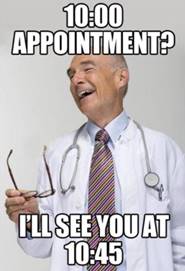
Editor’s Corner: You Have an Appointment

Jackie, my co-editor and friend, and I were talking about the term “doctor’s appointment.” We hear it all the time, but is it correct? Should it be “doctor appointment”? I’m afraid I don’t have an easy answer for you. The experts are all over the place on this one.

My first instinct was that “doctor’s appointment” is incorrect because the apostrophe denotes possession. I assumed it couldn’t be right because the appointment doesn’t belong to the doctor, it belongs to me. And I quickly found a resource that agrees with me: Everything Language and Grammar.

Though I love to be right, I know that one resource is not proof positive; and anyway, we started wondering whether the term might be possessive because the doctor also has an appointment with me, right? So, I kept looking and found an article on dictionarykiwi.com that substantiates the point of view that the appointment also belongs to the doctor. Dictionarykiwi is “created by the community,” so it’s not the most reputable resource, but the article makes a legitimate point.

I kept looking, hoping for something more conclusive, and I found a slightly confused pair of grammarians on A Way with Words,a radio program about language. They hemmed and hawed and finally determined that the term “doctor’s appointment” is used much more often than “doctor appointment.” They said that “doctor’s appointment” is a term that is “lexicalized,” meaning that usage becomes habit, and then we’re stuck with it, whether we like it or not. If you want to listen to their discussion, click here.

I found a few more articles, but they didn’t really offer anything new. Now we’re all confused, right? Well, here’s the upshot. Language evolves depending on common usage. Whether or not it’s correct, most people say and write “doctor’s appointment.” Because there is an ongoing argument about the correctness of the phrase, what you can do is simply avoid using it. You can say (or write) that you have an appointment with the doctor or that you have a medical appointment. That way, the sticklers who think it’s wrong have got nothing on you!

Donna Bradley Burcher | Senior Technical Editor | Symitar®

8985 Balboa Ave. | San Diego, CA 92123 | Ph. 619.278.0432 | Ext: 765432

Posted by: Jack Henry | May 3, 2017

Editor’s Corner: Nicknames, Part 2

Yesterday I told you a little about nicknames and shared some Spanish nicknames with you. Today I have part of article from Mental Floss for you. (Click the link to read about all ten names.)

If that isn’t enough, I’ve also included a link to men’s and women’s nicknames so you can find something fitting to call your friends or foes.

Why is Hank from Henry?

The name Henry dates back to medieval England. (Curiously, at that time, Hank was a diminutive for John.) So how do we get Hank from Henry? Well, one theory says that Hendrick is the Dutch form of the English name Henry. Henk is the diminutive form of Hendrick, ergo, Hank from Henk. Hanks were hugely popular here in the States for many decades, though by the early ‘90s it no longer appeared in the top 1,000 names for baby boys. But Hank is making a comeback! In 2010, it cracked the top 1,000, settling at 806. By 2013, it was up to 626.

Why is Chuck from Charles?

"Dear Chuck" was an English term of endearment, and Shakespeare, in Macbeth, used the phrase to refer to Lady Macbeth. What’s this have to do with Charles? Not much, but it’s interesting. However, Charles in Middle English was Chukken and that’s probably where the nickname was born.

Why is Peggy from Margaret?

The name Margaret has a variety of different nicknames. Some are obvious, as in Meg, Mog, and Maggie, while others are downright strange, like Daisy. But it’s the Mog/Meg we want to concentrate on here as those nicknames later morphed into the rhymed forms Pog(gy) and Peg(gy). [KC – Daisy isn’t so strange when you consider that Marguerite is the French term for a daisy (and a girl named Margaret).]

Why is Ted from Edward?

The name Ted is yet another result of the Old English tradition of letter swapping. Since there were a limited number of first names in the Middle Ages, letter swapping allowed people to differentiate between people with the same name. It was common to replace the first letter of a name that began with a vowel, as in Edward, with an easier to pronounce consonant, such as T. Of course, Ted was already a popular nickname for Theodore, which makes it one of the only nicknames derived from two different first names. Can you name the others?

Why is Sally from Sarah?

Sally was primarily used as a nickname for Sarah in England and France. Like some English nicknames, Sally was derived by replacing the R in Sarah with an L. Same is true for Molly, a common nickname for Mary. Though Sally from Peanuts never ages, the name itself does and has declined in popularity in recent years. Today, most girls prefer the original Hebrew name Sarah.

Links to English names and nicknames:

· English names and nicknames for women

· English names and nicknames for men

Kara Church

Technical Editor, Advisory

619-542-6773 | Ext: 766773

Symitar Documentation Services

NOTICE: This electronic mail message and any files transmitted with it are intended
exclusively for the individual or entity to which it is addressed. The message,
together with any attachment, may contain confidential and/or privileged information.
Any unauthorized review, use, printing, saving, copying, disclosure or distribution
is strictly prohibited. If you have received this message in error, please
immediately advise the sender by reply email and delete all copies.
« Newer Posts - Older Posts »

Categories