Posted by: Jack Henry | June 28, 2017

Editor’s Corner: Bunfight!

One of my friends sent this to me a couple of weeks ago, and I thought I would share it with you. It represents the fun and games we can have when sharing our different versions of English “across the pond.” The names and places have been changed to protect the innocent.

Good morning, Kara.

My manager, Nigel (from London) wrote, “It’s a bit of a bun fight” in an email. Being curious, I searched for it. I found these definitions; one in particular I thought was hilarious, and I had to share!

· The term bun fight is evidently widely used across nations of the old British Commonwealth and goes back to the late 1800s.

· A sustained, overblown argument about a petty matter, usually personal in nature to the participants but not to everyone else.

· bunfight n. a tea party, esp. with image of children struggling for sticky buns.

· bunfight n. a tea party or other function, typically of a grand or official kind.

· a heated argument or exchange

And now, for my favorite: It derives from disputes between antagonists who are both hot and cross.

Cheers!

Thank you, Ms. K., for sending me this and making my day. Next Easter, I will propose a toast to you before I munch down on some hot cross buns!

Kara Church

Technical Editor, Advisory

Symitar Documentation Services

Dear Editrix,

I cannot find background on a certain usage of “pretty.” How did it become an adverb? Such as: The next town is pretty far away.

Sincerely,

Pretty in Pink

Dear Pink,

What an interesting question! My first thought was to check with my favorite etymology site, the Online Etymology Dictionary. Here’s what I found there about the adjective pretty, and how it slid into use as an adverb:

pretty (adj)

Old English prættig (West Saxon), pretti (Kentish), *prettig (Mercian) "cunning, skillful, artful, wily, astute," from prætt, *prett "a trick, wile, craft," from Proto-Germanic *pratt- (source also of Old Norse prettr "a trick," prettugr "tricky;" Frisian pret, Middle Dutch perte, Dutch pret "trick, joke," Dutch prettig "sportive, funny," Flemish pertig "brisk, clever"), of unknown origin.

Meaning "not a few, considerable" is from late 15c. With a sense of "moderately," qualifying adjectives and adverbs, since 1560s. Pretty please as an emphatic plea is attested from 1902. A pretty penny "lot of money" is first recorded 1768.

I thought this was interesting, partly because its original meaning wasn’t “good-looking” or anything even close. The other part I find surprising is that we’ve been using it to mean “moderately” since the 1560s.

I continued digging in Merriam-Webster to see what they said about the adverb pretty. M-W doesn’t provide much more history, in fact, the examples are very recent. I’ve included a few of them here.

pretty (adverb)

1a : in some degree or extent : moderately, fairly

< … who seems like a pretty nice guy through most of the play … — Mimi Kramer, The New Yorker, 10 Aug. 1987>

< … has more five-star hotels than anywhere else in Australia, and most of these can be found pretty close to the business center of Perth. — Gillian Rowe, Business Travel International, September 1990>

b : to a great extent or degree : quite, very

<A lot of blood had formed in a puddle under him, and he looked pretty bad. His broken nose had swelled up like a doughball between his eyes. — Maggie Davis, The Far Side of Home, 1963>

< … both are gender- and age-specific modes of musical expression about sex, self-doubt and self-pity. Both tend to be pretty awful. — Josh Tyrangiel, Time, 26 May 2003>

Kara Church

Technical Editor, Advisory

619-542-6773 | Ext: 766773

Symitar Documentation Services

NOTICE: This electronic mail message and any files transmitted with it are intended
exclusively for the individual or entity to which it is addressed. The message,
together with any attachment, may contain confidential and/or privileged information.
Any unauthorized review, use, printing, saving, copying, disclosure or distribution
is strictly prohibited. If you have received this message in error, please
immediately advise the sender by reply email and delete all copies.

Posted by: Jack Henry | June 26, 2017

Editor’s Corner: Parallelism

With all of the PowerPoint® presentations coming our way for the Symitar Education Conference, I’ve been asked to refresh peoples’ memories about parallel and non-parallel writing structure.

Parallelism refers to using similar grammatical constructions to balance your bullet points and the phrases in your sentences. Using parallel structure in your writing helps increase clarity and readability.

Parallelism in Bulleted Lists

If one bullet point in the list starts with a verb (an action word) or an article (a, an, the), you should try to start them all similarly. Bulleted lists should be composed of all complete sentences (with punctuation), or they should all be sentence fragments (without punctuation). The important thing is to be consistent and clear.

Non-parallel list Parallel list
· Detailed table of contents

· All sections are numbered for easy reference

· Completely indexed

· Includes samples of reports and displays

· Prompts are shown as they display on the screen

· Detailed table of contents

· Numbered sections for easy reference

· Compete index

· Sample reports and displays

· Accurate display of screen prompts

There is an additional rule in JHA Style Guide for Technical Communication and Training, which states that each bullet that completes the introductory sentence should end with a period as shown in the following example:

Before you submit a document for editing, you should

· Read it carefully and look for mistakes.

· Ask someone to peer review your document.

· Run spell check.

We do not strictly enforce the previous rule for PowerPoint presentations. We do require consistency, however.

Parallelism in a Sentence

When writing a sentence that includes a series of related phrases, you should make sure to structure the phrases similarly.

· Non-parallel phrasing

To use NTMC home banking, a member must connect to the internet, go to your credit union’s home page, and should select a link to NTMC home banking from your website.

Notice that in the example above, the writer switches from third person (a member) to second person (you). The writer has also written the three tasks so that they are not parallel (a member must connect to…, go to your…, and should select…)

· Parallel phrasing

To use NTMC home banking, a member must connect to the internet, go to the credit union’s home page, and select a link to NTMC home banking from your website.

Jackie Solano | Technical Editor | Symitar®

8985 Balboa Ave. | San Diego, CA 92123 | Ph. 619.542.6711 | Extension: 766711

Symitar Documentation Services

NOTICE: This electronic mail message and any files transmitted with it are intended
exclusively for the individual or entity to which it is addressed. The message,
together with any attachment, may contain confidential and/or privileged information.
Any unauthorized review, use, printing, saving, copying, disclosure or distribution
is strictly prohibited. If you have received this message in error, please
immediately advise the sender by reply email and delete all copies.

Posted by: Jack Henry | June 23, 2017

Editor’s Corner: Peregrination

This week in Toastmasters, we had a fun day focused on the summer. As some of you know, there’s usually a word of the week (WOW) that we discuss and try to use when it’s our turn to talk. The word of this week was journey. Everyone did very well using that word, but what I found more interesting was this synonym for journey: peregrination. Peregrination means a journey, especially a long or meandering one.

I’d never heard that word, but I had heard of peregrine falcons, and I wondered if there was some connection. Here’s what I found on my word expedition. Enjoy!

From Merriam-Webster:

peregrinate

intransitive verb

: to travel on foot : walk, tour

transitive verb

: to walk over : traverse

peregrine

adjective

1 archaic : of or from a foreign country : alien, imported

2 archaic : engaged in or traveling on a pilgrimage <peregrine Christians going to visit the Holy Sepulchre — Matthew Carter>

3 a : having a tendency to wander : roving <believes the profession of peregrine typist has a happy future — Saturday Review>

b also per·e·grin·ic ¦perə¦grinik [peregrinic from Medieval Latin
peregrinus + English -ic] : widely distributed : found in many parts of the world

peregrine

noun

plural -s

1 obsolete : traveler, pilgrim

2: a sojourner in a foreign country; specifically : an alien resident of ancient Rome

3: peregrine falcon

peregrine falcon

noun

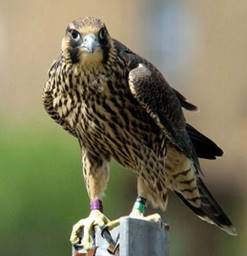
a swift falcon (Falco peregrinus) much used in falconry that is of almost cosmopolitan distribution and has adult plumage which is dark bluish ash on the back, nearly black on the head and cheeks, white beneath, and barred with black below the throat — compare duck hawk, 1, peale’s falcon
And from the Online Etymology Dictionary:

peregrinate (v.)

1590s, from Latin peregrinatus, past participle of peregrinari "to travel abroad, be alien," figuratively "to wander, roam, travel about," from peregrinus "from foreign parts, foreigner," from peregre (adv.) "abroad," properly "from abroad, found outside Roman territory," from per "away" (see per) + agri, locative of ager "field, territory, land, country" (from PIE root *agro- "field").

*agro- Proto-Indo-European root meaning "field;" probably a derivative of root *ag- "to drive, draw out or forth, move."

It forms all or part of: acorn; acre; agrarian; agriculture; agriology; agro-; agronomy; onager; peregrinate; peregrination; peregrine; pilgrim; stavesacre.

It is the hypothetical source of/evidence for its existence is provided by: Sanskrit ajras "plain, open country," Greek agros "field," Latin ager (genitive agri) "a field," Gothic akrs, Old English æcer "field."

peregrine (n.)

also peregrin, type of falcon, 1550s, short for peregrine falcon (late 14c.), from Old French faulcon pelerin (mid-13c.), from Medieval Latin falco peregrinus, from Latin peregrinus "coming from foreign parts," from peregre (adv.) "abroad," properly "from abroad, found outside Roman territory," from per "away" (see per) + agri, locative of ager "field, territory, land, country" (from PIE root *agro- "field"). Sense may have been a bird "caught in transit," as opposed to one taken from the nest. Peregrine as an adjective in English meaning "not native, foreign" is attested from 1520s.

Kara Church

Technical Editor, Advisory

Symitar Documentation Services

Posted by: Jack Henry | June 22, 2017

Editor’s Corner: Getting to the Point in Emails

Good morning, folks. Let me get right to the point, since that’s the topic of this Editor’s Corner article.

When writing a business email, you need to be brief. Often, the recipient of your email is going to be busy, so you should create a descriptive subject line, and then in the email, after a quick greeting, you should immediately state the reason for your email. Are you responding to a request, asking for assistance, or maybe offering information? Whatever it is, state it outright immediately and clearly.

You can always provide background information and other details later in the email, but the first sentence or two should make clear your reason for writing. How do you do that? Well, before you write, identify your primary message and your key points, and then start your email with that information.

Example

Hi, Bob.

Thanks for your email requesting to be added to the Grigsby distribution list. You will need to get manager approval before I can add you. Please have your manager contact me.

Regards,

Sharon

Remember that, generally, people rush through their emails, so don’t waste time with information they don’t need. And don’t use a lot of unnecessary words—make your email message as short and concise as possible. On the other hand, be sure to include all necessary information. Don’t make the reader rely on his or her memory of a past conversation or email thread. Your email should stand alone—it should be a complete thought or idea.

Finally, please, always run a spell and grammar check, and re-read what you’ve written to make sure it is clear and error free. You might even read it aloud to catch even more mistakes. The recipients of your emails are going to love you for saving them time. Think of all the new friends you’ll make!

Donna Bradley Burcher | Senior Technical Editor | Symitar®

8985 Balboa Ave. | San Diego, CA 92123 | Ph. 619.278.0432 | Extension: 765432

Symitar Technical Publications Writing and Editing Requests

NOTICE: This electronic mail message and any files transmitted with it are intended
exclusively for the individual or entity to which it is addressed. The message,
together with any attachment, may contain confidential and/or privileged information.
Any unauthorized review, use, printing, saving, copying, disclosure or distribution
is strictly prohibited. If you have received this message in error, please
immediately advise the sender by reply email and delete all copies.

Posted by: Jack Henry | June 21, 2017

Editor’s Corner: Going Dotty

The other day, I was wondering about this fad that goes in and out of style: polka dots! Where does the term come from, and why does this dot have a special name? The Grammarist tries to explain.

Polka dot is a term that has its origins in the mid-1800s. We will examine the definition of the word polka dot, where it came from, and some examples of its use in sentences.

A polka dot is one round, solid spot that is part of a pattern of spots spread across a fabric or other material in an equidistant pattern. The plural form is polka dots, note that there is no hyphen. The adjective form is properly rendered as polka-dotted, though the term polka dot is often seen used as an adjective. The word polka dot first appeared in the 1870s, named after the dance craze that swept Britain and the United States at this time, the polka. The polka is a Bohemian dance in double time. The polka was such a hot fad at the time, many things were named after it such as polka gauze and polka hats. The only remnant of this craze is the term polka dot. The word polka is derived from the Czech word půlka, which means half-step.

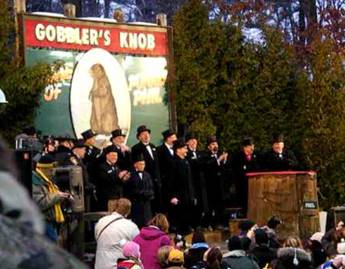
Preparing to do the Pennsylvania Polka at Gobbler’s Knob, with Punxatawney Phil

Polka dots!

“To go dotty” is an idiom meaning:

1. To become somewhat eccentric, odd, or mentally unbalanced. Jackson started going dotty after spending a month by himself in his cabin.

2. To become forgetful or absent-minded, especially due to senility or old age in general. Grandpa’s been going a bit dotty lately, I don’t know if he can take care of himself anymore.

3. To become very excited or enthusiastic (about something). I’ve never understood that pop star’s popularity, but kids just go dotty over her music.

From The Free Dictionary.

Kara Church

Technical Editor, Advisory

Symitar Documentation Services

Posted by: Jack Henry | June 20, 2017

Editor’s Corner: Babble

It’s been some time since I’ve shared one of Richard Lederer’s articles with you. The following excerpt is from his article on April 22, 2017 titled “Confusable words build a sky-high Tower of Babble.” You can see the full article here.

I once heard a Department of Defense official insist that “America must have the penultimate defense system!” But penultimate doesn’t mean “the very best.” [KC – See Ben’s article from
June 6, 2017.] Derived from the Latin paene, “almost,” and ultimus, “last,” penultimate actually means “next to the last.” The last thing we want is a penultimate defense system.

Building on that, I present my tower of more babbling words:

· Anchorite means “a person who lives in seclusion,” not “a sailor.”

· Antebellum means “before the war,” not “against war.”

· Apiary is not a place where apes are kept but where bees are kept.

· Cupidity means “a strong desire for wealth,” not “a strong desire for love.”

· Disinterested means “unbiased,” not “bored.”

· Friable means “easily crumbled,” not “easily fried.”

· Hoi polloi means “the masses,” not “the upper crust.”

· Meretricious means “falsely attractive,” not “worthy.”

· Presently means “soon,” not “now.”

· Prosody means “the study of verse,” not “the study of prose.”

· Restive means “fidgety,” not “serene.”

· Risible means “disposed to laugh,” not “easily lifted.”

· Scarify means “to criticize cuttingly,” not “to frighten.”

· Toothsome means “palatable,” not “displaying prominent teeth.”

And wherefore means “why,” not “where.” In William Shakespeare’s tragedy, Romeo and Juliet, when the heroine sighs, “O Romeo, Romeo! Wherefore art thou Romeo?” she is not trying to locate her new squeeze. Rather Juliet, a Capulet, is lamenting that the hunk she’s jonesing for turns out to be a member of a rival and despised family, the Montagues. This interpretation is clarified by the lines that follow:

Deny thy father and refuse thy name;
Or, if thou wilt not, be but sworn my love,
And I’ll no longer be a Capulet.

Kara Church

Technical Editor, Advisory

619-542-6773 | Ext: 766773

Symitar Documentation Services

NOTICE: This electronic mail message and any files transmitted with it are intended
exclusively for the individual or entity to which it is addressed. The message,
together with any attachment, may contain confidential and/or privileged information.
Any unauthorized review, use, printing, saving, copying, disclosure or distribution
is strictly prohibited. If you have received this message in error, please
immediately advise the sender by reply email and delete all copies.

Posted by: Jack Henry | June 19, 2017

Editor’s Corner: How to Write About Drop-Down Lists

Drop-down lists allow users to select one option from a list of options, but they don’t show all options at once.

When a drop-down list is inactive, it displays just one option, as in the following screenshot:

When you click the arrow to the right of the drop-down list (called a “drop-down arrow”), additional options appear:

When you click one of these options, the list returns to its original (collapsed) state, displaying just the option you selected.

Tip: Drop-down lists don’t let you enter free-form text. However, a similar user interface element (a “combo box”) allows you to type or select an option from a list.

How to Describe Drop-Down Lists

The JHA Style Guide says, “Use drop-down (with a hyphen) as an adjective to describe a noun. Do not use drop down [or drop-down] as a noun.”

· Incorrect: Select a value from the drop-down.

· Correct: Select a value from the drop-down list.

The Microsoft Manual of Style goes even further, suggesting, “Use [drop-down] only if necessary to describe how an item works or what it looks like.” Microsoft gives the example, “In the Item list, click Desktop.”

I think either way is fine, depending on the sophistication of your audience. If you’re writing for novice computer users, you might want to include the extra detail:

· Click the Item drop-down list, and then select Desktop.

If you’re writing for intermediate users, it’s probably not necessary to distinguish between drop-down lists and other kinds of lists:

· In the Item list, select Desktop.

Ben Ritter | Technical Editor | Symitar®
8985 Balboa Avenue | San Diego, CA 92123
619-682-3391 | or ext. 763391 | www.Symitar.com

Symitar Documentation Services

NOTICE: This electronic mail message and any files transmitted with it are intended
exclusively for the individual or entity to which it is addressed. The message,
together with any attachment, may contain confidential and/or privileged information.
Any unauthorized review, use, printing, saving, copying, disclosure or distribution
is strictly prohibited. If you have received this message in error, please
immediately advise the sender by reply email and delete all copies.

Posted by: Jack Henry | June 16, 2017

Editor’s Corner: Aluminum vs Aluminium

Dear Editrix,

Why do Americans and Canadians say aluminum, while the British and other English speakers outside of North America say aluminium?

Meddling with Metal in Monett

Dear Mr. Metal,

I found all sorts of interesting information on this topic! Superficially, this is just another pair of words we spell differently from each other, such as dialog/dialogue, or color/colour. In this case, there is an extra “i” in the British spelling, so they say al-u-min-i-um.

What is interesting is that in 1812, the discoverer, Sir. H. Davy, named it alumium—a third and different spelling. Here is a brief article about it from The Grammarist:

Aluminum is the American and Canadian spelling for the silver-white metallic element (number 13 on the periodic table) abundant in the earth’s crust. Aluminium is the preferred spelling outside North America. Neither term is superior to the other, and both are etymologically and logically justifiable. Aluminum is older, while aluminium is more consistent with other element names such as helium, lithium, magnesium, and so on (though let’s not forget there are other -um elements—molybdenum, tantalum, and platinum).

Aluminium has the edge in scientific writing even in North America. This is primarily because several influential scientific organizations and publications prefer the spelling.

Examples

Nonscientific American and Canadian publications prefer aluminum in all contexts—for example:

· Aluminum has replaced steel in roof panels, saving another 15 pounds. [New
York Times
]

· The exterior is covered entirely in aluminum foil. [USA
Today
]

And outside North America, aluminium is preferred—for example:

· This sleek duo are both constructed from aluminium. [Financial
Times (U.K.)
]]

· Mr Howes said the contract was for 80 tonnes of aluminium extrusions. [Sydney
Morning Herald
]

· The Airport police on Tuesday arrested three people for stealing aluminium parts worth Rs 3.60 lakh. [Times
of India
]

And from my buddy Phil, something funny to start your weekend with:

Kara Church

Technical Editor, Advisory

Symitar Documentation Services

Posted by: Jack Henry | June 15, 2017

Editor’s Corner: I or Me?

Hi, folks.

I’ve covered this topic before, but I hear and see this mistake regularly from very conscientious writers and speakers, so let’s review when it’s correct to use I and when you should use me.

I and me are both pronouns that you use to refer to yourself. The difference is that I is the subject of a sentence, and me is the object. A problem often occurs when you are talking or writing about you and another person.

For example, look at the following sentences. Would you use me or I?

· Last night, the baby slept with Clifford and ___.

· Mom and dad are fighting about you and ___.

People often get this wrong, but in both sentences, you would use me because me is the object in the sentence. (The object of a sentence is the entity that is acted upon by the subject. The baby and mom and dad, respectively, are the subjects of the two previous examples.)

Conversely, you would use I when you (and someone else) are the subject of the sentence. (The subject of a sentence is the person/people, place, thing, or idea that is doing or being something).

· Bertha and ___ are going to the cinema tonight.

· The champagne that Lavinia and ___ purchased is chilling in the ice bucket.

I realize that explaining this in terms of subjects and objects isn’t necessarily helpful, and that’s why I have a useful mnemonic for you: just remove the other person from the sentence to figure out whether to use I or me.

· Last night the baby slept with me.

· Mom and dad are fighting about me.

· I amgoing to the cinema tonight.

· The champagne that I purchased is chilling in the ice bucket.

If you want to dig into this topic a little more, watch this helpful two-minute video from Merriam-Webster’s editor-at-large. Have a lovely day!

Donna Bradley Burcher | Senior Technical Editor | Symitar®

8985 Balboa Ave. | San Diego, CA 92123 | Ph. 619.278.0432 | Extension: 765432

Symitar Technical Publications Writing and Editing Requests

NOTICE: This electronic mail message and any files transmitted with it are intended
exclusively for the individual or entity to which it is addressed. The message,
together with any attachment, may contain confidential and/or privileged information.
Any unauthorized review, use, printing, saving, copying, disclosure or distribution
is strictly prohibited. If you have received this message in error, please
immediately advise the sender by reply email and delete all copies.

« Newer Posts - Older Posts »

Categories