Posted by: Jack Henry | September 6, 2017

Editor’s Corner: Plain English Quiz

Are you using plain English so that your writing is understandable? Click here and then click the LET’S PLAY link to take a quiz that will tell you how clear your writing is. All you need to do is finish the sentences with the answer that seems right to you.

Jackie Solano | Technical Editor | Symitar®

8985 Balboa Ave. | San Diego, CA 92123 | Ph. 619.542.6711 | Extension: 766711

Symitar Documentation Services

NOTICE: This electronic mail message and any files transmitted with it are intended
exclusively for the individual or entity to which it is addressed. The message,
together with any attachment, may contain confidential and/or privileged information.
Any unauthorized review, use, printing, saving, copying, disclosure or distribution
is strictly prohibited. If you have received this message in error, please
immediately advise the sender by reply email and delete all copies.

Posted by: Jack Henry | September 5, 2017

Editor’s Corner: Lay vs. Lie Quiz

We have written previously about the difference between lay and lie (most recently in this post), but it continues to be a popular question.

This week, instead of repeating my earlier explanation, I put together a quiz. First, here are some quick reminders:

  • The word place sounds as if it contains the word lay. When you’re talking about placing something, use lay.
  • The word recline sounds as if it contains the word lie. When you’re talking about reclining, use lie.
  • The past tense of lie is lay.

Here are some recent headlines. For each one, try to decide whether lay or lie is correct.

Tip: If you are having trouble deciding between lay and lie, fill in the blank with place or recline, and see which one makes more sense.

1. City _____ Boulders Beneath I-90 in Downtown Spokane to Shift Homeless to Shelters (The Spokesman-Review)
a. Lays
b. Lies

2. How _____ Hardwood Floors Paved the Way for Thomas Rhett’s Success (KWBE)
a. Laying
b. Lying

3. How to Entertain Your Child While _____ Down (Lifehacker)
a. Laying
b. Lying

4. Keenan Reynolds: "Huge Honor" to Take Part in Wreath-_____ Ceremony (PressBox)
a. Laying
b. Lying

5. Philly Man Protests Gun Violence by _____ in Coffin (WPVI)
a. Laying
b. Lying

6. Vanessa Grimaldi Is "_____ Low" Following Nick Viall Split (Entertainment Tonight)
a. Laying
b. Lying

Answers
1: a. Lays
2: a. Laying
3: b. Lying
4: a. Laying
5: b. Lying
6: b. Lying

Ben Ritter | Technical Editor | Symitar®
8985 Balboa Avenue | San Diego, CA 92123
619-682-3391 | or ext. 763391 | www.Symitar.com

Symitar Documentation Services

NOTICE: This electronic mail message and any files transmitted with it are intended
exclusively for the individual or entity to which it is addressed. The message,
together with any attachment, may contain confidential and/or privileged information.
Any unauthorized review, use, printing, saving, copying, disclosure or distribution
is strictly prohibited. If you have received this message in error, please
immediately advise the sender by reply email and delete all copies.

Posted by: Jack Henry | September 1, 2017

Editor’s Corner: Daft

The other day, someone came by my desk and mentioned the word “daft” (meaning “silly,” or “foolish”) and talked about how wonderfully descriptive some British English is compared to American English. He suggested that I do a column on some of these great British phrases, so I made a note to look into it. Well, I’m here to tell you that my research kept dragging me into the darker corners of the internet and British slang. I can’t really share those things with you, but I did find some information that I sorted through so I could at least give you something.

These definitely aren’t from the highbrow collection of British terms, but I hope they entertain you. I’ve chosen a handful of the less salty items from Matador Network.

“I’ll give you a bunch of fives”
Meaning: You’re going to get a punch in the face.

“That was a right bodge job”
Meaning: That job went wrong.

“That’s pants”
Meaning: It’s not great, not very good.

“I’m knackered”
Meaning: I’m tired, exhausted.

“Don’t get shirty with me,” “Don’t get your knickers in a twist,” “You’re getting on my goat,” “Wind your neck in”
Meaning: Someone’s getting angry or aggravated with you or you’re getting annoyed or irritated with them.

“She was talking nineteen to the dozen”
Meaning: She was talking at a speedy rate.

“It’s all gone pear-shaped”
Meaning: Something has gone wrong.

“She’s as bright as a button”
Meaning: She’s clever.

He’s as mad as box of frogs,” “He’s crackers”
Meaning: He’s mad. He’s lost it.

“Spend a penny”
Meaning: To visit the bathroom.

“She’s such a curtain twitcher” or “Stop being such a nose ointment”
Meaning: She’s a nosy neighbor, stop being so nosy.

“That’s smashing,” “Super,” “Ace,” “Pucker”
Meaning: That’s “awesome.”

“Old Blighty”
Meaning: Britain.

“Having a good old chinwag”
Meaning: Having a gossip/chat.

“She’s so gobby”
Meaning: She’s very mouthy, rude.

“Careful, he’s on the chunder bus”
Meaning: He’s going to be sick, throw up.

“That’s lush”
Meaning: That’s nice, or that tastes good.

“I’m feeling really grotty”
Meaning: Feeling under the weather, not well.

Kara Church

Technical Editor, Advisory

619-542-6773 | Ext: 766773

Symitar Documentation Services

NOTICE: This electronic mail message and any files transmitted with it are intended
exclusively for the individual or entity to which it is addressed. The message,
together with any attachment, may contain confidential and/or privileged information.
Any unauthorized review, use, printing, saving, copying, disclosure or distribution
is strictly prohibited. If you have received this message in error, please
immediately advise the sender by reply email and delete all copies.

Posted by: Jack Henry | August 31, 2017

Editor’s Corner: Potter’s Field

A few weeks ago, I did a Toastmaster’s speech on five reasons to visit graveyards— besides burying people. During vacations, my husband and I always visit the local cemeteries wherever we are, because you learn a lot about a place’s history in their hallowed grounds.

In that same vein, I found this gem from The Grammarist about the term potter’s field. It’s not a peppy article for the day, but it’s certainly interesting. I hope you also find it so.

Potter’s Field

Potter’s field is a term that has a rather ancient origin. We will look at the meaning of the term potter’s field, where it comes from and some example of its use in sentences.

A potter’s field is a burying ground for indigent people, it is a graveyard for paupers. Contrary to what many may think, the word potter in potter’s field is not a proper name and it is not capitalized, according to the Oxford English Dictionary. The original potter’s field takes its name from the Bible, specifically the book of Matthew in the New Testament. In chapter twenty-seven, Judas Isacariot returns the thirty pieces of silver the high priests gave him in exchange for betraying Jesus. The priests did not return the silver to the temple coffers, as it was blood money. They used that money to buy a field to bury paupers in. As the story goes, the field they bought was the area in which potters dug their clay. On an interesting side note, during the 1500s the word potter was used to mean an itinerant peddler or a vagrant. By the 1700s the term potter’s field was used to mean any plot of land put aside to bury indigents. Note that the word potter’s in potter’s field is the singular possessive, as the apostrophe is placed before the s.

Kara Church

Technical Editor, Advisory

619-542-6773 | Ext: 766773

Symitar Documentation Services

NOTICE: This electronic mail message and any files transmitted with it are intended
exclusively for the individual or entity to which it is addressed. The message,
together with any attachment, may contain confidential and/or privileged information.
Any unauthorized review, use, printing, saving, copying, disclosure or distribution
is strictly prohibited. If you have received this message in error, please
immediately advise the sender by reply email and delete all copies.

Posted by: Jack Henry | August 30, 2017

Editor’s Corner: Spatulas, Flippers, and Turners

Here’s something I’ve wondered about, after working in kitchens from the Pacific Northwest down to Southern California. Is there a regional difference in what people call that thing that you flip hamburgers with vs. that thing you scrape a baking bowl with? I’ve called both things a spatula, but I decided to look into it and compare these things:

· spatula

· pancake turner

· burger flipper

· icing spatula

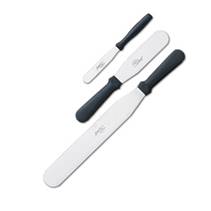
I found some answers and photos in an article from the Kitchenboy blog. Rather than repeat everything, I’m going to sum up the information here and share some photos with you.

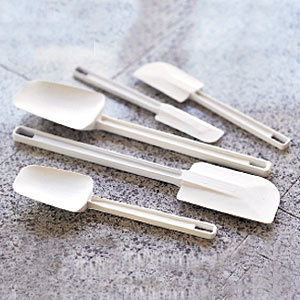
There are three basic categories for spatulas – the classic spatula, a turner, and an icing spatula.

To start, let’s look at the classic spatula.

This is what most people think of when you mention the word spatula. The primary purpose is to get all the batter or soft dough from a mixing bowl, but other uses include folding and blending ingredients, where a more gentle approach is required.

Turner

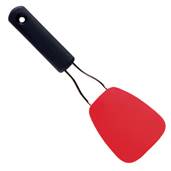
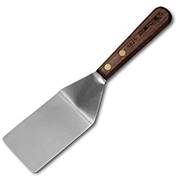
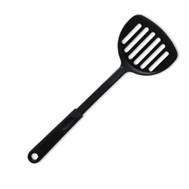
The turner is the product that some people have in mind when they ask for a spatula, this creates frustration when kitchen shop employees direct them to the “other” spatulas. [KC – This is what some of us might also called a “flipper.”]

Sometimes known as pancake turner, this tool is used for turning food so the other side can cook and then lifting or removing food from a pan. We have all used them while preparing pancakes, bacon, hamburgers, fish, potatoes, eggs and cookies.

And finally, icing spatulas.

The icing spatula is long and thin, available in varying lengths, the size of which is based on surface area to be iced.

Within the icing spatulas, there are two styles – offset and straight blade. The offset versions are designed to keep your fingers out of the icing, always a good idea.

So, I guess the answer is that, indeed, they are all spatulas, but if you want a specific type, it might be best to add what it is for (scraping, pancake-turning, icing) if you don’t want to upset the people at the kitchen supply store.

Kara Church

Technical Editor, Advisory

Symitar Documentation Services

Posted by: Jack Henry | August 29, 2017

Editor’s Corner: The Big, Bad Wolf

We’ve talked about the order of adjectives before, but someone sent me part of this article and I thought I’d pass it along to you. It is originally from a book called The Elements of Eloquence, by Mark Forsyth, but it went viral when a page was tweeted by a BBC editor. I did not Americanize the spelling.

“Adjectives in English absolutely have to be in this order: opinion-size-age-shape-colour-origin-material-purpose Noun. So you can have a lovely little old rectangular green French silver whittling knife. But if you mess with that word order in the slightest you’ll sound like a maniac. It’s an odd thing that every English speaker uses that list, but almost none of us could write it out.”

English speakers love to learn this sort of thing for two reasons. First, it astonishes us that there are rules that we didn’t know that we knew. That’s rather peculiar, and rather exciting. We’re all quite a lot cleverer than we think we are. And there’s the shock of realising that there’s a reason there may be little green men on Mars, but there certainly aren’t green little men. Second, you can spend the next hour of your life trying to think of exceptions, which is useful as it keeps you from doing something foolish like working.

Actually, there are a couple of small exceptions. Little Red Riding Hood may be perfectly ordered, but the Big Bad Wolf seems to be breaking all the laws of linguistics. Why does Bad Big Wolf sound so very, very wrong? What happened to the rules?

Ding dong King Kong

Well, in fact, the Big Bad Wolf is just obeying another great linguistic law that every native English speaker knows, but doesn’t know that they know. And it’s the same reason that you’ve never listened to hop-hip music.

You are utterly familiar with the rule of ablaut reduplication. You’ve been using it all your life. It’s just that you’ve never heard of it. But if somebody said the words zag-zig, or cross-criss you would know, deep down in your loins, that they were breaking a sacred rule of language. You just wouldn’t know which one.

All four of a horse’s feet make exactly the same sound. But we always, always say clip-clop, never clop-clip. Every second your watch (or the grandfather clock in the hall makes the same sound) but we say tick-tock, never tock-tick. You will never eat a Kat Kit bar. The bells in Frère Jaques will forever chime ‘ding dang dong’.

Reduplication in linguistics is when you repeat a word, sometimes with an altered consonant (lovey-dovey, fuddy-duddy, nitty-gritty), and sometimes with an altered vowel: bish-bash-bosh, ding-dang-dong. If there are three words then the order has to go I, A, O. If there are two words then the first is I and the second is either A or O. Mish-mash, chit-chat, dilly-dally, shilly-shally, tip top, hip-hop, flip-flop, tic tac, sing song, ding dong, King Kong, ping pong.

“What about the Big Bad Wolf?” tweeted many naysayers. But they obviously didn’t know about the rule of ablaut reduplication (Credit: Alamy)

Why this should be is a subject of endless debate among linguists, it might be to do with the movement of your tongue or an ancient language of the Caucasus. It doesn’t matter. It’s the law, and, as with the adjectives, you knew it even if you didn’t know you knew it. And the law is so important that you just can’t have a Bad Big Wolf.

Kara Church

Technical Editor, Advisory

Symitar Documentation Services

Posted by: Jack Henry | August 28, 2017

Editor’s Corner: Money Mules

Good morning!

As we prepare for our annual Symitar Education Conference, I have the honor of editing a slide show full of innovative solutions our credit union clients have come up with to make their lives easier. Today I came across a term that is several years old, but I can’t say I’d ever heard of it and it made me laugh. The term for today is money mule. (You’ll have to come to the Creative Solutions SEC session to find out what it does and who designed it.)

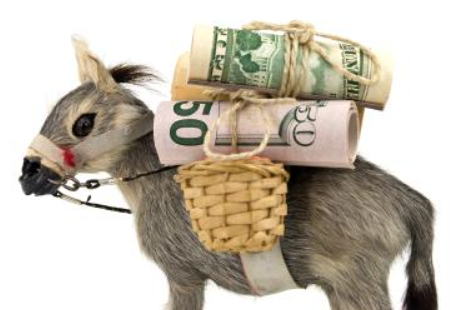
Money mules, also called smurfs, are people who help transfer money acquired illegally. Who came up with these terms? I don’t know. That’s for another day.

Here’s a broad picture of what happens a lot of the time and how people are often duped into being mules.

Someone posts an advertisement online or via some phishing attempt to get the soon-to-be mule’s attention (often it looks like a job offer).

Sometimes, the mule is asked to transfer money in exchange for a percentage of the transfer amount (thus hiding the thief’s identity and location). Using legal banks and services, the mule “allows the thief to transform a reversible and traceable transaction into an irreversible and untraceable one.” (Wikipedia)

Other times, the mule is given a check to deposit into his or her account (again, in exchange for a percentage of the total amount), then the mule transfers the money to the thief, and by the time the check bounces, the thief is gone and the mule is stuck without the money and with the incurred fees.

Whether or not the money mule is aware of what he or she is doing, it is definitely illegal.

Here is what to watch out for, as part of my anti-fraud customer service (thanks to the U.S. Computer Emergency Readiness Team:

Warning signs of mule recruitment:

· The position involves transferring money or goods.

· The specific job duties are not described.

· The company is located in another country.

· The position does not list education or experience requirements. All interactions and transactions will be done online.

· The offer promises significant earning potential for little effort.

· The writing is awkward and includes poor sentence structure.

· The email address associated with the offer uses a Web-based service (Gmail, Yahoo, Windows Live, Hotmail, etc.) instead of an organization-based domain.

Don’t be a money mule!

Kara Church

Technical Editor, Advisory

Symitar Documentation Services

Posted by: Jack Henry | August 25, 2017

Editor’s Corner: Kn Words

Dear Editrix,

My daughter and I were talking about words like knee and knew, and we were wondering why we ever started using the silent “k” and why we still do. Any ideas on this?

Sincerely,

Knight of the Knitted Brow

Dear Knight,

I found this article on Daily Writing Tips that I thought I’d share with you. I think they do a great job researching and answering this question for us. I hope it satisfies your family’s curiosity.

Editrix

Kn Words in English

A teaching site offers this rule for dealing with “silent k”: “k is often silent before n.”

An easier way to retain this information is to forget about “silent k” altogether. In a word like knot, k is not “a silent letter” at all, but part of the distinct phonogram kn.

The symbol kn is just another way to spell the sound /n/.

The spelling kn in a word like knave evolved from the Old English spelling cn, in which the “c” represented a guttural sound similar to the sound /k/. For example, the OE words from which our words knight, knot, and knave have evolved were spelled cniht, cnotta, and cnafa and pronounced with a hard first sound. The guttural sound eventually dropped out, leaving only the /n/ sound, but the old spelling has survived in kn.

Here are some familiar kn words.

knapsack
knave
knead
knee
kneel
knell
know
knickknack
knife
knight
knit
knob
knock
knoll
knotgrass
knothole
knowledge
knuckle

Note: For the remainder of the article see Daily Writing Tips.

Kara Church

Technical Editor, Advisory

Symitar Documentation Services

Posted by: Jack Henry | August 24, 2017

Editor’s Corner: Clear Writing, Part 2

Last week, I gave you the first five tips from Mark Nichols’s article called, “10 Tips for Clean, Clear Writing.” As promised, here are the last five tips with a little saucy commentary. Enjoy!

6. When in doubt, don’t capitalize. If you’re not certain that a word or phrase should be capitalized, look the term up in authoritative sources. Writers often Capitalize Important Concepts that don’t deserve such emphasis, but careful writers don’t. [dbb – This is an issue the editors deal with daily. The rule is that we capitalize
only proper nouns. Proper nouns are names used for a specific person, place, product, organization, etc., like
Donna, San Diego, Episys, Symitar.]

7. Refrain from using all-caps. Employ italics to emphasize a word or phrase. Reserve use of all capital letters for humorous indication of shouting or panic, and avoid in formal writing. [dbb – A hearty “Here, here!” from the editors on this one. WE HATE IT WHEN YOU USE ALL CAPS!]

8. Be consistent in formatting treatment. If a caption is boldfaced or italicized or appears in a different font, all captions should be formatted that way. If top-level headings are capitalized headline style (Capitalized Like This) rather than sentence style (Capitalized like this), treat subheadings the same way. [dbb – Good news! All the formatting work is done
for you in the Symitar template, which you can find on the “Symitar Documentation Services
page.]

9. Vary sentence length. A healthy mix of sentence length and syntactical forms (simple declarative statements, sentences with lists, sentences with subordinate clauses and parenthetical phrases, and so on) keeps the reader engaged.

10. Manage paragraph length. The traditional five-sentence paragraph form is fatiguing.

Enjoy today and the rest of the week!

Donna Bradley Burcher | Senior Technical Editor | Symitar®

8985 Balboa Ave. | San Diego, CA 92123 | Ph. 619.278.0432 | Extension: 765432

Symitar Technical Publications Writing and Editing Requests

NOTICE: This electronic mail message and any files transmitted with it are intended
exclusively for the individual or entity to which it is addressed. The message,
together with any attachment, may contain confidential and/or privileged information.
Any unauthorized review, use, printing, saving, copying, disclosure or distribution
is strictly prohibited. If you have received this message in error, please
immediately advise the sender by reply email and delete all copies.

Posted by: Jack Henry | August 23, 2017

Editor’s Corner: Turn Around, Bright Eyes

This past Monday probably found some of you outside looking through special glasses, cardboard cutouts, or watching the eclipse unfold on television. I did not prepare an Editor’s Corner for the event, but one of your favorites, Richard Lederer did. Below is his language lesson inspired by the events in our sky.

Stages of the eclipse (from NASA)

A Constellation of Words Go Dancing With the Stars

In just two days, and for the first time in 99 years, the shadow of a total solar eclipse will arc across the United States from coast to coast. So today is a bright occasion to gaze upward at the heavenly words that illuminate our language.

Have you ever been curious about why the words lunatic and lunar begin with the same four letters? Etymology supplies the answer. Lunatic derives from luna, Latin for “moon,” which when it is full, is said to render us daft — moonstruck or loony.

We moon about somebody, we moonlight with a second job that we perform at night, and newlyweds go on honeymoons. The ancients customarily drank mead, or honey wine, for the first 30 days of marriage. Honeymoon merges honey, used figuratively to mean “love,” with moon, as a synonym for “month.”

Now let’s soar up, up and away to the stars, which eclipse the moon when it comes to the intensity of the light that shines upon English words. In an astronomical number of ways, the English language sees stars. We are so starstruck and starry eyed that we call our stage and screen and athletic celebrities stars. May this column be a lodestar (“way” + “star”) — a source of inspiration — in your life. A lodestar is used in navigation to show the way.

A Latin word for “star” is stella, whence the adjective stellar, the noun constellation and name Stella. The most famous use of the name is by Tennessee Williams in his 1947 play “A Streetcar Named Desire,” in which Stanley Kowalski wails, “Stella! Stella!”

Another starry Latin word is astrum, a prolific root that gives us aster (a star-shaped flower), astrology (“star study”), astronomer (“star arranger”), asteroid (“star form”) and astronaut (“star sailor”). An asterisk is a symbol that looks like a “little star.” You may wish to dispute these celestial etymologies, but I think you’d be an asterisk it.

In William Shakespeare’s “Julius Caesar,” Cassius warns Brutus that fate lies “not in our stars, but in ourselves.” Nevertheless, for centuries, people have believed that the stars and their heavenly positions govern events on earth. If a conjunction of the planets is not propitious, disaster will strike. Cobbled from the Latin dis (“bad, against”) and astrum, disaster literally means “against the stars” — ill-starred, star-crossed. In the ghostly opening scene of “Hamlet,” Horatio speaks of “stars with trains of fire and dews of blood, / Disasters in the sun.”

Astrologers used to study the stars to see how their coming together at a person’s birth would influence his or her future. “When you wish upon a star, makes no difference who you are” goes the song. Desire is star-spun from the Latin de, “from,” + sidus, “star.” The idea is that we wish for and desire fortunate outcomes that stream from our lucky stars. In the same constellation is consider, which radiates from the Latin cum, “with” + sidera, “stars.” The first meaning of consider was “to examine stars together to gauge their effects on our fate.”

The influence of the stars reposes even within the word influence itself. Influence originally meant a flowing or streaming from the stars of an ethereal fluid that acted upon the character and destiny of human beings. The ancients believed that the influence of the stars generated the dog days, summer periods of triple h weather — hazy, hot and humid. In the days of the Romans, the six or eight hottest weeks of the summer, roughly July through the first half of August, were known colloquially as caniculares dies, or “days of the dog.” According to Roman lore, the dog star Sirius rose with and added its heat to the sun, making a hot time of the year even hotter.

Derived from Greek ekkentros, “out of the center,” from ek, “out of” + kentron, “center,” eccentric first appeared in English in 1551 as an astronomical term describing “a circle in which a heavenly body deviates from its center.” Modern-day astronomers still use eccentric in that way.

Greek also bequeaths us zodiakos, “circle of little animals.” Zodiac is the ancient Greek name for the heavenly belt of 12 signs believed to influence human behavior. The zo- in zodiac is related to the zo– in zoo and zoology — “life.”

Kara Church

Technical Editor, Advisory

Symitar Documentation Services

« Newer Posts - Older Posts »

Categories