As some of us prepare for Halloween and Dia de los Muertos (Day of the Dead), I wanted to find something new and exciting to share with you. I saw an article about why we say “Boo” to scare people, but it was a little on the gentle side. I wanted something scarier or at least something potentially scary—something to bring about the feeling of cold, creepy goosebumps moving up your back.
Last year, I went through watching a month of “scary” movies. I can’t say they were very frightening; they were just kind of disgusting. The year before that, my husband and I watched a month of the classics: Carrie, the Exorcist, etc. There are some new movies out there, but they didn’t inspire me. Then I found this: 17 Scary Sayings for ‘Ghost’ From Across the United States. I thought that sounded very promising.
I’m going to divide it into two sections, so you can enjoy it to the fullest. From Mental Floss:
On Halloween, the spirits of the dead are supposed to walk the earth with the living. Whether or not you believe that, or in ghosts in general, you might want to know what you’re getting into if you hear a South Carolina native mention a plat-eye or a Maine resident warn you about swogons. Familiarize yourself with these spooky regional slang terms for the spectral from the Dictionary of American Regional English (DARE).
Skookum
Referring to a ghost, demon, or spirit, skookum is chiefly a Northwest term and comes from a language of the Chinook Native American peoples of the Pacific Northwest. In the Northwest and Alaska, skookum as an adjective means strong, powerful, or good, while a skookum house is a jail and a skookum chuck is a turbulent channel of water.
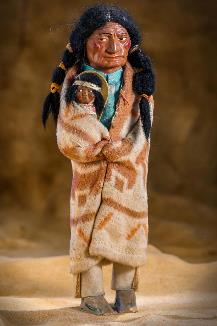
Skookum Doll
Tommyknocker
More than just a Stephen King novel, tommyknocker has been used in the West since at least the early 20th century to mean a ghost that lives in a mine. It also refers to the knocking noises that said ghost is supposed to make. This ghost sense comes from the English dialect word tommyknocker, meaning a “hammer used to break ore.”

Perfect mines for tommyknockers
Haunt
In the South and South Midland states, a haunt or hant is a ghost or spirit. The earliest definitions of haunt weren’t ghostly at all: According to the Oxford English Dictionary (OED), the word originated in the 13th century to mean “to practice habitually” or “to frequent a place.” Around 1576, it gained the figurative meaning of memories, cares, feelings, thoughts, etc. that distract one frequently. In 1597, the term wandered into the supernatural. From Richard III: “Some haunted by the ghosts they have deposed.” Almost 300 years later, it finally came to refer to a spirit or ghost.
Hot Hant and Hot Steam
You might run into a hot hant or a hot steam in the Lower Mississippi Valley and southern Alabama. In Ben Burman’s 1938 book, Blow for a Landing, hot hants are hot because “they’ve gone to hell.” In To Kill a Mockingbird, a hot steam is described as “somebody who can’t get to heaven, just wallows around on lonesome roads an’ if you walk through him, when you die you’ll be one too.”
Bugaboo
This ghostly South and South Midland expression might also refer to an imaginary monster or the devil. In use since at least 1710, the OED says the word might come from the now obscure meaning of bug, an imaginary evil spirit (the insect meaning came later), and might also be influenced by boo. It can also be seen as boogerboo and bugabo.
Booger
Careful if someone from the South or South Midland states tells you that you have a booger—they could mean something more frightening than a piece of snot. The word originated in the 1750s to mean a despicable man, according to the OED, and came to mean a menacing supernatural creature in the 1820s (and dried nasal mucus in 1891).

Those are the terms for Part 1! Next time, I’ll give you the rest of the list so you can walk into haunted houses across the nation, fully prepared!
Kara Church | Technical Editor, Advisory | Knowledge Enablement
Pronouns: she/her | Call via Teams | jackhenry.com
Editor’s Corner Archives: https://episystechpubs.com/
 Editor's Corner
Leave a comment