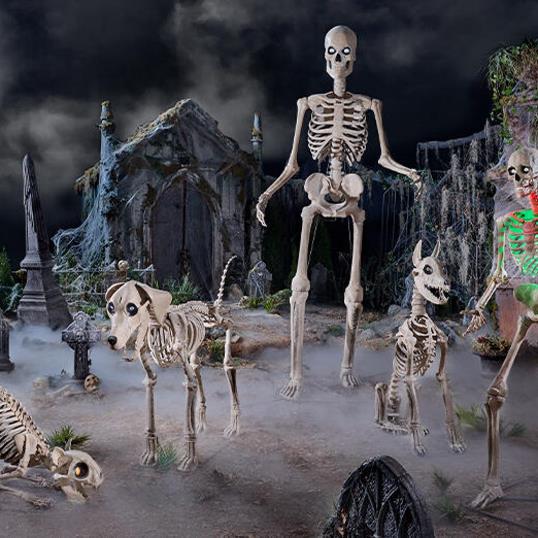
As more giant spiders and skeletons start filling local yards, Halloween is speeding toward us! I thought that now might be a good time to cover a couple of bony idioms we use. In fact, just the other day I was talking to my parents and asked them if they had “a bone to pick” with me. Then we all stopped talking and asked each other, “Where does that phrase come from?” Yep, that’s how conversations go in my family.
So I’m here with a little research about the phrase “a bone to pick,” and another idiom “(having a) skeleton in (one’s) closet.”
A Bone to Pick
When you have a bone to pick with someone, it means there’s something you need to discuss, and it might be unpleasant or involve an argument. For example, if your child consistently leaves a mess in the kitchen after you ask them to clean up after themself, you might start that conversation with “I have a bone to pick with you.”
As far as where the phrase comes from, I found this on The Idioms:
“A bone to pick” is an old idiom that dates back hundreds of years into the past. This proverb has been in use since the 1500s. It was derived from dogs and how they chewed meat off bones. The meaning is also taken from canines and how they oftentimes fight over who gets to gnaw on a bone as a snack. During the late Middle Ages, dogs were primarily owned by hunters, soldiers, and people who could afford to keep them around. They were probably the first people to coin this phrase. This saying has also evolved over time to its modern use.
Skeletons in the Closet
When referring to having a “skeleton in the closet,” most people are referring to a secret—a personal issue or something they’ve done that is really embarrassing or damaging—and it’s in the closet because they’re hiding it. If you know someone with an actual skeleton in their closet, that’s a different situation, and I’d contact the police about that. Here’s an example of the idiom in use: “Betsy’s brother Brandon knew that Betsy had skeletons in her closet from a former marriage. And he knew if her current husband Travis found out, he would never forgive her.” To find out where the phrase comes from, here is part of an article: “Skeletons in the Closet”: Where the Creepy Phrase Comes From
The expression “skeletons in the closet” can be traced back to the 19th century. While the exact origin is somewhat murky, it appears to have first emerged in British literature. One of the earliest recorded uses was in 1816, when British author Thomas De Quincey wrote about “the skeleton in the cupboard” in his essay “On Murder Considered as One of the Fine Arts.” In this context, De Quincey was discussing the hidden sins and darker aspects of human nature, suggesting that everyone has secrets they would prefer to keep hidden.
The imagery of a skeleton is particularly powerful; it evokes the idea of something frightening and taboo. The closet, on the other hand, is a place where we store things away from plain sight—making it a fitting metaphor for secrets we don’t want to reveal. Combined, these elements create a vivid picture of the hidden aspects of our lives that we often conceal from friends, family, and society.
The Evolution of the Idiom
The phrase caught on in popular culture during the Victorian era, a time when societal norms placed a heavy emphasis on propriety and reputation. Victorians often believed that maintaining a polished exterior was essential, which meant that any blemish on one’s character was to be hidden away—much like a skeleton tucked away in a closet. The idiom became a way to describe the dissonance between one’s public persona and private reality.
Interestingly, the phrase has undergone several transformations over the years. While it originally carried a somewhat morbid connotation, it has evolved into a more generalized expression of keeping secrets. Today, it can refer to anything from a past relationship to a family scandal or even minor embarrassments. The versatility of the phrase has allowed it to remain relevant over the centuries, making it a staple in conversations, literature, and media.
Kara Church | Technical Editor, Advisory | Knowledge Enablement
Pronouns: she/her | Call via Teams | jackhenry.com
Editor’s Corner Archives: https://episystechpubs.com/
 Editor's Corner
Leave a comment