Good morning, fellow travelers! (I haven’t been anywhere lately, but I wish I were traveling.)
Today I’m here to talk about TV. Specifically, a new show called Kaos, on Netflix. When Donna mentioned it to me, I was so excited. It’s about the Greek gods and Mt. Olympus, but it takes place on Crete (where I haven’t been but would love to go).
My husband and I sat down with a bowl of Kalamata olives and prepared for hilarity (and I hoped for Greek phrases or an insult or two).
But it wasn’t for me. One of the first things I noticed was that all the street signs were in English. Then I realized that though a character was getting souvlaki or gyros or something, it was from a food truck, not a little hole in the wall souvlaki shop. On the plus side, he looked Greek.
As we made our way through the town, I thought, “That’s not Crete. Not even close.” I’ve never been there, but I knew this wasn’t it. There are Greeks in Greece, and it isn’t limited to one dark-haired dude in a taco truck. There isn’t “one look” for Greeks, but there is certainly a more traditional look. But nothing in the environment or people said “Greece,” to me.
Okay, move on Kara. Let’s get to something about language.
When they started mentioning some of the gods, I was excited. This show is a modern version of the myths, so I gave it some slack. But then Jeff Goldblum as Zeus, with an American accent? The other characters had different accents, but they were British. Still nothing to remind me of the Heroes, Gods, and Monsters of the Greek Myths.
I continued to watch, and the names were there. Orpheus, Euridice, Hera, Zeus…okay, now we’re cooking!
When a woman went to the church for something like confession, she referred to speaking with the tacita. I was tingling. An unfamiliar word to learn more about, one that I’d never heard from my cousin or other Greeks.
I kept my pen handy. Oh! A group of people doing a sort of salute and saying, “Vero.” Okay, wait a second. That sound like “truth” in romance languages [verdad – Spanish, vérité – French,
veritas – Latin), but the Greek word for truth is
αλήθεια (alēthia)]. Hmm. I’m getting suspicious.
Then a group starts singing. That sure sounds like the Pope singing Latin.
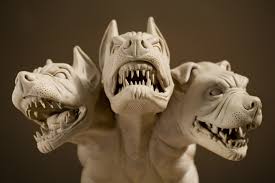
Finally, in another episode, we meet Cerberus, the three-headed dog from hell (or in hell). They call him Fotis. Again, my hackles rise.
This is what I found out about these words, for those of you less cynical than I, who may start or continue watching the show.
- Tacita (Latin) means “silent.” There’s a good reason Tacita is silent. Spoiler alert! She has no tongue.
- Vero (Latin) means “in truth.” Like I said, this is kind of like a salute, a “Preach it, brother!” “We’re with you, sister!”
- Fotis (Latin) means “light.” In most cultural references I’ve seen, hell isn’t exactly a sunny place where you would call your three-headed dog Light.
Truth is (or should I say, vero), this is supposed to be a comedy. Maybe that’s why the dog’s name is Light. Maybe that’s why there aren’t any Greek people in Greece. I don’t know. I try to take fun where I can get it, but sometimes I just can’t look past the obvious.
If you are looking for some more typical Grecian myths, I loved the book I mentioned above (but I was nine years old when I read it, getting geared up for a trip to Greece). There is also something English for you, Ode on a Grecian Urn, by John Keats. There, now I feel like I taught you something.
Kara Church | Technical Editor, Advisory | Technical Publications
Pronouns: she/her | Call via Teams | jackhenry.com
Editor’s Corner Archives: https://episystechpubs.com/
 Editor's Corner
Leave a comment