April is a very happy birthday month, with our department celebrating new babies and a lot of birthdays. According to our own Jane Gredvig, “All the best people are born in April.” Before it ends, I’d like to share some words from one of our favorite birthday babies, Shakespeare. His birth date isn’t really known, but history assigns his baptism day as the April 26, so we’ll take it.
The following words are from the article Words Popularized By Shakespeare That We Still Use. I have only included a handful of favorites, to keep it short.
bedazzle
Pardon, old father, my mistaking eyes,
That have been so bedazzled with the sun
That everything I look on seemeth green.
—The Taming of the Shrew (Katherine, 4.5.46–48)
The word bedazzle has since expanded to mean “to impress forcefully, especially so as to make oblivious to faults or shortcomings.”
foulmouthed
… he speaks most vilely of you, like a foul-mouthed man as he is, and said he would cudgel you.
—Henry IV, Part I (Hostess Quickly, 3.3.96–97)
Foulmouthed, sometimes hyphenated as foul-mouthed, describes someone “using obscene, profane, or scurrilous language; given to filthy or abusive speech.” [KC – What’s not to love? I’ll keep myself under control for our time together.]
swagger
… a rascal that swaggered with me last night—who, if alive and ever dare to
challenge this glove, I have sworn to take him a box o’ th’ ear …
—Henry V (Williams, 4.7.114–16)
Hip-hop hitmakers and Shakespeare have a lot in common. They can write sick verses and love the word swagger. By our count, Shakespeare used forms of the word swagger 16 times. For Shakespeare, swaggermeant “to walk or strut with a defiant or insolent air” or “to boast or brag noisily.” It’s based on swag, or “sway,” as a swaggerer may so strut—and extended, by 1990s hip-hop, to “a confident attitude.”
pageantry
… What pageantry, what feats, what shows,
What minstrelsy, and pretty din,
The regent made in Mytilene
To greet the king …
—Pericles (Gower, 22.6–9)
Shakespeare’s pageantry is “the performance or pageants,” a pageant here being “an ornate public spectacle illustrative of the history of a place, institution, or the like, often given in dramatic form or as a procession of colorful floats.” It was the idea of a “spectacle” that led pageantry to its more familiar sense of “a magnificent display”—or an “empty” one, all show and no substance.
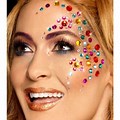
You can bedazzle almost anything, even your face!
Kara Church | Technical Editor, Advisory | Technical Publications
Pronouns: she/her | Call via Teams | jackhenry.com
Editor’s Corner Archives: https://episystechpubs.com/
 Editor's Corner
Leave a comment