Cheers all! Thank you Donna, Jackie, and Laura for sitting in the Editor’s Corner so I could go on vacation. While you entertained the audience and shared your wisdom on grammar and other things English, I was in England (and Scotland). Let me just say that at times, I really wondered if we all share a common language.
Right now my brain is still in a different time zone, but over the next couple of weeks I will share some of the new vocabulary I learned and maybe a few insights and stories about the land our language came from. Today I will share a few terms I learned on my trip to Stonehenge.
henge: A henge is a Neolithic earthwork, usually consisting of a circular or oval-shaped bank with an internal ditch. Maybe this would be easier to show you?
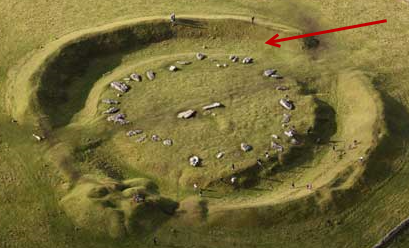
Arbor Low Henge
cursus: Cursus is the name given to large parallel lengths of banks with external ditches. They were originally thought to be Roman race courses and were therefore named cursus.

Stonehenge Cursus
lintel: (Not to be confused with lentil, the delicious legume used to make dal.) From Wikipedia: “A lintel can be a load-bearing building component, a decorative architectural element, or a combined ornamented structural item. It is often found over portals, doors, windows, and fireplaces.”

Post and Lintel Construction
sarsen: Sandstone blocks used in the construction of Stonehenge; found in quantity in the United Kingdom.
trilithon: A trilithon (or trilith) is a structure consisting of two large vertical stones (posts) supporting a third stone set horizontally across the top (lintel).
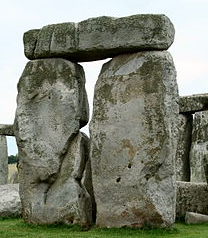
Stonehenge Trilithon
barrow: Term used in England to describe a large mound of earth (or stones) over the remains of the dead. Stonehenge is surrounded by many barrows.

Barrow near Stonehenge
For more information on Stonehenge, you can check out the Wikipedia page here.

Kara and Ray: happy, but freezing at Stonehenge.
Kara Church
Technical Editor, Advisory

 Editor's Corner

Leave a comment