Posted by: Jack Henry | April 22, 2025

Editor’s Corner: Clams

The other day, my husband said, “Good morning, how’s it going?” My response was, “I’m happy as a clam.” Then I walked into the back yard and thought, “Eww. That’s gross. Why would we say we’re as happy as a slippery, slimy mollusk? I have never seen a clam that looked particularly happy or sad.”

“Editrix,” I said to myself, “It’s high time for you to figure out why you compare yourself to a clam when you’re joyful.”

So here we are.

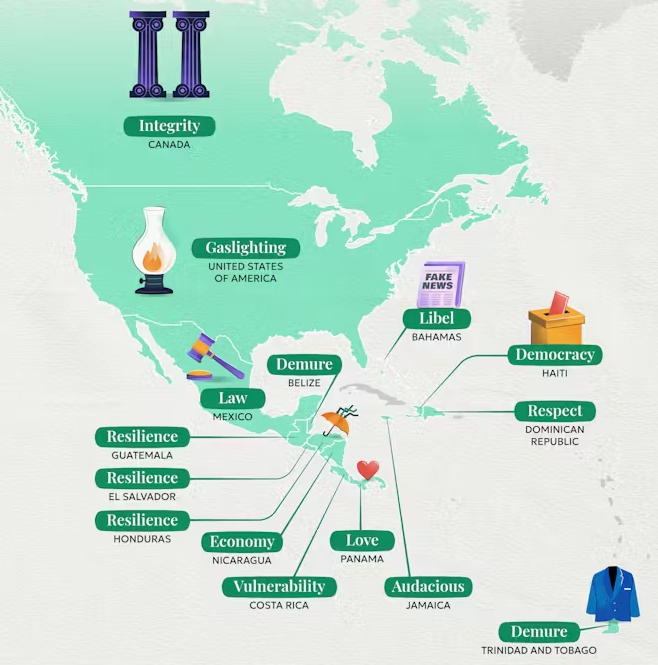
As I mentioned, “Happy as a clam” means really happy, in case you haven’t heard the phrase before. I decided to read a bit about it on Phrase Finder. When I opened the page, I saw this:

Wait a second! It’s a smiling clam. Okay, that makes slightly more sense. You don’t usually look at them at this angle: side view, flat on the beach.

Then the article mentions that “happy as a clam” is only the first part of the idiom. The full phrase is “I’m “as happy as a clam at high water.” When the tide is in and the water’s high, you can’t see them—neither can the seagulls, osprey, and other critters that love to have clam dinners.

The phrase has been attributed to folks in the Northeast U.S. where the idiom and clams are familiar. It goes back as far as the 1800s.

I think what I appreciate most about this article is the photo. That right there says “happy” to me, with the little clammy smile. Unfortunately, I’ve seen some very unhappy clams here as the seagulls pick them up, fly in the air, and drop them several times, until they crack.

Now I understand why the high tides are made for good times.

Kara Church | Technical Editor, Advisory | Technical Publications

Pronouns: she/her | Call via Teams | jackhenry.com

Editor’s Corner Archives: https://episystechpubs.com/
Posted by: Jack Henry | April 17, 2025

Editor’s Corner: Dialog vs Dialogue

The other day, I was doing what editors do sometimes and wondering about the words dialog and dialogue. Are they both correct? Is one a U.S. spelling and the other British? Is one for tech and the other for talk? It got sillier from there, so I thought I should look into it and find some answers.

I used the website Writing Explained for my research, and as you’ll see, there isn’t just one way to use the different spellings when you’re in the United States.

When should I use the spelling dialog?

Dialog is an acceptable spelling of the word dialogue, when used in U.S. computing. It is used (as we do at JH) to refer to a pop-up window, in which you might answer a brief prompt or question. This is referred to as a dialog box.

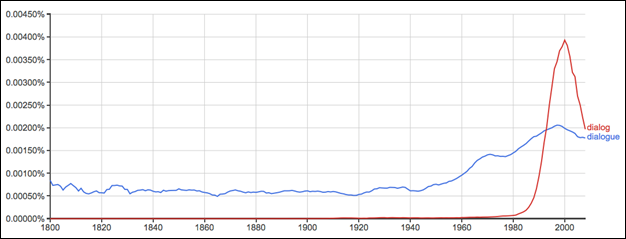
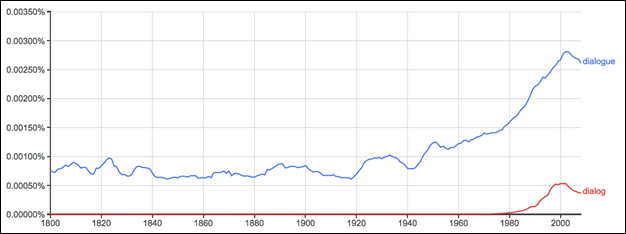
The British rarely use the spelling dialog, whether it be when writing about an interchange with people or communicating with the computer. The following chart is from Writing Explained, and it shows the British use of each spelling over time:

This next chart is the U.S. use of both spellings. (See the website if you want to read more about the topic.)

For us writers and editors in the U.S., just keep on trucking and using dialog (and dialog box) in technical documentation.

As for dialogue, in the U.S., there’s a place for that, too. When writing about two or more people conversing, the spelling of dialogue is correct. This was mentioned as the preferred spelling in formal use, in both British and American English (though dialog is creeping into some writing here).

Outside of its use for conversation, dialogue “has become something of a buzzword in politics since the 1960s. In this sense, it approximates the meaning of negotiations between diplomatic contacts of two nations. While this use was initially met with objections, it has become well established in Modern English.”

There’s one other question: can dialogue be used as a verb? I saw several answers to this, and here is mine: NO. “Let’s dialogue about this topic later.” No, no, no. Let’s discuss it, let’s talk about it, let’s throw it out the window…you don’t need to use a longer word to sound fancy, especially if it is not being used correctly.

The bottom line in the U.S.:

  • Dialog (noun) – For technical writing about the computer world (dialog box).
  • Dialogue (noun) – For communicating with another person; for politics.
  • Dialogue (verb) – No. Bad dog. No treats.

Kara Church | Technical Editor, Advisory | Technical Publications

Pronouns: she/her | Call via Teams | jackhenry.com

Editor’s Corner Archives: https://episystechpubs.com/
Posted by: Jack Henry | April 15, 2025

Editor’s Corner: Brownie Points

Good morning, folks!

One of you asked me about a couple of idioms the other day. One idiom, about hash houses or opium dens, is going to remain unanswered. The other idiom, “Where did the term ‘brownie points’ come from?” is a little more work appropriate, depending on who you ask.

Amazingly enough, there are several answers about where the idiom might come from. I will do my best to relay the different possibilities. This information is from Phrase Finder. The basic definition is “an imaginary award given to someone who does good deeds or tries to please.” (Note: The term is generally used in a humorous way. The “award” is imaginary, after all.)

Examples:

  • Judd said that he will earn brownie points with his mom if he takes the trash out every day. Maybe she will let him go to the concert if he does it for the next two weeks.
  • The sales team earned brownie points with the clients by passing out gifts at the user conference.

Now, let’s look at some of the possible histories.

Railroads

Though the writer of the article mentions this, he then shoots down the possibility that brownie points started here. From 1886 and on, it was the rumored practice of a New York State Superintendent (G.R. Brown) to issue merits for good behavior. These would’ve been “Brown points,” though, not “brownie points,” and there isn’t anything recorded that confirms the story.

Girl Scouts

The youngest of the girl scouts (7–10 years old) are called the Brownies. I tried out for the Camp Fire Girls (Bluebirds), but I was kicked out for lying. (Eight years old and I was lying, cutting class, and riding the short bus home with the kindergartners. I behaved better after that.) Anyway, the Girl Scout Brownies were named after pixies in Scottish folklore. The brownies were good little imps who did housework while the homeowners slept. In real life, Brownies and Girl Scouts receive badges for learning skills, contributing to the community, and doing good deeds. Somehow these badges might have changed into “Brownie points.”

Publishing

A publishing company gave delivery boys vouchers called greenies and brownies. (Five greenies equal one brownie.) Again, there is no recording of the vouchers being called “brownie points.”

Photography

Kodak had a Brownie Camera Club in 1900, where kids learned how to use the Brownie box camera, but while kids could send in photos for cash prizes, there were no brownie points associated with the experience.

Food Rationing

During WWII, you were given a number of “points” to use for the food you bought. The example the writer gives is for meat, where red or brown points were used. From Phrase Finder, “Grade A Lambs Legs – 6 red or brown points per lb. (37 cents).”

American Military Slang

How do I put this? The army didn’t refer to brownie points, they referred to “brown nosing” and even worse. Essentially, doing everything you could, the lewder the better, to put yourself in someone’s good graces.

Conclusion

Of all of these possibilities, the most plausible is that the phrase comes from the Girl Scout Brownies. You’ve got the term “brownie” right in the name, the name comes from creatures doing nice things, and the Brownies are taught to earn badges doing good deeds.

Right now, I’m too short on energy to try to earn brownie points. I could definitely use a nice, chocolatey baked good, though, and I’m not talking about Girl Scout cookies!

Kara Church | Technical Editor, Advisory

Pronouns: she/her | Call via Teams | jackhenry.com

Editing Requests

NOTICE: This electronic mail message and any files transmitted with it are intended
exclusively for the individual or entity to which it is addressed. The message,
together with any attachment, may contain confidential and/or privileged information.
Any unauthorized review, use, printing, saving, copying, disclosure or distribution
is strictly prohibited. If you have received this message in error, please
immediately advise the sender by reply email and delete all copies.

Posted by: Jack Henry | April 10, 2025

Editor’s Corner: Hypernyms and hyponyms

Hello, my fellow travelers.

Today I have two new words for you (and for me): hypernym and hyponym.

Recognizing the Greek prefixes (hyper – over, hypo – under) and the suffix (-nym – name), I thought maybe I could use the powers of Athena to figure out the definitions; alas, I could not. What’s an over-name and an under-name? I couldn’t guess, so I searched the internet and here’s what AI gave me:

  • hypernym: A word with a broad meaning that more specific words fall under. For example, color is a hypernym of red. Hypernyms are also called supertypes, umbrella terms, or blanket terms.
  • hyponym: A word that belongs to a specific subcategory of something more general. For example, a poodle is a hyponym of dog—a poodle is a specific breed of dog.

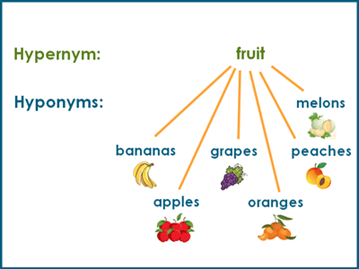
Okay, now I’m confused. I found this drawing, which makes more sense to me than a list of words.

In the graphic, hypernym is the term above and hyponyms are the terms below. This goes back to the Greek, and now I think I can successfully provide some examples to you.

Hypernym (over, above) Hyponyms (under, below)
color Red, yellow, pink, orange, green, teal, blue
clean Sweep, scrub, vacuum
animal Dog, cat, iguana, guinea pig, capybara
tree Pine, oak, juniper, manzanita, madrona
music R&B, grunge, opera, heavy metal, hip-hop, pop
shape Square, triangle, oval, circle
food Chocolate, chocolate, chocolate, carrots
beverage Tea, gin, tonic, coffee, Diet Dr. Pepper (Blackberry)

I hope these terms make sense to you and that you can win your next trivia night with them!

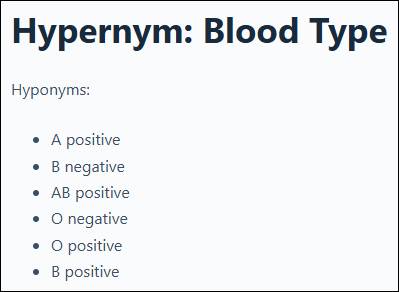
Wait! Here’s a fun one from a children’s book. I’m so glad I didn’t go to that school!

I hope your day is splendid!

Kara Church | Technical Editor, Advisory | Technical Publications

Pronouns: she/her | Call via Teams | jackhenry.com

Editor’s Corner Archives: https://episystechpubs.com/
Posted by: Jack Henry | April 8, 2025

Editor’s Corner: Get Your Goat

Today I thought it would be nice to sit back, take it easy, and look at a few items from the Merriam-Webster article: When Pigs Fly and Other Barnyard Idioms. I didn’t write most of this, but I thought it was interesting. My text here is blue, while M-W’s text is in black. There are many more idioms in the previously mentioned article.

I’m starting here, with the one I hadn’t heard, but that made me laugh out loud:

Talk the Hind Leg off a Donkey

Definition – to talk for a long time

As is the case with many of our farming idioms, the animal referenced is interchangeable with any one of a number of others. There is nothing special about a donkey’s leg, that it may be talked off; any number of other animals have legs that may be similarly removed.

Bring Home the Bacon

Definition – to earn the money that is needed to live

While many similar idioms have numerous slight variations, bacon appears to be the overwhelming favorite type of foodstuff to bring home as a linguistic indicator of one’s ability to provide. There is no evidence whatsoever, for instance, for the fixed use of bring home the rump roast.

Put All One’s Eggs in One Basket

Definition – to risk all one has on the success or failure of one thing

The egg lends itself well to idioms, some of which have survived better than others. The success of each phrase’s survival seems to be unpredictable; teach your grandmother to suck eggs is still pretty common, even though very few grandmothers are doing this… Put all one’s eggs in one basket (and assorted variants) has been in use for over three hundred years, and it looks like it will stick.

Have a Cow

Definition – to become very angry, upset, etc.

This idiom is perhaps best known as a catchphrase of Bart Simpson, the lovable rapscallion of the television show The Simpsons (he is frequently heard admonishing others to not have a cow). Have a cow predates The Simpsons, having been in use since the middle of the 20th century. It is thought to have come from the earlier British expression to have kittens (”to become very nervous or upset about something”).

Look a Gift Horse in the Mouth

[KC – I feel like this horse is giving me the side-eye. I guess I offended him by calling him Fluffy the Snow Eater.]

Definition – to look in a critical way at something that has been given to one

Why should one not look a gift horse in the mouth? Because it might mean that you are examining the animal’s teeth to see how old it is, and that is considered rude. Earlier versions of this idiom often were some form of “don’t look at a gift (or given) horse’s teeth.”

Get One’s Goat

Definition – to make one angry or annoyed

Sometimes the goat is simply got, and sometimes it is got up; sometimes it is just a goat, and sometimes it is a nanny goat. We’d like to say that no actual goats were angered in the creation of this idiom, but to be honest we really aren’t sure, as the etymology is obscure. [KC – Not to be confused with GOAT (greatest
o
f all time).]

Kara Church | Technical Editor, Advisory | Technical Publications

Pronouns: she/her | Call via Teams | jackhenry.com

Editor’s Corner Archives: https://episystechpubs.com/

Posted by: Jack Henry | April 3, 2025

Editor’s Corner: Selling like hotcakes!

Good morning, friends!

One of my favorite people used the phrase “selling like hot cakes” in an email the other day and then asked where that phrase came from. Well, he didn’t need to go any further, because I love pancakes! Is a hot cake the same thing as a pancake? Why do we have a phrase about a breakfast food, which is used to mean “to be in great demand”? Honestly, I’d answer any question for the promise of a pancake!

I started out wondering, “Are hot cakes and pancakes the same thing?” The article in Mental Floss says that the words are pretty darn old. Hot cakes go back to the 1600s and pancakes are from the 1400s. A quick search on my question, though, ended up not being so quick. Merriam-Webster has an entire article about this heavenly starchy food, with the following terms:

  • pancake: thin, flat cake that’s made by pouring batter into a pan
  • hot cake: a synonym for pancake
  • flapjack: (U.S. and Canada) informal synonym of pancakes, with usage of either term typically depending on regional preferences. The word flapjack is traced back to the late 1500s. It’s a combination of the verb flap, in the sense similar to flip or toss, and jack, which comes from the proper name.
  • griddlecake: another (less common) synonym for pancakes. The word griddle in the name commonly refers to a specific type of frying pan…used for cooking pancakes (and other things).

Mmmm. I’m ready for breakfast! But I haven’t really answered the question about where this phrase comes from. To sell like hot cakes means to “be sold quickly and in large quantities.” There is no exact event to pinpoint or time at which this became popular, so I’m going to go with an assumption that the etymologists have made:

Hot cakes have always been popular at events like county fairs and church socials, where the crowd greatly outnumbers the culinary staff and the cakes often sell as fast as they can be made, the term was coined and spread through popular usage.

Kara Church | Technical Editor, Advisory | Technical Publications

Pronouns: she/her | Call via Teams | jackhenry.com

Editor’s Corner Archives: https://episystechpubs.com/
Posted by: Jack Henry | April 1, 2025

Editor’s Corner: April Fools

Ahh, April Fool’s Day. It has never been my favorite. My husband, on the other hand, loves it. And he’s pretty good at his tricks, I have to give him that. I just hate feeling like I have to be on the alert all day long for something that might be a lie. Or a trick, like putting hemorrhoid cream in my toothpaste tube.

As I mentioned before, on behalf of my former coworker, I said that I would look into April Fool’s Day. I found a lot of information, though nobody really knows where it started—just that it has been around forever.

The first thought is that it could be as old as ancient Rome and the festival of Hilaria (joyful) by the followers of Cybele, inspired by an Egyptian legend of Isis and Osiris (and some dude named Seth). It involved dressing in disguises, teasing each other, and of course, partying.

Wikipedia and History.com both mention Chaucer’s Canterbury Tales from 1392 as a possibility of April Fools’ beginning. They also mentioned France and poisson d’avril (April’s Fish) from a poem in 1508. Others say it goes back to 1582 when France switched to the Gregorian calendar. At this point, some were celebrating the new year in January, and others in March, ending April 1. The people using the “new” calendar referred to the uninformed old calendar people as “fools.” There are reasons why each of these potential beginnings is suspect. As history.com says, “Its exact history is shrouded in mystery.”

Returning to France’s “April’s Fish,” poisson d’avril, it was with this version that the “tease” or “trick” started to occur. The tricks on the fool weren’t too elaborate. Paper fish were put on people’s backs, and they were called “April fish.” In later years, the celebration was accompanied by bread, pastries, and chocolates in the shape of fish.

Skipping ahead to today, there are many countries that practice April Fools traditions, including much of Europe, Turkey, Armenia, Poland, Ukraine, the Nordic countries, and more.

History.com provides us with this information about some of the pranks that have happened over the years:

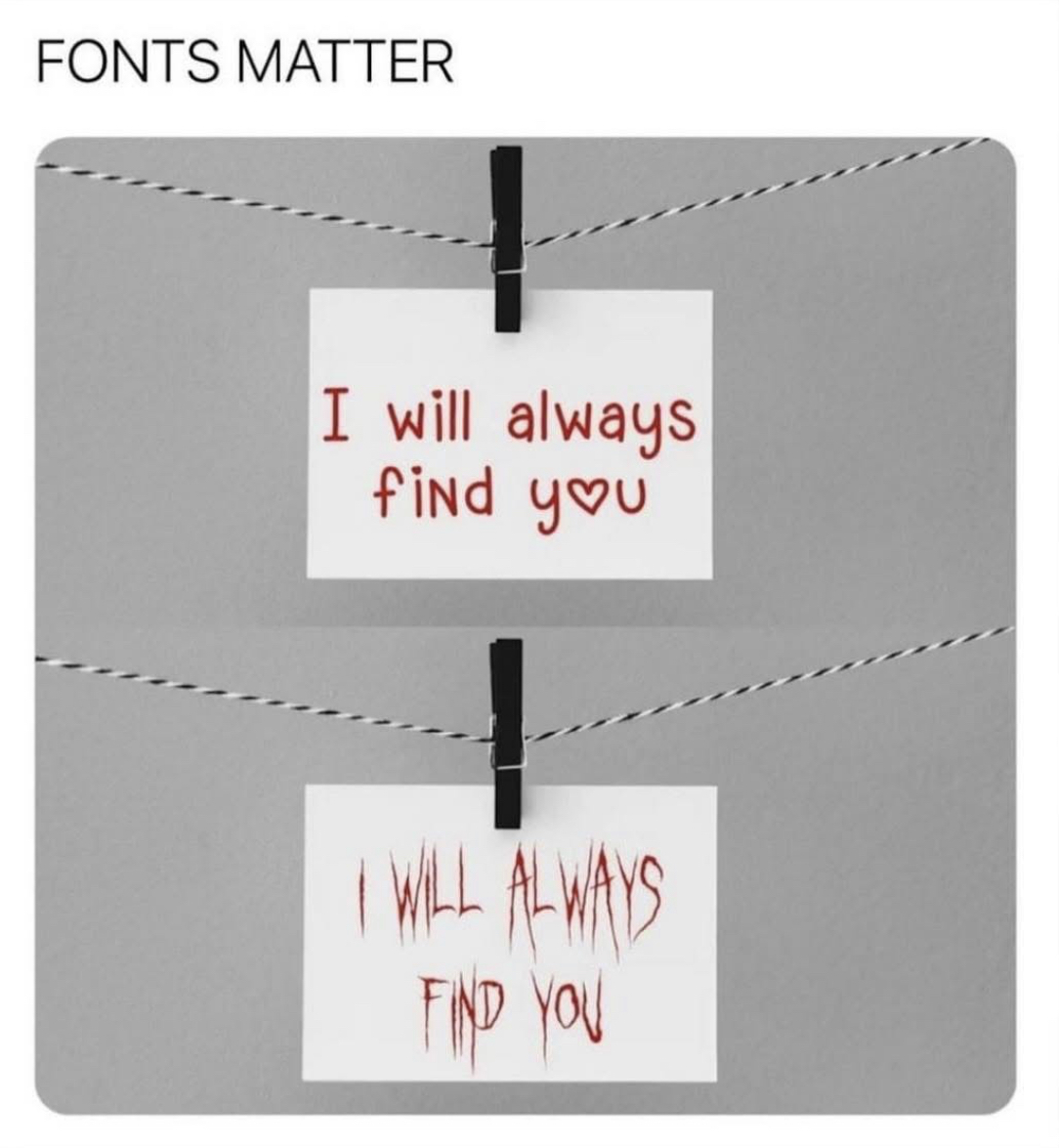
  • In 1957, the BBC reported that Swiss farmers were experiencing a record spaghetti crop and showed footage of people harvesting noodles from trees [KC – And vines. See photo below.]
  • In 1992, National Public Radio ran a spot with former President Richard Nixon saying he was running for president again… only it was an actor, not Nixon, and the segment was all an April Fools’ Day prank that caught the country by surprise.
  • In 1996, Taco Bell, the fast-food restaurant chain, duped people when it announced it had agreed to purchase Philadelphia’s Liberty Bell and intended to rename it the Taco Liberty Bell.
  • In 1998, after Burger King advertised a “Left-Handed Whopper,” scores of clueless customers requested the fake sandwich.
  • Google™ notoriously hosts an annual April Fools’ Day prank that has included everything from “telepathic search” to the ability to play Pac-Man on Google Maps™.

I’m glad I’m working from home this April Fool’s Day! I’ll be careful to check anything my husband says with Snopes!

Kara Church | Technical Editor, Advisory

Pronouns: she/her | Call via Teams | jackhenry.com

Editing Requests

NOTICE: This electronic mail message and any files transmitted with it are intended
exclusively for the individual or entity to which it is addressed. The message,
together with any attachment, may contain confidential and/or privileged information.
Any unauthorized review, use, printing, saving, copying, disclosure or distribution
is strictly prohibited. If you have received this message in error, please
immediately advise the sender by reply email and delete all copies.

Posted by: Jack Henry | March 27, 2025

Editor’s Corner: Gearing up for April

You may remember, back in February my friend Ron sent a series of questions about Valentine’s Day, including “Why does Valentine’s Day Suck?” He sent a new set of questions for April. I saw him in between his submission of Valentine’s Day questions and now, and he seemed to be in much better spirits. The questions I got this time were:

1. Why can people be fools only on April 1?

2. What is the origin of the word etymology?

3. Is there a synonym for thesaurus?

There was also a rhetorical question about the delights of retirement, but I won’t tease you with that since most of us aren’t there yet. So, let’s get to the questions!

1. Why can people be fools only on April 1?

Ron, you know that’s a lie. People can be fools every day, all day, forever. I found some interesting things about April 1, and there’s enough out there for a full article, so that will come closer to the day. Until then, you must wait and wonder.

2. What is the origin of the word etymology?

From Etymology Online (with a few edits for space)
late 14c., ethimolegia "facts of the origin and development of a word," from Old French etimologie, ethimologie (14c., Modern French étymologie), from Latin etymologia, from Greek etymologia "analysis of a word to find its true origin.”

In classical times, with reference to meanings; later, to histories. Classical etymologists, Christian and pagan, based their explanations on allegory and guesswork, lacking historical records as well as the scientific method to analyze them, and the discipline fell into disrepute that lasted a millennium. Flaubert ["Dictionary of Received Ideas"] wrote that the general view was that etymology was "the easiest thing in the world with the help of Latin and a little ingenuity."

As practiced by Socrates in the Cratylus, etymology involves a claim about the underlying semantic content of the name, what it really means or indicates. This content is taken to have been put there by the ancient namegivers: giving an etymology is thus a matter of unwrapping or decoding a name to find the message the namegivers have placed inside….

By late-14c. a sense had developed of "conjugation and categorization of words," apparently from a misunderstanding of etymology as dealing in tenses, and it is listed with prosody, orthography and syntax as an element of grammar:

…for the beginners of any language whatsoever, [etymologie] is so necessarie, that without it, they could not understand or learne it: The which by the Latin Grammarians hath beene, and is called Declension and Coniugation. [John Minsheu, "A Spanish Grammar," 1599.]

OED considers this sense to be "now historical."

3. Is there a synonym for thesaurus?

Why yes, there are several offerings for you. They don’t really seem to be synonyms, but the first three were provided by Merriam-Webster as the top rated, and the remainder are from M-W’s lesser-rated suggestions and Microsoft® Word’s Shift+F7 search.

  • dictionary
  • glossary
  • vocabulary
  • lexicon
  • gloss
  • wordbook
  • nomenclator
  • phrasebook
  • wordlist

As I said, I’ll return to question 1 later.

Kara Church | Technical Editor, Advisory | Technical Publications

Pronouns: she/her | Call via Teams | jackhenry.com

Editor’s Corner Archives: https://episystechpubs.com/

Posted by: Jack Henry | March 25, 2025

Editor’s Corner: Standing Pat

Hey Kara,

I used the phrase “standing pat” in an email, and I used it without really questioning it, but I then thought “standing pat,” how did that come about?

Dear Tony,

You know, that is an odd phrase, isn’t it? I found this explanation from CrossIdiomas.com (with some edits for the sake of space):

The idiom “stand pat” has a rich history that dates back to the 19th century. It is believed to have originated in the game of poker, where it was used to describe a player who refused to take any more cards and instead chose to play with the hand they were dealt.

Over time, the term “stand pat” began to be used more broadly as a metaphor for someone who refuses to change their position or beliefs, even when faced with new information or evidence. This can be seen in political debates, business negotiations, and personal relationships.

The phrase gained widespread popularity in the early 20th century thanks in part to its use by United States President Calvin Coolidge. He famously declared that he would “stand pat” on his policies during his re-election campaign, solidifying the phrase’s place in American vernacular.

Today, “stand pat” continues to be used as a way of describing someone who is stubbornly resistant to change. It serves as a reminder that sometimes it is important to reassess our positions and remain open-minded if we want to achieve success and growth.

Usage and Variations of the Idiom “stand pat”

One variation of this idiom is “stick to your guns.” This means that you should remain steadfast in your beliefs and not back down, even if others are pressuring you to do so. Another variation is “hold firm,” which also suggests staying resolute in one’s stance.

In some cases, the phrase “stand pat” can have a negative connotation, implying stubbornness or inflexibility. However, it can also be seen as a positive trait when applied appropriately. For example, a leader who stands pat on their values and principles despite opposition may be viewed as strong and principled.

I hope that answers your questions and addresses your curiosity!

Kara Church | Technical Editor, Advisory | Technical Publications

Pronouns: she/her | Call via Teams | jackhenry.com

Editor’s Corner Archives: https://episystechpubs.com/
Posted by: Jack Henry | March 20, 2025

Editor’s Corner: Livers and Lilies

Happy Spring!

Today I was looking through my emails at some words of the day I hadn’t looked at yet. What caught my eye was the term lily-handed. I’d never seen nor heard that term before. I wondered if it was anything like lily-livered. Suddenly I found myself reading about livers and bad moods. Here are some things from Phrase Finder about lily-livered. We’ll get to lily-handed later.

What’s the meaning of the phrase ‘Lily-livered’?

Cowardly.

Why would that mean cowardly?

One clue is that our Middle Ages predecessors believed the liver to be in control of our emotions. It was thought to be the organ that created blood and that a poorly functioning liver was the cause of mental or physical weakness. Anyone who was choleric, bilious or irritable was labelled ‘liverish’. There were numerous ‘livery’ conditions:

  • liver-hearted, or lily-livered – craven, cowardly
  • liver-faced – mean spirited
  • liver-lipped – pale and feeble
  • liver-sick – suffering from dropsy, or the diseases we now call cirrhosis and hepatitis

By contrast, a robust liver supplying ample blood was thought to create rosy cheeks glowing with ruddy good health. References to ‘ruddy’ meaning ‘healthy’ date from the 14th century.

The second part of the explanation is that the lily was synonymous with whiteness. The White or Madonna Lily seems to have a whiteness that is whiter than other whites and the plant was grown in medieval gardens as a symbol of purity.

In the same way as ‘liver’, ‘lily’ has been used as a prefix in several descriptive terms, in this case describing conditions that exemplify purity or paleness– lily-cheeked, lily-fingered, lily-handed, lily-wristed and so on.

So, putting the two adjectives together we get ‘lily-livered’, that is, ‘having a pale and bloodless liver’.

Of course, I had to find out what the definitions for the lily words were, especially lily-handed. (Definitions from all over the internet.)

  • lily-cheeked – white or fair (as a lily)
  • lily-fingered
    • positively used: white as a lily, delicately fair
    • negatively used: pale; fragile; weak.
    • used to describe someone doesn’t do any hard labor work
  • lily-handed
    • characterized by a delicate and pale-skinned beauty
    • having hands that are white due to lack of outdoor work; unaccustomed to physical labor
    • fastidious and foppish
  • lily-wristed
    • lacking courage
    • cowardly

So as beautiful as lilies are, they seem to have earned a little negative “flavor.” Or maybe it’s that hard work has gained more favor? I suspect it is all more of a class-related thing, but I’m not going to go there right now. I’ve done rough-handed work, lily-handed work, and danced in a dumpster: it all has its ups and downs.

Kara Church | Technical Editor, Advisory

Pronouns: she/her | Call via Teams | jackhenry.com

Editing Requests

NOTICE: This electronic mail message and any files transmitted with it are intended
exclusively for the individual or entity to which it is addressed. The message,
together with any attachment, may contain confidential and/or privileged information.
Any unauthorized review, use, printing, saving, copying, disclosure or distribution
is strictly prohibited. If you have received this message in error, please
immediately advise the sender by reply email and delete all copies.

« Newer Posts - Older Posts »

Categories