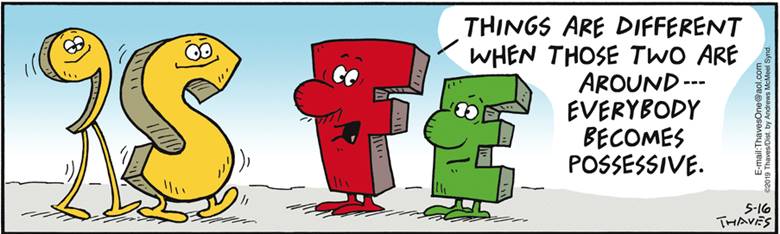
Posted by: Jack Henry | April 2, 2019

Editor’s Corner: Pushing the Envelope

The other day, one of you said you were “pushing the envelope” with your response to my Editor’s Corner article about double exclamation points and double question marks. (I must admit, it was quite smart of you to bring up Spanish and the upside-down punctuation at the beginning of a question or an exclamation!) But once you were done flashing around your intelligence and smartitude, you asked me about the phrase “pushing the envelope.” I was imagining a wig-wearing man, sitting around a table with noblemen and pushing an envelope to someone. I was so very wrong!

To my buddy Keith (and the rest of you language-lovers), here’s where this fairly modern phrase comes from, according to The Grammarist and several other sites I checked.

To push the envelope means to extend the boundary of what is possible, to take a risk by going farther than others think is acceptable.

The term push the envelope was popularized in the early 1980s, following the publication of the book The Right Stuff by Tom Wolfe. The book The Right Stuff chronicled American pilots who tested high-speed aircraft, including the early astronauts. Tom Wolfe quoted pilots using the term “pushing the outside of the envelope” to describe challenging speed records and other aerial feats.

The envelope in question is the “flight envelope,” which includes all possible aircraft maneuvers. The idiom most probably originated among American pilots during World War II. After the publication of Wolfe’s book, the term push the envelope migrated into everyday English to be used in a figurative sense.

Related terms are pushes the envelope, pushed the envelope and pushing the envelope.

Kara Church

Technical Editor, Advisory

Symitar Documentation Services

Posted by: Jack Henry | March 28, 2019

Editor’s Corner: The Sound of Silence

Good morning! Today I have an excerpt from a column by Richard Lederer, titled “There’s a lot of fun in making the alphabet dance.” I couldn’t find this one online yet, so to read the entire thing, you’ll have to wait for him to post it on his website.

The word alphabet is a joining of the first two letters of the Greek alphabet, alpha and beta. The Greeks inherited their letters from the Phoenicians, who probably took their alpha from the Hebrew aleph, “ox.” The old Cambodian alphabet, with 74 letters, is the world’s longest. Rotokas, spoken on the South Pacific island of Bougainville, uses only 11 letters.

Now, let’s listen to the sounds of silence. All 26 of our letters are mute in one word or another. Here is an alphabet that demonstrates the deafening silence that rings through English spelling. [KC-I have to say, this is a bit of a cheat when you get to the French words, but then again, we do use them in English without translating them.]

A: bread, marriage, pharaoh

B: debt, subtle, thumb

C: indict, yacht, blackguard [(bla-gərd) kitchen servants of a noble household; street urchins that run errands and shine shoes.]

D: edge, handkerchief

E: more, height, steak

F: halfpenny (hāp(ə)ni)

G: gnarled, reign, tight

H: bough, ghost, heir

I: business, seize, Sioux

J: marijuana, rijsttafel [(rīˌstäfəl)
Indonesian meal consisting mostly of rice, with small portions of meat, vegetables, eggs, curries, pickles, and condiments.]

K: blackguard, knob

L: half, salmon, would

M: mnemonic

N: column, hymn

O: country, people

P: psychology, receipt

Q: lacquer, racquet

R: dossier, forecastle [(fōksəl) an ancient warship’s short upper deck forward raised like a castle to command an enemy’s decks; the part of the upper deck of a ship forward of the foremast.]

S:debris, island, viscount

T: gourmet, listen, rapport

U: circuit, dough, gauge

V: fivepence (fi-pən(t)s)

W: answer, two, wrist

X: faux pas, grand prix

Y: aye, prayer

Z: rendezvous

Growing up watching the Electric Company and Sesame Street, it was usually about the silent “e” or silent “k.” Who knew that all of our letters can be “quiet” at times?

Enjoy your day!

Kara Church

Technical Editor, Advisory

Symitar Documentation Services

Posted by: Jack Henry | March 26, 2019

Double the Trouble

This month’s Chicago Manual of Style Q&A reminded me of something that I now consider a peeve. I never gave it much thought before I started editing, but now it plagues me in several ways. What is it? Doubles! Nope, I’m not talking about tennis, or mixed drinks—I’m talking about punctuation: double question marks and double exclamation points.

I would add double spaces after a period to the discussion, but you all know how we feel about those extra spaces. If not, you can go to our blog site and have a look at this past article and the attached links: Editor’s Corner.

So, what did the CMOS say about double question marks and double exclamation points? Did they break down and adopt them like they have emojis? Thank goodness, no. They still have some standards that will help us editors from having to wear out our Delete keys.

Q. What’s the official CMOS stance on double question marks?? I see this a lot in blogs, online magazines, DIY news sites, etc. [KC – My first thought was this, “But of course they must be okay! They’re on the internet and people use them all the time.” And my second thought was, “And everything “The Onion” writes
about is absolutely a true news story!” Crazy kids!]

A. We don’t have an official stance on double question marks. But to invoke the spirit of CMOS if not the letter, you might keep in mind that any kind of emphasis tends to lose its effectiveness if overdone. This is essentially our stance on exclamation points (see CMOS 6.71), advice that’s equally applicable to doubled question marks.

Now, unless you have a subscription to CMOS, or a hard copy like one of your friendly editors, you’re just going to have to trust me on this. Essentially, their stance is that one exclamation point is good enough. It’s all you need! And more than one question mark? Well, that’s just silly.

Stick with one exclamation point, one question mark, and (okay) one space after a period. It’s the right thing to do.

Kara Church

Technical Editor, Advisory

Symitar Documentation Services

Posted by: Jack Henry | March 21, 2019

Editor’s Corner: Women

Happy Women’s History Month!

Chaka Khan said it best: “I’m every woman, it’s all in me!” But maybe Grammarphobia said it second best. As I mentioned Tuesday, “woman is not derived from (or a mere variation on) the term ‘man.’” Well let’s see where it’s from then, shall we?

“In Anglo-Saxon times, when words were bubbling away in the stewpot of Old English, there were several ways to refer to men and women. For a few hundred years, manna and other early versions of our modern word ‘man’ referred merely to a person regardless of sex—that is, a human being. So how did the Anglo-Saxons tell one sex from the other? A single or married man was a wer or a waepman (literally a ‘weapon-person’). A single or married woman was a wif or a wifman.

“By the year 900 or so, wifman began to lose its f. Over the next five hundred years, it went through many spellings until it settled down as our modern word ‘woman.’ Meanwhile, wif, which had its own share of spellings before becoming ‘wife’ in the 1400s, led a double life. It could mean a married woman, as it does today, but also a woman, married or single, in a humble trade—an archaic usage that survives in the quaint terms ‘fishwife’ and ‘alewife.’

“Speaking of quaint terms, whatever happened to the weapon-people? Around the year 1000, the various versions of manna began to mean an adult male as well as a human being. By the 1400s, manna had become our modern word ‘man,’ while the old macho terms wer and waepman had fallen out of use. [KC – Except when talking about werewolves!] That left the guys without a unique word for an adult male. They had to share ‘man’ with humanity in general.”

Well, there you have it! I wish all of you amazing women (and men) a happy March!

Kara Church

Technical Editor, Advisory

Symitar Documentation Services

Posted by: Jack Henry | March 19, 2019

Editor’s Corner: Man

It’s Women’s History Month, so today we’re going to talk about men. Nope, I’m not kidding. We will definitely get to women, but we’re starting here with an excerpt from an article on masculine terms used in interjections, from the Grammarphobia blog.

Q: I’m curious about the use of male nouns in interjections like “man oh man” and “oh brother.” Did these expressions begin life as euphemisms? Where are they heard most? Are there female equivalents? Oh boy! I can hardly wait for your response.

A: You may be surprised to hear this, but “man” has been used as an interjection since Anglo-Saxon days, according to the Oxford English Dictionary.

You’d have a hard time making out the Old English examples, but here’s one from 1530 by John Palsgrave: “Plucke up thy herte, man, for Goddes sake.”

In this old sense, the OED says, “man” is used to address a person or introduce a remark “emphatically to indicate contempt, impatience, exhortation, etc.”

You’re asking about a much more recent usage, however.

From the published references in the OED, the usage appears to have originated in the early 19th century. At first, according to the dictionary, it was “chiefly” heard among African-Americans and South Africans.

[KC – My personal favorite use of “man, oh, man” is in the chorus of the song “I Palindrome I,” by They Might Be Giants.]

There’s no indication that these expressions began life as euphemisms. From the examples in the OED and other sources, the usage appears to be most common in North America.

The OED describes the use of the interjection “brother” as “a mild exclamation of annoyance, surprise, etc.”

“Boy,” “oh boy,” “oboy,” and “boy oh boy” are described as interjections “expressing shock, surprise, excitement, appreciation, etc. Freq. used to give emphasis to the following statement.”

We can’t think offhand of a female version of the kind of “man,” “brother,” or “boy” interjection that’s aroused your curiosity.

In an expression like “way to go, woman” or “what’s happening, sister?” or “you go, girl,” the interjection is used to address someone (as in that early “man” usage we mentioned at the beginning).

By the way, the word “woman” is not derived from (or a mere variation on) the term “man.” The story is much more complicated.

And I will deliver that complicated story to you Thursday!

Kara Church

Technical Editor, Advisory

Symitar Documentation Services
Posted by: Jack Henry | March 14, 2019

Editor’s Corner: I Feel Like

I know this is not a new phenomenon, but I notice a lot more people these days saying, “I feel like” rather than “I think” or “I believe,” so I decided to do a little research to see what’s going on.

Turns out it is not my imagination, and most of the articles that popped up in my research stand firmly against “I feel like.”

A New York Times article titled “Stop saying ‘I feel like’” had this to say: “This reflex to hedge every statement as a feeling or a hunch is most common among millennials. But I hear it almost as often among Generation Xers and my own colleagues in academia. As in so many things, the young are early carriers of a broad cultural contagion.”

Wow, a “contagion.” I think we know exactly how that author feels.

The article goes on to point out that the phrase became common in the ‘90s. And it states that it is used because it gives users an out. They are not stating a fact, they are merely giving an opinion. When people are just stating their feelings, you can’t really fight back with logic. You can’t really disagree with feelings.

And it turns out that the New York Times is not alone in their dislike of the phrase.

Entrepreneur published an article called “’I Feel Like’ Is the Newest Controversial Phrase You Should Avoid.” The article states, “Saying ‘I feel like’ is a nonassertive, fearful way to introduce an idea…In protecting the person who says it from being judged or offending anyone, it also ‘halts argument,’ because it suggests to others that they cannot understand or challenge the speaker’s subjective feelings and experiences.”

Other articles I looked at (but not every single one) had similar opinions. Most condemn the phrase as wishy-washy and non-committal.

But many people simply use this term as a matter of habit. We all tend to use popular phrases that we hear, and this one is pretty prevalent in U.S. society.

So, whether you fall in the “stop using it” camp or the “it’s just another fad” camp, it’s good to be aware of the conversation that is taking place around this phrase. And it’s always a good idea to be cognizant of what you’re saying and how it could be perceived by others.

I feel like I’ve said my piece here. I hope you feel like it was worth your time.

Donna Bradley Burcher | Senior Technical Editor | Symitar®

8985 Balboa Ave. | San Diego, CA 92123 | Ph. 619.278.0432 | Extension: 765432

Symitar Documentation Services

NOTICE: This electronic mail message and any files transmitted with it are intended
exclusively for the individual or entity to which it is addressed. The message,
together with any attachment, may contain confidential and/or privileged information.
Any unauthorized review, use, printing, saving, copying, disclosure or distribution
is strictly prohibited. If you have received this message in error, please
immediately advise the sender by reply email and delete all copies.

Posted by: Jack Henry | March 12, 2019

Editor’s Corner: Assume and Presume

Have you ever wondered if assume and presume mean the same thing? Do you ever even use the word presume? Are you worried that if you do, you’ll sound like the 19th century explorer Sir Henry Morton Stanley, who, after searching throughout Africa for some time, finally found fellow explorer and missionary Dr. Livingston and greeted him by saying, “Dr. Livingston, I presume?”

Do you wonder why Morton used the word presume instead of assume?

To answer all my questions, let’s first look at some definitions:

  • Assume means to suppose something to be the case without proof
  • Presume means to suppose something to be the case based on probability or evidence

So, you assume something when you really have no idea, and you presume something when you have reason to believe it could be right or true. These days, people seem to use assume in both cases. But as I’ve said before, we’re not most people. We’re nerds who care about using just the right word in just the right situation. You’re with me, I presume?

In case you have trouble remembering which word means what, here’s a useful, work appropriate mnemonic: presume and proof both start with the letter p. To presume something is to suppose that it is true based on proof.

There you go! Enjoy the rest of your day.

Donna Bradley Burcher | Senior Technical Editor | Symitar®

8985 Balboa Ave. | San Diego, CA 92123 | Ph. 619.278.0432 | Extension: 765432

Symitar Documentation Services

NOTICE: This electronic mail message and any files transmitted with it are intended
exclusively for the individual or entity to which it is addressed. The message,
together with any attachment, may contain confidential and/or privileged information.
Any unauthorized review, use, printing, saving, copying, disclosure or distribution
is strictly prohibited. If you have received this message in error, please
immediately advise the sender by reply email and delete all copies.

Posted by: Jack Henry | March 7, 2019

Editor’s Corner: Vocabulary Quiz

Today, I have a vocabulary quiz from Daily Writing Tips for you. Like previous vocabulary quizzes that I’ve shared, this one is made up of five commonly confused word pairs. All you have to do is guess the right word to complete each sentence. You have a 50/50 chance. As always, you don’t win anything if you get them all right, but it’ll put a positive spin on the rest of your day. You can’t put a price on that.

And if you don’t get them all right, there’s still a silver lining because we all learn from our mistakes, right? So, you’ll probably remember these word pairs and never make the same mistake again. You can’t put a price on that either.

The quiz questions are directly below. You have to scroll down a bit for the answers and the very helpful explanations. On your mark, get set, go!

In each sentence, choose the correct word from the pair of similar terms. (If both words possibly can be correct, choose the more plausible one.)

1. Mozart was a musical ______ who gave his first concert at the age of four.

a) prodigy
b) prodigal

2. None of the freshmen wanted to room with Felix because of his _____ manners; he piled wet towels on the floor, used anyone’s toothbrush, and left food scraps to moulder in the wastepaper basket.

a) barbaric
b) barbarous

3. Your design would probably work, but building it is not ______ because of the expense and rarity of the materials.

a) practical
b) practicable

4. His friends’ plan to vandalize the school went against the boy’s ______ , so he refused to take part.

a) conscience
b) conscious

5. Some have called this ______ life “a vale of tears.”

a) earthy
b) earthly

Answers and Explanations

1. Mozart was a musical prodigy who gave his first concert at the age of four.
a) prodigy

A prodigy is something out of the ordinary. It’s often used to refer to a child with gifts beyond his age. A prodigal is a wastrel, a person who spends his wealth foolishly, with no thought for the future.

2. None of the freshmen wanted to room with Felix because of his barbarous manners; he piled wet towels on the floor, used anyone’s toothbrush, and left food scraps to moulder in the wastepaper basket.
b) barbarous

Barbarous and barbaric are similar in meaning; many speakers use them interchangeably to mean “uncivilized.” Barbaric always refers to extreme, gruesome cruelty; barbarous can refer to behavior that is merely coarse.

3. Your design would probably work, but building it is not practicable because of the expense and rarity of the materials.
b) practicable

A practical idea is sensible and reasonable. A practicable idea, on the other hand, is one that can be done or put into practice.

4. His friends’ plan to vandalize the school went against the boy’s conscience, so he refused to take part.
a) conscience

Conscience is a noun. It is a person’s moral guide. Conscious is an adjective meaning “alert, aware.”

5. Some have called this earthly life “a vale of tears.”
b) earthly

Earthly is an adjective referring to things on or of the earth. Earthy is also an adjective. Earthy is a pleasant word for vulgar. “An earthy remark,” for example, is one that would not be spoken in polite company.

Donna Bradley Burcher | Senior Technical Editor | Symitar®

8985 Balboa Ave. | San Diego, CA 92123 | Ph. 619.278.0432 | Extension: 765432

Symitar Documentation Services

About Editor’s Corner

Editor’s Corner keeps your communication skills sharp by providing information on grammar, punctuation, JHA style, and all things English. As editors, we spend our days reading, researching, and revising other people’s writing. We love to spend a few extra minutes to share what we learn with you and keep it fun while we’re doing it.

Did someone forward this email to you? Click here to subscribe.

Don’t want to get Editor’s Corner anymore? Click here to unsubscribe.

Do you have a question or an idea for Editor’s Corner? Send your suggestions or feedback to Kara, <a href="mailto:DBurcher, Jackie, or <a href="mailto:BRitter.

NOTICE: This electronic mail message and any files transmitted with it are intended
exclusively for the individual or entity to which it is addressed. The message,
together with any attachment, may contain confidential and/or privileged information.
Any unauthorized review, use, printing, saving, copying, disclosure or distribution
is strictly prohibited. If you have received this message in error, please
immediately advise the sender by reply email and delete all copies.

Posted by: Jack Henry | March 5, 2019

Editor’s Corner: Retronym

Today I received a newsletter about a word I hadn’t heard before: retronym. I was thinking it must mean something about old clothing styles or movies or technology that came back into fashion—but I was wrong.

According to Wikipedia: “A retronym is a term used to describe an older object or idea to contrast it with something similar but newer.” Here is an example from The Grammarist, which might give you a better idea of what they are and how they are formed:

Evolving technology does not always create new words, sometimes it takes words that have been in use for a period of time in the English language and gives them new meanings. For example, the word phone has been in use for a long time to mean an instrument that one uses to call another person to speak with him. For decades, all phones worked by virtue of a rotary dial. Today, when one says the word phone, it conjures the image of a hand-held wireless device. To talk about the original model of the phone, it is now necessary to refer to the retronym rotary phone.

Make sense? Here are a few more retronyms for you, from Wikipedia:

  • Manual transmissions in vehicles were just called "transmissions" until the invention of automatic transmissions.
  • Plain M&M’s: Plain M&M’s candies (now Milk Chocolate) would not have been called that until 1954, when Peanut M&M’s were introduced.
  • Regular coffee: The development of decaffeinated coffee led to this coinage.
  • Acoustic guitar: Before the invention of the solid-body electric guitar, all guitars amplified the sound of a plucked string with a resonating hollow body. Similarly: acoustic piano.
  • Bar soap: The common cake of soap used in the tub or shower was familiarly called "soap" or "bath soap"; the term "bar soap" arose with the advent of soaps in liquid and gel form.
  • Corn on the cob: Before canned corn was widely available, "corn on the cob" was simply "corn".
  • Paper copy, hard copy: With the proliferation of exchange of documents in the form of electronic files, physical copies of documents acquired this retronym. Occasionally extended to the copying devices; i.e. paper copiers..
  • Silent film: In the earliest days of the film industry, all films were without recorded sound. Once "talkies" became the norm, it became necessary to specify that a particular film was "silent".
  • Sit-down restaurant: With the rise of fast-food and take-out restaurants, the "standard" restaurant received a new name in the United States.
  • Whole milk: Milk was formerly available in just one version, with the cream included, and benefited eventually by pasteurization and homogenization. But it was still called simply milk. This variety of milk is now referred to in the U.S. as whole milk (3.25% milkfat) to distinguish it from 2% (reduced fat) milk, 1% (low fat) milk, and skim milk (nearly no fat).

She’s so retro, the first woman’s hair doesn’t fit into the picture! And you

must love the gloves!

Kara Church

Technical Editor, Advisory

Symitar Documentation Services

Posted by: Jack Henry | February 28, 2019

Editor’s Corner: If Nothing Else

“If nothing else” is a remarkably difficult phrase to define, which might be why Merriam-Webster gives this uncharacteristically muddled definition:

  • if nothing else: used to say that something is probably the only thing that is true, acceptable, desirable, or certain because there are no better/worse possibilities

Some dictionaries adopt a narrower definition, such as the following (from the Longman Dictionary of Contemporary English):

  • if nothing else: used to emphasize one good quality or feature that someone or something has, while suggesting that it might be the only good one

Examples:

  • “Andrea’s work has always been very neat, if nothing else.” (Macmillan Dictionary)
  • “The food is cheap, if nothing else.” (Merriam-Webster)

For these sentences to make sense, the reader needs to recognize that “neat” and “cheap” are positive characteristics.

“If nothing else” can also mean the opposite (emphasizing the only bad quality that something has). For example, you could say, “I’m not buying that new sportscar. It’s too expensive, if nothing else.”

There are many other meanings the phrase can take, such as the following:

  • if you do nothing else (“If nothing else, you should send him a card.”)
  • if there’s no alternative (“If nothing else, there’s the party to go to this evening.”)
  • if they have nothing else in common (“Everybody knew each other, and had grown up in proximity, if nothing else.”)

If you’re not careful, you can make too big of a logical leap and end up confusing your reader.

Examples:

  • “The sun is hot, if nothing else.”
  • “The Statue of Liberty is green, if nothing else.”
  • “That tree is leafy, if nothing else.”

When you’re writing a business email or a technical document, you don’t want to leave anything open to interpretation. Use more precise language.

About Editor’s Corner

Editor’s Corner keeps your communication skills sharp by providing information on grammar, punctuation, JHA style, and all things English. As editors, we spend our days reading, researching, and revising other people’s writing. We love to spend a few extra minutes to share what we learn with you and keep it fun while we’re doing it.

Did someone forward this email to you? Click here to subscribe.

Don’t want to get Editor’s Corner anymore? Click here to unsubscribe.

Do you have a question or an idea for Editor’s Corner? Send your suggestions or feedback to Kara, <a href="mailto:DBurcher, Jackie, or <a href="mailto:BRitter.

Ben Ritter | Technical Writing Supervisor | Symitar®
8985 Balboa Avenue | San Diego, CA 92123
619-682-3391 | or ext. 763391 | www.Symitar.com

Symitar Documentation Services

NOTICE: This electronic mail message and any files transmitted with it are intended
exclusively for the individual or entity to which it is addressed. The message,
together with any attachment, may contain confidential and/or privileged information.
Any unauthorized review, use, printing, saving, copying, disclosure or distribution
is strictly prohibited. If you have received this message in error, please
immediately advise the sender by reply email and delete all copies.

« Newer Posts - Older Posts »

Categories