Posted by: Jack Henry | April 25, 2019

Editor’s Corner: A long E for Edith

My dear friend Edith, whose first language is German, always has a new question about English for me when I see her. During our last dinner, she asked me why the “eo” in people and the “oe” in subpoena were pronounced with a “long e” sound, but the “o” is there without a squeak.

I looked around for some helpful hints on spelling and pronunciation, and I found this: “When there are two vowels together in a word, and they are immediately next to each other, you usually pronounce only the first vowel, which is their long vowel sound.” Here are a few examples:

  • Boat: only the “o” is pronounced (with a “long o” sound)
  • Bait: only the “a” is pronounced (with a “long a” sound
  • Increase: only the “e” is pronounced (with a “long e” sound)

Unfortunately, there are a zillion exceptions to that rule. English is a combination of so many languages that we have the same sound for many combinations of letters. So, rather than get too far afield from the original “eo” and “oe” that sound like a “long e,” let’s look at something else I found.

I saw an article in Daily Writing Tips called The Six Spellings of “Long E.” While this didn’t address either of Edith’s examples, it did show six other combinations of letters that make the “long e” sound. Instead of pasting it all here, I have digested it, and now I am returning it to you (like a mamma bird) in a tabular format, with examples of my own. We will call this The Eight Spellings of “Long E.”

Letters Examples Sentence
e me, he, she He is a very angry little caterpillar.
ee heel, see, feel, tee, kneel, wheel When you see Jose, tell him he owes me a lunch.
ea heal, meal, read, lead, appeal, zeal, real It is with vim, vigor, and zeal that I approach the upcoming weekend in Aruba.
ei conceit, ceiling, receipt, receive I was staring up at the ceiling when the phone rang.
ie believe, brief, chief, retrieve, reprieve, priest, siege I went into the confessional, kneeled, and said, “Forgive me father for I have sinned.” The voice on the other side responded, “I’m not sure who you are, but I am not a priest.”
eo people, feoff My dog Bella prefers hanging around people more than she likes spending time with other dogs.
oe subpoena, phoenix, amoeba, onomatopoeia In high school, teachers always read Edgar Allen Poe’s poem “Bells” to demonstrate onomatopoeia.
ey valley, key, alley, galley The stench coming from the alley was almost unbearable.

And lastly, this little bit on the word subpoena: some say the “b” is silent in American English but pronounced in British English. The “oe” is left over from the Latin. And from Merriam-Webster, we have this etymology:

If you think you recognize the sub- in subpoena as the prefix meaning "under, beneath, below," you’re on target. Subpoena arrived in Modern English (via the Middle English suppena) from the Latin sub poena, a combination of sub and poena, meaning "penalty." Other poena descendants in English include impunity ("freedom from penalty"), penal ("of or relating to punishment"), and even punish. There is also the verb subpoena, as in "Defense lawyers have subpoenaed several witnesses to the crime."

Kara Church

Technical Editor, Advisory

619-542-6773 | Ext: 766773

Symitar Documentation Services

NOTICE: This electronic mail message and any files transmitted with it are intended
exclusively for the individual or entity to which it is addressed. The message,
together with any attachment, may contain confidential and/or privileged information.
Any unauthorized review, use, printing, saving, copying, disclosure or distribution
is strictly prohibited. If you have received this message in error, please
immediately advise the sender by reply email and delete all copies.

Posted by: Jack Henry | April 23, 2019

Editor’s Corner: Different Demics

Hello everyone! I hope this finds you in good health. One of the disaster recovery specialists in our department sends us monthly preparedness information, and something he sent during flu season caught my eye. It was a tip of the week about endemics, epidemics, and pandemicsit doesnt get more exciting than that!

Today lets have a look at these words, where they are from, and the differences between them.

  • endemic (adj.): a disease with a constant presence in a region. From Greek en "in" + dmos "people

    Example: In North America, winter colds and flu are endemic; in large areas of Africa, malaria is endemic.

  • epidemic (adj.)

A sudden outbreak where the tally of new cases exceeds expectations for an infectious disease in a given region. From Greek epi "among, upon" + dmos "people, district.

Example: The article said that between 1988 to 1990, California experienced its worst measles epidemic in decades. The cause? People not getting the measles vaccine for their children.

  • pandemic (adj.)

A disease that exceeds expected case levels but may also spread over many countries or continents. From Greek pan- "all" + dmos "people"

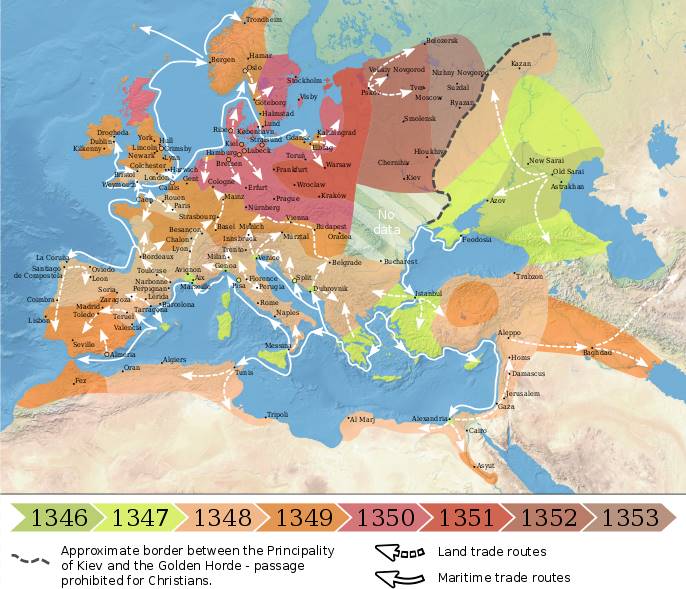
Example: At first, the Black Plague seemed to be contained to a certain area of Asia, but by 1353 they estimate this pandemic killed up to 200 million people in Europe and Asia.

On that note, I hope you all have a very jolly day!

Spread of the Black Death (named for the lymph nodes that became

black and swollen after bacteria entered through the skin)

Kara Church

Technical Editor, Advisory

Symitar Documentation Services

Posted by: Jack Henry | April 18, 2019

Editor’s Corner: Once or After?

Which of the following sentences do you think is correct?

  • Please call me once you finish working.
  • Please call me after you finish working.

Trick question. They’re both correct. The word you choose (once or after) depends on how big a hurry you are in to get that phone call. If you want the phone call to occur immediately after you finish working, the correct choice is once. If you just want the phone call to occur sometime after you finish working, the correct choice is after. Once is more urgent.

In both cases, the words are being used as conjunctions. Here are the definitions:

  • once: at the moment when: as soon as
  • after: at a later time than something else happens

Most people use the words interchangeably, and it usually doesn’t make much difference. But since we know the distinction, we can be more precise. Didn’t someone once say that precision is next to godliness? If they didn’t, they should have.

Now, here’s an interesting twist: not only can once and after both be used as conjunctions, they can also both be used as adverbs. But as adverbs, the definitions are not close in meaning, so there’s no chance of accidental misuse:

  • once: one time and no more
  • after: following in time or place

Here are some examples of the adverbs in a sentence:

  • We saw that band perform once.
  • We arrived shortly after the band started playing.

Ah, English. It’s like my crazy uncle Cecile: irregular, inconsistent, and a sometimes a little confusing.

Donna Bradley Burcher | Senior Technical Editor | Symitar®

8985 Balboa Ave. | San Diego, CA 92123 | Ph. 619.278.0432 | Extension: 765432

Symitar Documentation Services

NOTICE: This electronic mail message and any files transmitted with it are intended
exclusively for the individual or entity to which it is addressed. The message,
together with any attachment, may contain confidential and/or privileged information.
Any unauthorized review, use, printing, saving, copying, disclosure or distribution
is strictly prohibited. If you have received this message in error, please
immediately advise the sender by reply email and delete all copies.
Posted by: Jack Henry | April 16, 2019

Editor’s Corner: New

Dear Editrix,

What’s the difference, if any, between new and brand-new?

Sincerely, a Blessing from Monett

Dear Mr. Blessing,

What an interesting question and I am happy to tell you that I found some interesting answers! First, apparently there are people out there who would ask, “What’s the difference between bran new and brand-new?” To those people I say, “It is brand-new with a ‘d’ at the end. If your bran is new, well, maybe you are trying a different type of cereal.”

And as for new versus brand-new, here’s the general explanation from Merriam-Webster:

  • new: having originated or occurred lately: not early or long in being: recent, fresh, modern—opposed to old
  • brand-new: fresh from the manufacturer: conspicuously new and unused: recently introduced

And being a smart aleck, I had to look up brand spanking new, and the age of this expression was a surprise to me. From The Grammarist:

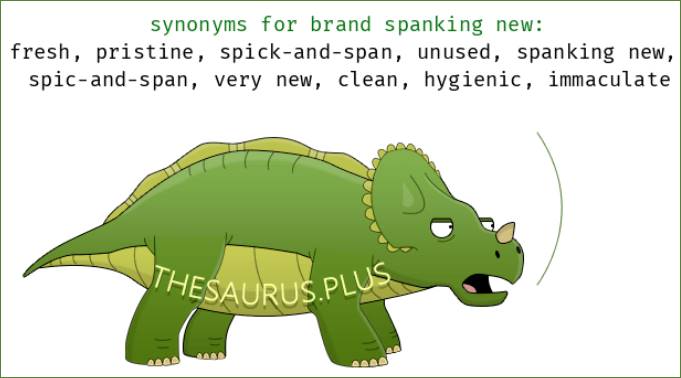
The phrase brand spanking new means to be entirely new or recently created, and was first recorded in 1860. It evolved from the compound word brand-new and the phrase spick-and-span. Also, spanking, while the main definition is to hit someone on the butt, can also mean to move quickly. So, one might say that a brand spanking new object was created quickly or appeared very fast. In truth, no one knows quite how it was coined or what it originally referred to.

Lastly, I found these little tidbits for differentiating the new and the brand-new:

  • If there can be anything newer than new, it is brand-new.
  • If you buy a brand-new TV, it remains so as it is delivered to you in packed condition, but once you have opened and installed in your home or office, it is just a new TV and not a brand new one.
  • An unsold car in a showroom is brand-new, but it becomes just new once you have bought and used it for a few days.
  • Brand-new indicates a product that is in original packing and unused condition.

Kara Church

Technical Editor, Advisory

Symitar Documentation Services

Posted by: Jack Henry | April 11, 2019

Editor’s Corner: Red

This weekend promises to be interesting and full of colorful flowers at Art Alive, the San Diego Museum of Art exhibition where local folks create interpretations of the museum’s art out of flowers and plants; it’s pretty amazing in some cases.

In honor of the colors I will see, I am sharing a Grammar Girl article about the color red and some of the idiomatic phrases that go with it. Here are some excerpts from her article, but to read about “red herrings” and “painting the town red,” you’ll have to go here.

Red Tape

Why do we call bureaucracy “red tape”?

It turns out it’s pretty simple. In the 1500s, Charles V, the king of Spain and the Holy Roman Emperor, started tying red string or ribbons, also known as “tape,” around administrative documents that were especially important and needed quick attention. It worked well, and the practice quickly spread to other royal courts throughout Europe.

You can think of the first example in the Oxford English Dictionary, from 1658, as foreshadowing how red tape would come to be something of a problem because it’s about a red-taped bundle being lost:

A Little bundle of Papers tied with a red Tape, were lost on Friday last was a seven night, between Worcester-house and Lincolns-Inn.

Whoever those belonged to was already having his or her project derailed by a problem with red tape! Or at least related to a red-taped bundle.

Red Letter Day

Another phrase with the word “red” that has a relatively straightforward origin is “red letter day,” which means a grand or special day, as in “Aardvark caught four trout down at the lake. It’s a red letter day!”

We use this phrase because special days have been written in red on calendars going all the way back to the Roman Republic. Later, special days such as saints’ days were written in red on early Christian calendars, and today secular holidays are also sometimes printed in red on calendars. It’s all about the calendars!

Red-Handed

Red-handed…means you caught someone in the act of doing the crime or that the guilt is obvious, but originally it meant specifically catching a murderer with blood on his hands, which is a very literal sense for “red-handed.” It’s only more recently that it’s taken on a more metaphorical meaning.

It goes back to Scottish law in the 1400s and the shorter term “red hand.” According to the Oxford English Dictionary, a clearly guilty criminal was said to have been taken “with red hand,” and someone who wasn’t so obviously guilty could be said to have been taken “without red hand.”

Here are a couple of paintings as floral arrangements from the 2018 Art Alive:

Kara Church

Technical Editor, Advisory

Symitar Documentation Services

Posted by: Jack Henry | April 9, 2019

Editor’s Corner: Fold and Foaled

Today’s article, from The Grammarist, made me laugh when I first opened it, because it says, “foaled and fold are two commonly confused words.” Really? I don’t think I’ve ever been talking about doing laundry and accidently referred to birthing horses instead…but maybe that’s just me.

After reading the article, though, I found the discussion of homophones educational, so I thought I’d share it with you. I hope you find it interesting and that you never get the laundromat and the barn confused!

Foaled and fold are two commonly confused words that are pronounced in the same way when spoken aloud but are spelled differently and have different meanings, which makes them homophones. Homophones exist because of our ever-changing English language, and are a challenge for those who wish to learn to speak English. The way the spelling and definitions differ can be confusing when attempting to learn vocabulary correctly.

Proper pronunciation of spoken English may help the listener distinguish between homophones; the words affect-effect are a good example. However, pronunciation is usually more ambiguous, as English pronunciation may vary according to dialect, and English spelling is constantly evolving.

Pronunciation may change even though the spelling doesn’t, producing two words that are pronounced in the same manner but have different meanings such as night and knight. English words are also spelled according to their etymologies rather than their sound. For instance, the word threw is derived from the Old English word thrawan, and the word through came from the Old English word thurh.

Homophones are confusing words and are commonly misspelled words because of the confusion that arises from words that are pronounced alike but have very different usage and etymology. A spell checker will rarely find this type of mistake. Even a participant in a spelling bee will ask for an example of a homophone in a sentence, so that she understands which word she is to spell by using context clues.

Foaled is the past tense of the verb to foal, which means to give birth to a foal. Obviously, the verb foal is only used when speaking about a mare that gives birth. The noun foal means a young horse or other equine animal. The word foaled is derived from the Old English word fola, meaning young horse. Related verbs are foal, foals, foaling.

Fold means to bend something in on itself, to crease paper or fabric, or to close up shop or cease playing a hand of cards, especially in the game of poker. Fold is used as a verb or as a noun to mean a crease or curve in something, or a penned area used to hold livestock. The word fold is derived from the Old English word falden meaning to bend back on itself. Related verbs are folds, folded, folding.

Kara Church

Technical Editor, Advisory

Symitar Documentation Services

Posted by: Jack Henry | April 4, 2019

Editor’s Corner: Know Your Audience

Today, I’d like to share the best writing advice that I ever received: know your audience.

As a writer, your job is not to empty your entire brain onto the page with every document (or email or presentation) you write. Always start by asking two questions.

Question #1: What Does the Reader Already Know?

Who is the intended reader? Consider questions such as the following:

  • What is this person’s job?
  • How much experience does this person have?
  • What education and training does this person have?

Some writers find it helpful to picture a real person (a coworker, a friend, or a family member) and write specifically for him or her.

Question #2: What Does the Reader Need to Know?

In other words, what are the reader’s goals? If you’re writing an airport paperback, the reader’s goal might be fending off boredom while waiting for a plane. However, in a business setting, the reader’s goal is something more concrete, like backing up important data, generating a report, or connecting a laptop to a video projector.

Even if you’re not writing step-by-step instructions, the information you provide has to be useful in some way. If the reader is not better equipped to do his or her job after reading your document, it probably wasn’t worth writing in the first place.

Start Writing

After you’ve identified what the reader already knows and what the reader needs to know, write to fill this gap—no more, no less. I have found that once my projects have such a well-defined scope, the actual writing process tends to go smoothly.

My Last Post

In January, I was promoted from technical editor to technical writing supervisor. Therefore, this Editor’s Corner post (my 83rd!) will be my last.

Thank you for reading. I hope you learned something and had some fun along the way. The other editors will continue to post on our current Tuesday and Thursday schedule.

About Editor’s Corner

Editor’s Corner keeps your communication skills sharp by providing information on grammar, punctuation, JHA style, and all things English. As editors, we spend our days reading, researching, and revising other people’s writing. We love to spend a few extra minutes to share what we learn with you and keep it fun while we’re doing it.

Did someone forward this email to you? Click here to subscribe.

Don’t want to get Editor’s Corner anymore? Click here to unsubscribe.

Do you have a question or an idea for Editor’s Corner? Send your suggestions or feedback to Kara, <a href="mailto:DBurcher, or Jackie.

Ben Ritter | Technical Writing Supervisor | Symitar®
8985 Balboa Avenue | San Diego, CA 92123
619-682-3391 | or ext. 763391 | www.Symitar.com

Symitar Documentation Services

NOTICE: This electronic mail message and any files transmitted with it are intended
exclusively for the individual or entity to which it is addressed. The message,
together with any attachment, may contain confidential and/or privileged information.
Any unauthorized review, use, printing, saving, copying, disclosure or distribution
is strictly prohibited. If you have received this message in error, please
immediately advise the sender by reply email and delete all copies.

Posted by: Jack Henry | April 2, 2019

Editor’s Corner: Pushing the Envelope

The other day, one of you said you were “pushing the envelope” with your response to my Editor’s Corner article about double exclamation points and double question marks. (I must admit, it was quite smart of you to bring up Spanish and the upside-down punctuation at the beginning of a question or an exclamation!) But once you were done flashing around your intelligence and smartitude, you asked me about the phrase “pushing the envelope.” I was imagining a wig-wearing man, sitting around a table with noblemen and pushing an envelope to someone. I was so very wrong!

To my buddy Keith (and the rest of you language-lovers), here’s where this fairly modern phrase comes from, according to The Grammarist and several other sites I checked.

To push the envelope means to extend the boundary of what is possible, to take a risk by going farther than others think is acceptable.

The term push the envelope was popularized in the early 1980s, following the publication of the book The Right Stuff by Tom Wolfe. The book The Right Stuff chronicled American pilots who tested high-speed aircraft, including the early astronauts. Tom Wolfe quoted pilots using the term “pushing the outside of the envelope” to describe challenging speed records and other aerial feats.

The envelope in question is the “flight envelope,” which includes all possible aircraft maneuvers. The idiom most probably originated among American pilots during World War II. After the publication of Wolfe’s book, the term push the envelope migrated into everyday English to be used in a figurative sense.

Related terms are pushes the envelope, pushed the envelope and pushing the envelope.

Kara Church

Technical Editor, Advisory

Symitar Documentation Services

Posted by: Jack Henry | March 28, 2019

Editor’s Corner: The Sound of Silence

Good morning! Today I have an excerpt from a column by Richard Lederer, titled “There’s a lot of fun in making the alphabet dance.” I couldn’t find this one online yet, so to read the entire thing, you’ll have to wait for him to post it on his website.

The word alphabet is a joining of the first two letters of the Greek alphabet, alpha and beta. The Greeks inherited their letters from the Phoenicians, who probably took their alpha from the Hebrew aleph, “ox.” The old Cambodian alphabet, with 74 letters, is the world’s longest. Rotokas, spoken on the South Pacific island of Bougainville, uses only 11 letters.

Now, let’s listen to the sounds of silence. All 26 of our letters are mute in one word or another. Here is an alphabet that demonstrates the deafening silence that rings through English spelling. [KC-I have to say, this is a bit of a cheat when you get to the French words, but then again, we do use them in English without translating them.]

A: bread, marriage, pharaoh

B: debt, subtle, thumb

C: indict, yacht, blackguard [(bla-gərd) kitchen servants of a noble household; street urchins that run errands and shine shoes.]

D: edge, handkerchief

E: more, height, steak

F: halfpenny (hāp(ə)ni)

G: gnarled, reign, tight

H: bough, ghost, heir

I: business, seize, Sioux

J: marijuana, rijsttafel [(rīˌstäfəl)
Indonesian meal consisting mostly of rice, with small portions of meat, vegetables, eggs, curries, pickles, and condiments.]

K: blackguard, knob

L: half, salmon, would

M: mnemonic

N: column, hymn

O: country, people

P: psychology, receipt

Q: lacquer, racquet

R: dossier, forecastle [(fōksəl) an ancient warship’s short upper deck forward raised like a castle to command an enemy’s decks; the part of the upper deck of a ship forward of the foremast.]

S:debris, island, viscount

T: gourmet, listen, rapport

U: circuit, dough, gauge

V: fivepence (fi-pən(t)s)

W: answer, two, wrist

X: faux pas, grand prix

Y: aye, prayer

Z: rendezvous

Growing up watching the Electric Company and Sesame Street, it was usually about the silent “e” or silent “k.” Who knew that all of our letters can be “quiet” at times?

Enjoy your day!

Kara Church

Technical Editor, Advisory

Symitar Documentation Services

Posted by: Jack Henry | March 26, 2019

Double the Trouble

This month’s Chicago Manual of Style Q&A reminded me of something that I now consider a peeve. I never gave it much thought before I started editing, but now it plagues me in several ways. What is it? Doubles! Nope, I’m not talking about tennis, or mixed drinks—I’m talking about punctuation: double question marks and double exclamation points.

I would add double spaces after a period to the discussion, but you all know how we feel about those extra spaces. If not, you can go to our blog site and have a look at this past article and the attached links: Editor’s Corner.

So, what did the CMOS say about double question marks and double exclamation points? Did they break down and adopt them like they have emojis? Thank goodness, no. They still have some standards that will help us editors from having to wear out our Delete keys.

Q. What’s the official CMOS stance on double question marks?? I see this a lot in blogs, online magazines, DIY news sites, etc. [KC – My first thought was this, “But of course they must be okay! They’re on the internet and people use them all the time.” And my second thought was, “And everything “The Onion” writes
about is absolutely a true news story!” Crazy kids!]

A. We don’t have an official stance on double question marks. But to invoke the spirit of CMOS if not the letter, you might keep in mind that any kind of emphasis tends to lose its effectiveness if overdone. This is essentially our stance on exclamation points (see CMOS 6.71), advice that’s equally applicable to doubled question marks.

Now, unless you have a subscription to CMOS, or a hard copy like one of your friendly editors, you’re just going to have to trust me on this. Essentially, their stance is that one exclamation point is good enough. It’s all you need! And more than one question mark? Well, that’s just silly.

Stick with one exclamation point, one question mark, and (okay) one space after a period. It’s the right thing to do.

Kara Church

Technical Editor, Advisory

Symitar Documentation Services

« Newer Posts - Older Posts »

Categories