Posted by: Jack Henry | March 3, 2020

Editor’s Corner: 30 Hilarious Words for Everyday Problems

Good morning! I found this article called “30 Hilarious Words for Everyday Problems” on the Best Life website. I’m committed to memorizing some of these. I love this kind of thing!

I think I’ve covered a few of these words in previous posts, but they’re funny enough to repeat. I’ll give you 15 today and you can look forward to the remaining 15 on Thursday. I challenge you to use at least one of these in conversation over the next few days.

  1. Collywobbles: Feeling a nervous fluttering in your stomach, enough that you want to stop whatever you’re doing and run away.

EXAMPLE: “I almost asked her out. But then I got the collywobbles.”

  1. Shivviness: An old Yorkshire word for that weird clingy feeling when you’re trying to break in a new pair of underwear. A “shive” is a loose thread in some clothing that won’t stop rubbing you the wrong way.

EXAMPLE: “Sorry I can’t sit still, but these new boxers are giving me the shivvies.”

  1. Croochie-proochles: What happens to your body when you’ve been sitting in the same cramped, uncomfortable position for too long. It’s kind of amazing how Scottish slang from the 18th century can perfectly describe the feeling of taking a nonstop flight from New York to LA.

EXAMPLE: “I was in the backseat for that whole road trip, with my knees up to my chin, and I still have the croochie-proochles.”

  1. Flapdoodle: Just read something that’s painfully untrue? It’s probably flapdoodle. It’s like fake news, but fancier. Used since the mid-19th century, it’s the less abusive way of saying, “You are full of it!”

EXAMPLE: “I wouldn’t believe anything he tells you. All he does is read flapdoodle.”

  1. Horror vacui: If you’re the kind of person who decorates your home by covering every square inch of wall space with something—artwork, pictures of friends and family, a mirror—because it drives you crazy when there’s any empty space at all, you’re suffering from a condition called horror vacui.

EXAMPLE: “Maybe we don’t cover that wall with a thousand paintings. I’m just saying, your horror vacui is starting to drive me batty.”

  1. Crapulence: The bloated feeling you get after eating way too much or drinking to excess. It has its origins in the Greek word crapula, for a hangover caused by overindulgence.

EXAMPLE: “The last time I ate a whole plate of nachos by myself, I was feeling like crapulence for a week.”

  1. Ishkabibble: A Yiddish word that first appeared in the U.S. during the early 20th century. It translated roughly as “I should worry?” It’s not an actual question, but a flippant response. You’re not concerned, despite whatever warnings you’ve been given.

EXAMPLE: “Oh, he thinks I should get a lawyer, does he? Ishkabibble!”

  1. Yule Hole: Gorged a bit too heavily over the holidays? You may be experiencing yule hole. That’s when you’ve reached the last hole on your belt buckle. We have the Scots to thank for this lovely reminder to go easy on the carbs in the New Year.

EXAMPLE: “I need to hit the gym. I overdid it during Christmas. I hit my yule hole.”

  1. Acrasia: When you know you shouldn’t be doing something but you do it anyway, you’re being acrasia. Pronounced “uh-KRAY-zee-yuh”, as in “You crazy, yah!” From a 19th-century Greek word meaning lack of strength or willpower.

EXAMPLE: “You’re still smoking? You’re acrasia!”

  1. Gobemouche: A naive or gullible person who is easily fooled. It’s derived from the French word gober (to swallow) and mouche (fly). So basically, a gobemouche is “fly-swallower,” somebody who’ll accept just about anything.

EXAMPLE: “I have this friend on Facebook who’s always posting stories about Bigfoot. He believes in it too. What a gobemouche!”

  1. Humdudgeon: When you just can’t summon the energy or enthusiasm to get to work. It originated in the 18th century to describe an imagined illness. You’re not really sick, you just don’t feel like showing up.

EXAMPLE: “I can’t make it to our meeting today. I’ve got a bad case of humdudgeon.”

  1. Coddiwomple: An old English word for not having any freaking idea where you’re heading. If you’ve ever driven around on a weekend with no destination in mind, you’ve been out coddiwompling.

EXAMPLE: “I’m not in the mood to go anywhere. Let’s just coddiwomple for a while.”

  1. Gwenders: It sounds like it has something to do with a girl named Gwen, but this is actually a term for the tingling sensation, or “pins and needles,” you can feel in your hands when they’re numb from too much cold.

EXAMPLE: “I need to buy some gloves. I get the gwenders every time I try to throw a snowball with bare hands.”

  1. Ninnyhammer: A less than intelligent person. Somebody prone to saying idiotic things. You’re probably Facebook friends with a few of ninnyhammers.

EXAMPLE: “As politicians go, he’s the biggest ninnyhammer of them all. And that’s saying something!”

  1. Sialoquent: Originating from the ancient Greek words sialon (“saliva”) and loqui (“speak”), it’s when somebody can’t speak without letting some spit fly.

EXAMPLE: “Hey, hey, hey, say it don’t spray it. You’re being sialoquent!”

Donna Bradley Burcher | Senior Technical Editor | Symitar®

8985 Balboa Ave. | San Diego, CA 92123 | Ph. 619.278.0432 | Ext: 765432

About Editor’s Corner

Editor’s Corner keeps your communication skills sharp by providing information on grammar, punctuation, JHA style, and all things English. As editors, we spend our days reading, researching, and revising other people’s writing. We love to spend a few extra minutes to share what we learn with you and keep it fun while we’re doing it.

Did someone forward this email to you? Click here to subscribe.

Don’t want to get Editor’s Corner anymore? Click here to unsubscribe.

Do you have a question or an idea for Editor’s Corner? Send your suggestions or feedback to Kara and <a href="mailto:DBurcher.

NOTICE: This electronic mail message and any files transmitted with it are intended
exclusively for the individual or entity to which it is addressed. The message,
together with any attachment, may contain confidential and/or privileged information.
Any unauthorized review, use, printing, saving, copying, disclosure or distribution
is strictly prohibited. If you have received this message in error, please
immediately advise the sender by reply email and delete all copies.

Posted by: Jack Henry | February 27, 2020

Editor’s Corner: 14 English Punctuation Marks

Have you ever wondered how many English punctuation marks there are? I never did until I read a recent article from Daily Writing Tips. It turns out there are 14. Seriously! That seemed like a lot until I saw the list, which doesn’t include any surprises. It would have been kind of cool to find out there is one we never knew about.

I’m going to list them all for you and provide a little additional information, where necessary. Please indulge me—this is the kind of thing that delights me.

Punctuation Marks That End Sentences

  1. Period
    This lovely little undervalued piece of punctuation tells you that a sentence has come to an end. At the risk of starting WWIII, I’ll remind everyone that we only use one space after a period. I know that drives some of you crazy, but that’s the standard (in fact, it’s been the accepted standard since we moved from typewriters to word processors).
  2. Question Mark
    Use a question mark when you are asking a direct question: “Do you think he’ll bring donuts to work this Friday?” You do not need a question mark if you are merely wondering about something: “I wonder if he’ll bring donuts to work this Friday.”
  3. Exclamation Point
    We all love an exclamation point because it adds emphasis and enthusiasm to our writing. My loving suggestion here is to only use one at a time in professional writing. When you text your friends and family, use as many as your heart desires!

Punctuation Marks Within Sentences

  1. Comma
    Commas are what we scientifically call a punctuational bugaboo. Like many of you, these critters caused me the most confusion throughout my education. There are a number of comma rules to learn and quite a bit of optional comma usage—just to mess you up. Click here if you’re interested in delving a little deeper into the mighty comma and all its rules.
  2. Colon
    Colons can be used for two purposes: to introduce an example or series of items or to separate two independent clauses. I cheekily snuck a colon into the previous sentence to show how to use a colon to introduce an example. Look for more of that—I’ll be cheekily sneaking in examples in most of these explanations.
  3. Semicolon
    My mom told me that I should love people and like things, but she didn’t understand my relationship with the semicolon. I love semicolons; they let me (and you) join two independent clauses. Sure, you could use a period and create two separate sentences, but a semicolon is a uniter. Semicolons are the Joan of Arc of the punctuation world.
  4. Dash
    Dashes are not to be confused with hyphens, which are shorter, and which show up later in my list. There are two types of dashes, the en dash (–) and the em dash (—). The en dash is usually used to indicate a range of numbers. The em dash has more uses—it can be used in place of commas, parentheses, or even colons.
  5. Quotation Marks
    We use quotation marks for dialog, to set off a direct quotation, or to emphasize a word or phrase. In American English, we use double quotation marks (“) most of the time—but we use single quotation marks (‘) when we have a quote within a quote.
  6. Ellipsis
    Oh, what a fun piece of punctuation the ellipsis mark is! These three dots (…) indicate a pause or omitted information. There are two important usage rules for the ellipsis marks: use only three dots and…do not add space before or after the ellipsis mark.
  7. Parentheses
    We use parentheses for asides and additional information (they are very useful in long, complex sentences).
  8. Brackets
    Brackets are used to indicate that you’ve added something into a quote. Here’s an example: “The proper study of [hu]mankind is books.” -Aldous Huxley
    They are also used in programming code.
  9. Braces
    Braces are primarily used in mathematical expressions and computer programming, where they keep elements together, so we do sometimes use them in our documentation.

Punctuation Marks Within Words

  1. Apostrophe
    We editors have written about the poor misunderstood apostrophe on several occasions. They are much simpler than you think. There are only two purposes for apostrophes: to indication possession (e.g., It is Donna’s world) or to indicate missing letters or numbers (e.g., Dude needs to say goodbye to the ’90s).
  2. Hyphen
    I told you the much-loved hyphen was coming! It is last but not least in this list. We use hyphens to join two (or more) words into a compound word. My plea to you is to avoid using hyphens when you really should use dashes. See #7 above for electrifying information about dashes and how to use them.

And with that, I bid you adieu. Enjoy a properly-punctuated day today.

Donna Bradley Burcher | Senior Technical Editor | Symitar®

8985 Balboa Ave. | San Diego, CA 92123 | Ph. 619.278.0432 | Ext: 765432

About Editor’s Corner

Editor’s Corner keeps your communication skills sharp by providing information on grammar, punctuation, JHA style, and all things English. As editors, we spend our days reading, researching, and revising other people’s writing. We love to spend a few extra minutes to share what we learn with you and keep it fun while we’re doing it.

Did someone forward this email to you? Click here to subscribe.

Don’t want to get Editor’s Corner anymore? Click here to unsubscribe.

Do you have a question or an idea for Editor’s Corner? Send your suggestions or feedback to Kara and <a href="mailto:DBurcher.

NOTICE: This electronic mail message and any files transmitted with it are intended
exclusively for the individual or entity to which it is addressed. The message,
together with any attachment, may contain confidential and/or privileged information.
Any unauthorized review, use, printing, saving, copying, disclosure or distribution
is strictly prohibited. If you have received this message in error, please
immediately advise the sender by reply email and delete all copies.

Posted by: Jack Henry | February 25, 2020

Editor’s Corner: Bad, Badly, and Botox

Good morning, everyone! Today I’m giving you a double whammy: a small lesson and one of those quick quizzes many of you enjoy taking because you love to learn. (Or I work with a bunch of masochists, but that’s too much information for your editor to know.)

The topic for today is from Grammarbook.com and it is about words we sometimes find tricky. Are you feeling well today, or are you feeling good? Did he smell bad, or did he smell badly? What is the difference and how do you know which word to use when? First, the article; then, the quiz. [KC – I might’ve changed some of the examples
a bit.]

The word bad is an adjective used to modify nouns and pronouns.
Example: She was in a bad accident.

Adverbs often end in ly. The word badly is an adverb that answers how about the verb.
Example: She was hurt badly in the accident.

The confusion comes with four of the sense verbs: taste, look, smell, and feel.

When we use these verbs actively, we should follow them with adverbs. (Hear is always used actively.)

When we use these verbs descriptively, we should follow them with adjectives.

Examples:
I feel bad about telling Zuza that she is a poor twerker.
I am not feeling with fingers in the above example; I am describing my state of mind, so the adjective is used (no ly).

He feels badly since he burnt his fingers in acid.
He feels with his fingers here so the adverb (ly form) is used.

You can use this same rule about sense verbs with adjectives and adverbs other than bad and badly.

Examples:
The balaclava over his face, and his handknit body suit made him look suspicious to the police.
He did not look with eyes. Look describes his appearance, so the adjective is needed.

She looked suspiciously at the $3 bill.
She looked with her eyes so the adverb is needed.

He looked good for someone who dieted on Twinkies® and never exercised.
He didn’t look with eyes. Good is describing his appearance so the adjective is needed.

She smelled well for someone with a cold.
She is actively smelling with her nose, so the adverb is needed.

Rule: Well, although more often an adverb, functions as an adjective when referring to health.
Example: He doesn’t feel well enough today to come to work.

Pop Quiz

Based on the information you just read, choose the best answer from each pair or trio.

1. Please don’t feel bad/badly about shaving off your eyebrows.

2. Her face looked bad/badly bruised after going to a Botox® party.

3. She looked cautious/cautiously at the purple Chihuahua ahead of her.

4. He feels cautious/cautiously when walking alone at night with a pocket full of hundreds and uncashed casino chips.

5. He smelled good/well/like the devil after rubbing aftershave on his neck.

6. If you feel good/well enough on Saturday, we hope you’ll join us at the circus.

(Answers below.)

Pop Quiz Answers

1. Please don’t feel bad about shaving off your eyebrows.

2. Her face looked badly bruised after going to a Botox® party.

3. She looked cautiously at the purple Chihuahua ahead of her.

4. He feels cautious when walking alone at night with a pocket full of hundreds and uncashed casino chips.

5. He smelled good after rubbing aftershave on his neck. [KC –
Like the devil is acceptable if you have strong allergies or don’t like aftershave.]

6. If you feel well enough on Saturday, we hope you’ll join us at the circus.

Kara Church

Technical Editor, Advisory

619-542-6773 | Ext: 766773

Symitar Documentation Services

NOTICE: This electronic mail message and any files transmitted with it are intended
exclusively for the individual or entity to which it is addressed. The message,
together with any attachment, may contain confidential and/or privileged information.
Any unauthorized review, use, printing, saving, copying, disclosure or distribution
is strictly prohibited. If you have received this message in error, please
immediately advise the sender by reply email and delete all copies.

Posted by: Jack Henry | February 20, 2020

Editor’s Corner: Misused Words and Phrases

Good morning! A while back I came across a list of frequently misused words and phrases, and I thought it would be helpful to share them because some of them are pretty common. I did not compile the list myself; it comes from GrammarBook.com.

I know we’ve covered a couple of these before, but most of them are new, and I found the explanations useful (although a little too snarky).

If you want to read the entire article, click here. Read on and write on!

Irregardless

I’ve heard a lot of bright people say this nonsense word, which results from confusing and combining regardless and irrespective. If people would just think about it, what’s that dopey ir- doing tacked on? In technical terms, ir- is an “initial negative particle.” So, if irregardless means anything, it means not regardless when its hapless speaker is trying to say the exact opposite.

Center around

“The whole play centers around the consequences of ill-gotten gains.”This common, misbegotten expression results from the unhappy union of two similar terms: center on and revolve around. Because the phrases are roughly synonymous, if you use them both enough, they merge in the mind. What’s annoying about center around is that it’s imprecise, and disheartens readers who take writing seriously. The center is the point in the middle. How, exactly, would something center around? You get dizzy trying to picture it.

Hone in

This is another mongrel, like the two that preceded it. It’s the brain-dead combo of hone and home in. We simply can’t allow confusion to be the basis of acceptable changes in the language. In recent years, hone in has achieved an undeserved legitimacy for the worst of reasons: the similarity, in sound and appearance, of n and m. Honing is a technique used for sharpening cutting tools and the like. To home in, like zero in, is to get something firmly in your sights: get to the crux of a problem.

Reticent

This trendy word properly means uncommunicative, reserved, silent. But sophisticates who like to fancy up their mundane blather are now using it when they mean reluctant. “I was reticent to spend so much on a football game.” When I hear something like that, I wish the speaker would just reticent the heck up.

Allude

Allude to means mention indirectly. In one of its most unspeakable moves, Webster’s lists refer as a synonym. Horrors! When you refer to something, it’s a direct transaction: “I refer to Section II, paragraph one, Your Honor.” When you allude to something or someone, you don’t come out and say it; you’re being subtle, sly or sneaky: “Someone I know better wise up.”

Off (of)

“Hey! You! Get off of my cloud,” sang the Rolling Stones, unnecessarily. The of is extraneous, and off of is what’s known as a pleonasm. That means: starting now, avoid it.

Couple (of)

“Hey, gimme a couple bucks, wouldja?” When I was a kid, this is how neighborhood tough guys talked, while cracking their chewing gum. Don’t drop the of; one more little syllable won’t kill you. [dbb – So, we’re supposed to omit “of” from the phrase “off of” but keep it in the phrase “couple of.” Why? Well, first off, many sources say it’s OK to just say “a couple”
(without “of”), but they say this choice is more informal. The explanation given is that you would say “I’d like a pair of earrings” not “I’d like a pair earrings,” and “couple,” like “pair,” means “two of something considered together.” The experts advise
that we use “couple of” in professional writing but that omitting “of” is not a serious usage error in everyday speech and writing.]

Donna Bradley Burcher | Senior Technical Editor | Symitar®

8985 Balboa Ave. | San Diego, CA 92123 | Ph. 619.278.0432 | Ext: 765432

About Editor’s Corner

Editor’s Corner keeps your communication skills sharp by providing information on grammar, punctuation, JHA style, and all things English. As editors, we spend our days reading, researching, and revising other people’s writing. We love to spend a few extra minutes to share what we learn with you and keep it fun while we’re doing it.

Did someone forward this email to you? Click here to subscribe.

Don’t want to get Editor’s Corner anymore? Click here to unsubscribe.

Do you have a question or an idea for Editor’s Corner? Send your suggestions or feedback to Kara and <a href="mailto:DBurcher.

NOTICE: This electronic mail message and any files transmitted with it are intended
exclusively for the individual or entity to which it is addressed. The message,
together with any attachment, may contain confidential and/or privileged information.
Any unauthorized review, use, printing, saving, copying, disclosure or distribution
is strictly prohibited. If you have received this message in error, please
immediately advise the sender by reply email and delete all copies.
Posted by: Jack Henry | February 18, 2020

Editor’s Corner: Row or Road?

Hi Kara,

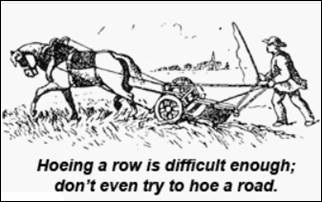
I often hear the phase “road to hoe” and always thought that was strange. I saw it in print for the first time and thought it even stranger. With many famers in my family, “row to hoe” makes much more sense as a person would hoe weeds along a row of crops. It is back-breaking work, which makes it hard and seemingly endless if a full field is expected to be weeded.

So, are some people just using it wrong? And did it come from farming?

Thanks,

Deborah

Dear Deborah,

I come from families in the steel and stone trades, so I’ve never used the terms “road or row to hoe,” but your logic behind “row” makes a lot of sense. First, for those not familiar with this phrase, “a tough (or hard) row to hoe” means someone is facing a difficult situation and has a lot of problems to deal with.

And indeed, you are correct with both of your assumptions: the correct version is “row to hoe,” and it is from farming. From our friends at the Grammarist:

In farming and gardening, to hoe a row is to turn a line of soil for the planting of seeds or bulbs. This is the origin of the idiom tough row to hoe, which describes a large, challenging task. A literal tough row to hoe might be one that is long or that involves hoeing dirt with lots of rocks or roots.

A figurative tough row to hoe is any large undertaking that is especially difficult.

Road to hoe is a misspelling. For some reason, it’s especially common in sports writing—for example:

§ They have a significantly tougher road to hoe as their schedule sees them go to Baltimore next week. [Daily
Norseman
]

§ They’ve got a long way to go, a tough road to hoe. [Bleacher
Report
]

§ With Carolina poised to make another run at Atlanta next season, a weakened Florida may have a tough road to hoe in Columbia next fall. [Garnet and Black Attack]

The misspelling creates some funny imagery (imagine a team of football players, in uniform, hoeing a road), but careful readers will recognize the spelling as wrong.

So there you are, right on all accounts! Excellent job!

Kara Church

Technical Editor, Advisory

Symitar Documentation Services

Posted by: Jack Henry | February 18, 2020

Recall: Editor’s Corner: Row or Road?

Kara Church would like to recall the message, “Editor’s Corner: Row or Road?”.
NOTICE: This electronic mail message and any files transmitted with it are intended exclusively for the individual or entity to which it is addressed. The message,
together with any attachment, may contain confidential and/or privileged information.
Any unauthorized review, use, printing, saving, copying, disclosure or distribution is strictly prohibited. If you have received this message in error, please immediately advise the sender by reply email and delete all copies.

Posted by: Jack Henry | February 18, 2020

Editor’s Corner: Row or Road?

Hi Kara,

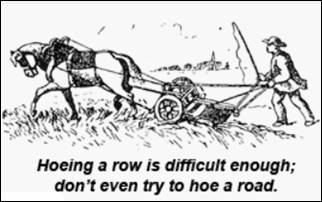
I often hear the phase “road to hoe” and always thought that was strange. I saw it in print for the first time and thought it even stranger. With many famers in my family, “row to hoe” makes much more sense as a person would hoe weeds along a row of crops. It is back-breaking work, which makes it hard and seemingly endless if a full field is expected to be weeded.

So, are some people just using it wrong? And did it come from farming?

Thanks,

Deborah

Dear Deborah,

I come from families in the steal and stone trades, so I’ve never used the terms “road or row to hoe,” but your logic behind “row” makes a lot of sense. First, for those not familiar with this phrase, “a tough (or hard) row to hoe” means someone is facing a difficult situation and has a lot of problems to deal with.

And indeed, you are correct with both of your assumptions: the correct version is “row to hoe,” and it is from farming. From our friends at the Grammarist:

In farming and gardening, to hoe a row is to turn a line of soil for the planting of seeds or bulbs. This is the origin of the idiom tough row to hoe, which describes a large, challenging task. A literal tough row to hoe might be one that is long or that involves hoeing dirt with lots of rocks or roots.

A figurative tough row to hoe is any large undertaking that is especially difficult.

Road to hoe is a misspelling. For some reason, it’s especially common in sports writing—for example:

§ They have a significantly tougher road to hoe as their schedule sees them go to Baltimore next week. [Daily
Norseman
]

§ They’ve got a long way to go, a tough road to hoe. [Bleacher
Report
]

§ With Carolina poised to make another run at Atlanta next season, a weakened Florida may have a tough road to hoe in Columbia next fall. [Garnet and Black Attack]

The misspelling creates some funny imagery (imagine a team of football players, in uniform, hoeing a road), but careful readers will recognize the spelling as wrong.

So there you are, right on all accounts! Excellent job!

Kara Church

Technical Editor, Advisory

Symitar Documentation Services

Posted by: Jack Henry | February 13, 2020

Editor’s Corner: Sides

Dear Editrix,

An article I read today used “lower right-hand side of the tablet” instead of “lower right side of the tablet.” I wondered whether the addition of the word “hand” is to clarify the intended meaning of the word “right.” It can mean the opposite of “left,” or it can mean “correct.” I have seen this ambiguity used countless times to (attempted) comic effect in political discussions.

I can see this question coming up in documentation instructing users where to look for a certain button or a menu to click. What’s the official word on this?

Mark in Allen

Dear Mark,

I did some digging, but I didn’t have much luck finding anything “official.” My first thought was that “right side” and “left side” are enough information to give people to figure out where to look for something, and the minimalist in me would say the same. But then I read a few things that reflected your logic: that because “right” can also mean “correct,” sometimes people say “right-hand side” to clarify that they are talking about the side of the paper or tablet or book that your right hand is on—not that there might be a correct side and that’s the side you should be on.

I also saw an argument stating that “left-hand side” is less ambiguous than just saying “left side.” In this case, the gentleman said that because the word “left” is the past participle of “leave,” you might think that someone saying “the left side” is talking about “the abandoned side.” That seems a little far-fetched to me, especially if you are talking about directions. I don’t know how many people would misinterpret the instructions to “sign at the bottom left side of the paper,” and start looking for the bottom abandoned side of the paper. If that were the case, you may just want to set that paper-signer free to go chase butterflies.

So, to answer your question, in our documentation I would recommend that people stick with “right-side” and “left-side,” since the topic is usually clear, and people have a screen or receipt or document in front of them to look at. In conversation, however, or if you are writing a novel, I think “right-hand side” and “left-hand side” are perfectly good ways to communicate and avoid ambiguity.

Kara Church

Technical Editor, Advisory

Symitar Documentation Services

Posted by: Jack Henry | February 11, 2020

OK or Okay?

Dear Editrix,

I’ve always wondered: is it OK or okay?

Sincerely,

HM

Dear HM,

What a good question! I know that we editors have discussed it amongst ourselves, but I’m not sure if we’ve ever covered it with the Editor’s Corner group, so let’s dive in! My heroine, Grammar Girl, wrote up an article about this topic that covers most of the bases:

The Origin of OK

"OK" was born in America in the 1830s. Much like the text messaging abbreviations of today, "OK" was an abbreviation for a funny misspelling of "all correct": "oll korrekt." According to the Oxford English Dictionary, the "okay" spelling didn’t appear until 1895.

There were other odd abbreviations with similar origins in the same era ("OW" for "oll wright," for example), but Martin Van Buren, whose nickname was Old Kinderhooks because he was born in Kinderhook, NY, adopted the motto "Vote for OK" and called his supporters the "OK Club" in his presidential campaign, and the campaign publicity established "OK" in the American lexicon.

"OK" and "Okay" Are Both OK

The two spellings peacefully coexist today: the Associate Press recommends "OK" and the Chicago Manual of Style recommends "okay." My publisher follows Chicago style for my books, but to honor the word’s origins, I insist on "OK" instead of "okay." So far, they have been kind enough to indulge me.

"Okay" Dominates in Fiction, but "OK" Wins Overall

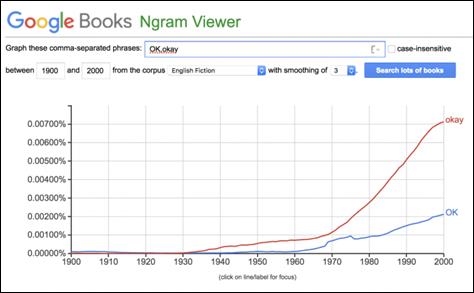
Because "okay" is the form recommended by Chicago, and Chicago is the dominant style guide in the publishing industry, "okay" is the dominant form in fiction, as you can see from the following Google Ngram search that is limited to English fiction:

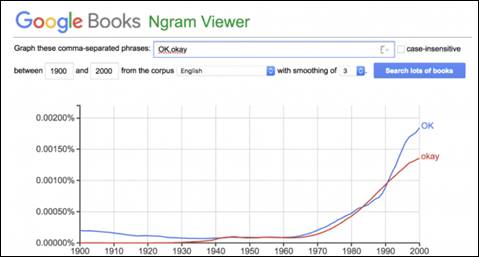
However, when the search is more broad, covering all English in Google Books, "OK" overtook "okay" in 1990.

I checked our JHA Style Guide to see if we discuss the term, but we don’t. We usually follow the Chicago Manual of Style, in our writing, but I have seen OK buttons and Okay prompts in our software. We would document each of those as they appear.

It looks like you are safe with either option! I like the Grammar Girl use of OK because it has been around longer, even though at some point I was trained to spell it out as “okay.” I think I’m going to go for the shorter, quicker option from now on. J

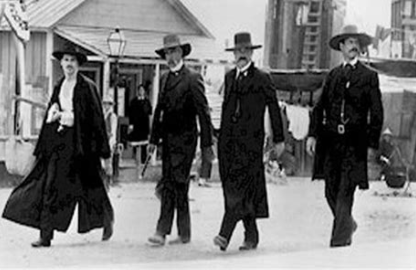
1881 Shootout at the OK Corral in Tombstone, Arizona

Kara Church

Technical Editor, Advisory

Symitar Documentation Services

Posted by: Jack Henry | February 6, 2020

Editor’s Corner: Thursday Quiz

Good morning! It’s been a while since we had a grammar quiz, and to my surprise, I always get a good response when I share them with you. I guess we are all that nerdy student who reminded the teacher that they forgot to assign the homework (or give us the Thursday quiz). Nerds unite!

This was a long quiz from GrammarBook.com, so I’ve shortened it for the sake of expediency. If you’re interested in taking the whole 25-question quiz, click this link.

It is a comprehensive quiz that covers a lot of different grammar rules, but the nice thing is that they provide links to articles so that you can research any of the ones you get wrong. So, whenever you’re ready, off you go. I wish you luck. Scroll down to see the answers and the links to the articles that explain the rule.

1. Why does Amanda look so [slow/slowly] today?

2. Think [quick/quickly]—we must get there soon.

3. Choose the better sentence from the following pair:

a. The boss said not to be late.

b. The boss said to be on time.

4. Choose the better sentence from the following pair:

a. I can’t barely tell if that’s a house or a barn.

b. I can barely tell if that’s a house or a barn.

5. Choose the better sentence from the following pair:

a. Anita rarely watches that show.

b. Anita doesn’t hardly ever watch that show.

6. Choose the better sentence from the following pair:

a. Jermaine talks to Cynthia more than Brian.

b. Jermaine talks to Cynthia more than Brian does.

7. Choose the better sentence from the following pair:

a. Mount Everest is taller than any other mountain.

b. Mount Everest is taller than any mountain.

8. Identify the sentence that uses proper parallelism:

a. Lijuan prefers eating lunch at noon and to dine at seven p.m.

b. Lijuan prefers eating lunch at noon and dining at seven p.m.

9. Identify the sentence that uses proper parallelism:

a. The nursery rhyme has lasted and made many children happy.

b. The nursery rhyme lasts and has made many children happy.

10. There’s been much talk of [who/whom] they think will be the first reporter to break the story.

11. The committee selected [her/she] to accompany [he/him] on the diplomatic mission.

12. The author of the letter is [I/me].

13. Identify whether the following comparison is fine as written or better expressed with the alternative sentence: Patricia speaks to Felicia as much as Alicia.

a. Patricia speaks to Felicia as much as Alicia does.

b. Fine as written

Quiz Answers

1. Why does Amanda look so slow today?
Adjectives and Adverbs: Another Look at –ly

2. Think quickly—we must get there soon.
Adjectives and Adverbs: Another Look at –ly

3. Choose the better sentence from the following pair:
b. The boss said to be on time. Navigating Negative Constructions

4. Choose the better sentence from the following pair:
b. I can barely tell if that’s a house or a barn. Navigating Negative Constructions

5. Choose the better sentence from the following pair:
a. Anita rarely watches that show. Detaining the Double Negative

6. Choose the better sentence from the following pair:
b. Jermaine talks to Cynthia more than Brian does. Overseeing Omissions in Writing

7. Choose the better sentence from the following pair:
a. Mount Everest is taller than any other mountain.Overseeing Omissions in Writing

8. Identify the sentence that uses proper parallelism:
b. Lijuan prefers eating lunch at noon and dining at seven p.m. Practicing Parallelism

9. Identify the sentence that uses proper parallelism:
a. The nursery rhyme has lasted and made many children happy. Practicing Parallelism

10. There’s been much talk of who they think will be the first reporter to breakthe story.
Picking Proper Pronouns: Part I

11. The committee selected her to accompany him on the diplomatic mission.
Picking Proper Pronouns: Part II

12. The author of the letter is I.
Picking Proper Pronouns: Part II

13. Identify whether the following comparison is fine as written or better expressed with the alternative sentence: Patricia speaks to Felicia as much as Alicia.
a. Patricia speaks to Felicia as much as Alicia does. Composing Comparisons

Donna Bradley Burcher | Senior Technical Editor | Symitar®

8985 Balboa Ave. | San Diego, CA 92123 | Ph. 619.278.0432 | Ext: 765432

About Editor’s Corner

Editor’s Corner keeps your communication skills sharp by providing information on grammar, punctuation, JHA style, and all things English. As editors, we spend our days reading, researching, and revising other people’s writing. We love to spend a few extra minutes to share what we learn with you and keep it fun while we’re doing it.

Did someone forward this email to you? Click here to subscribe.

Don’t want to get Editor’s Corner anymore? Click here to unsubscribe.

Do you have a question or an idea for Editor’s Corner? Send your suggestions or feedback to Kara and <a href="mailto:DBurcher.

NOTICE: This electronic mail message and any files transmitted with it are intended
exclusively for the individual or entity to which it is addressed. The message,
together with any attachment, may contain confidential and/or privileged information.
Any unauthorized review, use, printing, saving, copying, disclosure or distribution
is strictly prohibited. If you have received this message in error, please
immediately advise the sender by reply email and delete all copies.
« Newer Posts - Older Posts »

Categories