Posted by: Jack Henry | April 17, 2020

Editor’s Corner: Special Sign Edition, Part 2

Hello and good morning!

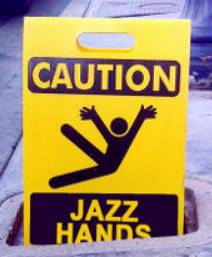
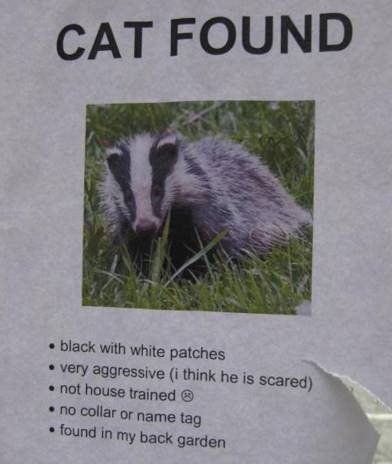
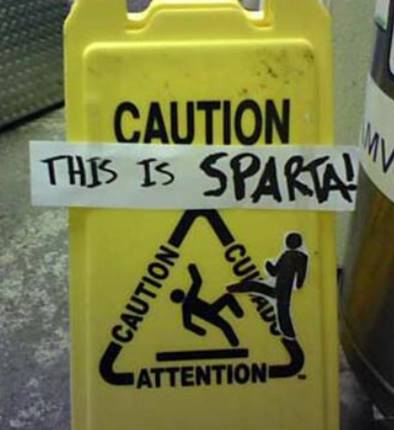
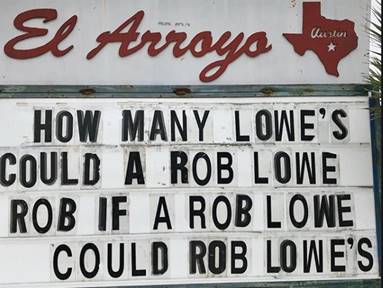
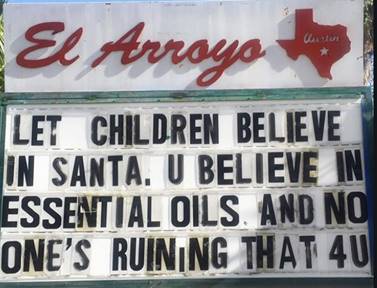
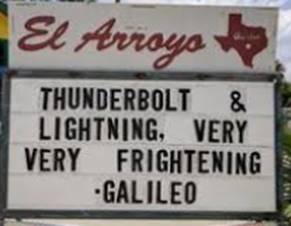
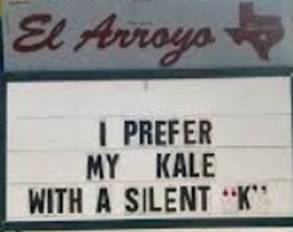
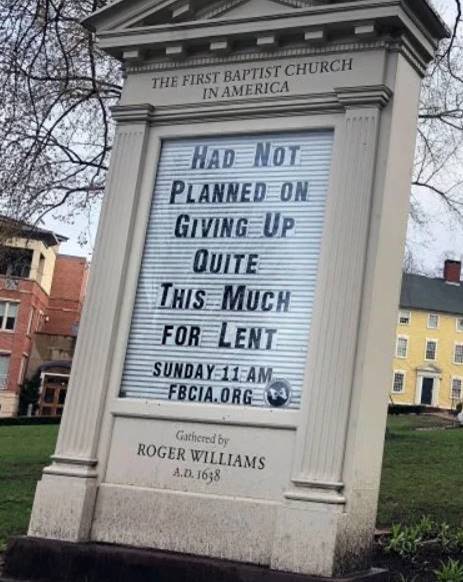
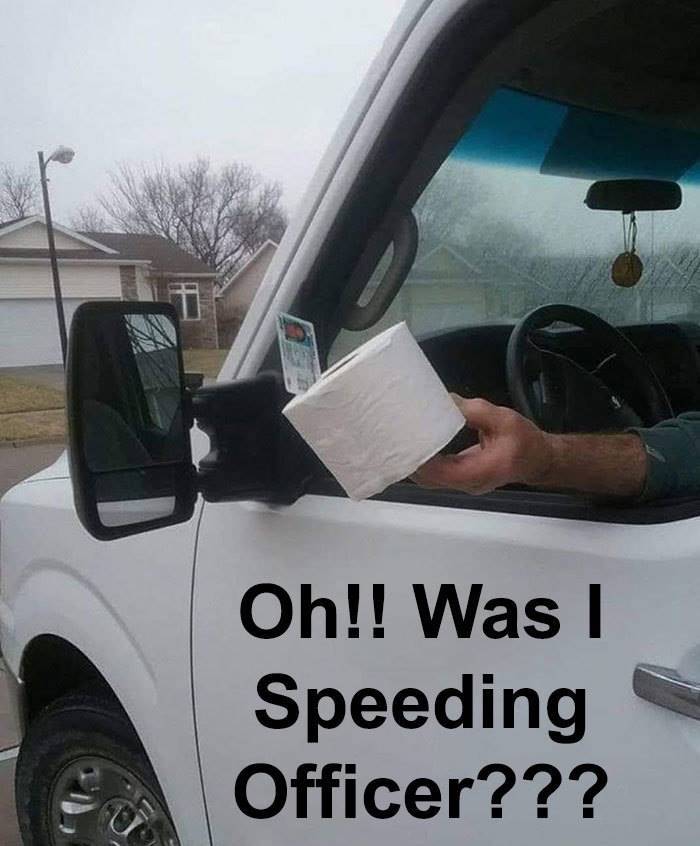
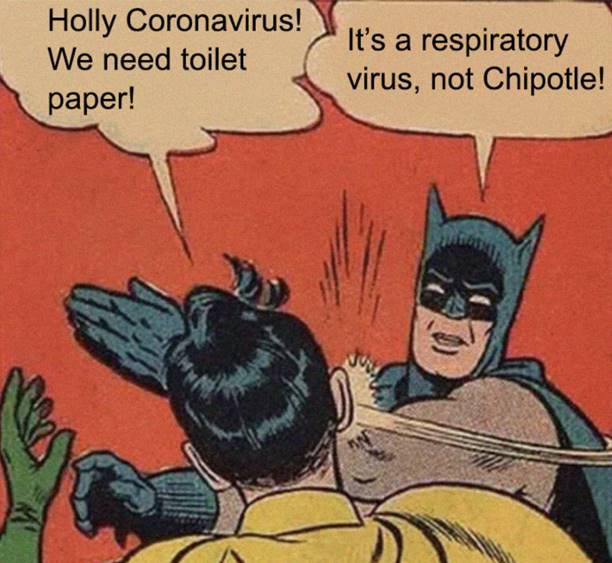
I guess a lot of us needed a little respite from the 24-hour coronavirus news because my funny signs edition of Editor’s Corner a few weeks ago got a lot of smiley faces from you. I found a few more that I thought I’d share with you so that we can all keep on truckin’!

Several of you mentioned El Arroyo (in Austin, Texas) and that they are renowned for their funny signs and yummy Tex-Mex food. I’ve included a few of their signs at the end—I agree. Hilarious folks!

Kara Church

Technical Editor, Advisory

Symitar Documentation Services

Posted by: Jack Henry | April 16, 2020

Editor’s Corner: Redundancy Quiz

Stuck at home with nothing fun to do? It’s your lucky day! I have a quiz for you. Why is that lucky, you ask? Well, first, many of you have told us that you like quizzes. And second, this one should be pretty easy for you. I think you’ll be able to correct the sentences without much trouble, but that doesn’t mean the quiz is unnecessary because we editors see these mistakes often.

This quiz is about redundancy—words and phrases that are not necessary because they repeat what has already been said.

So take a look at the five sentences below and remove the redundant words. Then scroll down to see the correct answers. Good luck, have fun, and stay safe!

1. After a few minutes, the hawk was a small speck in the sky.

2. The Medical Examiner was called to the building where a dead corpse had been found.

3. I had to return back to the house to fetch my briefcase.

4. The boss wants us to meet together as soon as possible to address the problem of shrinkage.

5. Buy now and we’ll throw in a printer as an added bonus.

Answers and Explanations

1.
Original: After a few minutes, the hawk was a small speck in the sky.
Correct: After a few minutes, the hawk was a speck in the sky.

A speck is a small spot.

2.
Original: The Medical Examiner was called to the building where a dead corpse had been found.
Correct: The Medical Examiner was called to the building where a corpse had been found.

The idea of “dead” is included in the word corpse.

3.
Original: I had to return back to the house to fetch my briefcase.
Correct: I had to return to the house to fetch my briefcase.

The verb return includes the sense of “going back” to a place.

4.
Original: The boss wants us to meet together as soon as possible to address the problem of shrinkage.
Correct: The boss wants us to meet as soon as possible to address the problem of shrinkage.

The word together is redundant because to meet means “to assemble a group in one place.”

5.
Original: Buy now and we’ll throw in a printer as an added bonus.
Correct: Buy now and we’ll throw in a printer as a bonus.

Donna Bradley Burcher | Senior Technical Editor | Symitar®

8985 Balboa Ave. | San Diego, CA 92123 | Ph. 619.278.0432 | Ext: 765432

About Editor’s Corner

Editor’s Corner keeps your communication skills sharp by providing information on grammar, punctuation, JHA style, and all things English. As editors, we spend our days reading, researching, and revising other people’s writing. We love to spend a few extra minutes to share what we learn with you and keep it fun while we’re doing it.

Did someone forward this email to you? Click here to subscribe.

Don’t want to get Editor’s Corner anymore? Click here to unsubscribe.

Do you have a question or an idea for Editor’s Corner? Send your suggestions or feedback to Kara and <a href="mailto:DBurcher.

NOTICE: This electronic mail message and any files transmitted with it are intended
exclusively for the individual or entity to which it is addressed. The message,
together with any attachment, may contain confidential and/or privileged information.
Any unauthorized review, use, printing, saving, copying, disclosure or distribution
is strictly prohibited. If you have received this message in error, please
immediately advise the sender by reply email and delete all copies.

Posted by: Jack Henry | April 14, 2020

Editors Corner: Getting in shape with your abs and acs

Over the years, I think Donna, Jackie, Ben, and I have each written about acronyms and initialisms, yet they still seem to be a thorn in the side of many people. One of the largest complaints is that they are overused. Amen to that, brothers and sisters!

Another complaint is that when they are used, people do not explain what they stand for. My primary message today is that if you use acronyms and initialisms, you need to explain what they stand for the first time you use them.

But first, let’s have a little refresher. An abbreviation is the shortened form of a word, like “vs.” instead of “versus,” or “avg.” instead of “average.” Therefore, acronyms and initialisms are often considered abbreviations. Acronyms are abbreviations that are pronounced like words (EASE, HELOC, MICR). Initialisms are abbreviations that are pronounced by saying each letter (AIX, OS, PTO).

When you use an acronym or initialism that is not commonly known, the JHA rule is to spell it out the first time and put the abbreviation in parentheses. (If you aren’t sure how common it is, err on the side of caution and spell it out.) After you spell it out with the abbreviation once, you can use the abbreviation alone. For example:

  • We could all save money and improve the way we do things if we practiced continuous process improvement (CPI). CPI has cut costs in several departments and prevented waste in others.
  • Use the plan, do, check, act (PDCA) method to manage the new user experience (UX) project with single sign-on (SSO). We think people will really look forward to SSO because it is such a time saver.

While that might seem like a lot of “’splainin’ to do, Lucy,” imagine this: your email is being read by someone in another department, or possibly a new employee. It only takes a second to spell things out the first time so that your audience isn’t reading or hearing the acronyms like this the first time:

  • Use the PDCA method to manage the new UX project with SSO.

If you need some assistance, we have these Symitar resources:

If you would like to read more about acronyms and initialisms, you can revisit these Editor’s Corner posts:

And if you just came for a picture of a cute puppy, I have that, too:

Kara Church

Technical Editor, Advisory

Symitar Documentation Services

Posted by: Jack Henry | April 9, 2020

Editor’s Corner: (Not) Going Viral

Hello, my fellow English lovers and homebodies!

As we all try to decide whether we should make a face mask out of an old T-shirt, a shopping bag, or a coffee filter to best combat danger at the grocery store, I thought I’d finally do more than share jokes about viruses with you.

First, a little about the name coronavirus. The name comes from the Latin, corona, which means “crown.” And, as many things from Rome, this was borrowed from the Greek word for garland or wreath: κορώνη (korónee). So why name it after a crown? Apparently if you had an electron microscope in your pocket, you’d be able to see little crown-like protuberances on the virus—or, if you prefer the Wikipedia definition “the club-shaped viral spike peplomers, create the look of a corona surrounding the virion.” (Yeah, good luck with that.)

Next, I’d like to mention that I noticed some of you breaking the six-foot social distancing rule by getting too close to this virus and nicknaming it “Rona.” Don’t do it! Being that familiar with her is a chance you don’t want to take. How about getting familiar with Grammar Girl, instead? She’s much kinder.

In one of her recent articles, Grammar Girl explains why some disease names are capitalized and others aren’t. Here is the information in a nutshell:

  • Most disease names are not capitalized, such as influenza, diabetes, and cancer. Coronavirus should be lowercase, except that I started the sentence with it. COVID-19, on the other hand, is all caps, because it an abbreviation for COronaVIrus Disease-2019.
  • Diseases named after regions are capitalized. Remember Ebola and West Nile? Well, those were named after the regions where the viruses were first found: the Ebola river in Zaire (now the Democratic Republic of the Congo) and the West Nile district in Uganda.
  • Diseases named after people are capitalized. So, sometimes diseases are named after the discoverer and other times they are named after a person who got the disease. Alois Alzheimer was the doctor who identified Alzheimer’s disease, but Grammar Girl explains that people don’t like the apostrophe “s” because the disease doesn’t belong to Alois. Lou Gehrig’s disease, on the other hand, was a disease he had, and it has an official name of amyotrophic lateral sclerosis or ALS.

On that note, if you’re still with me, I will now reward you with some more humor. These are difficult times, and difficult times call for a nice margarita, or if you aren’t in Mexico—humor.

Enjoy your day!

Kara Church

Technical Editor, Advisory

Symitar Documentation Services

Posted by: Jack Henry | April 7, 2020

Editor’s Corner: Covering bases

Dear Editrix,

Today, I was sending an email and I used the idiom, “covered all of the bases.”

As I was typing, I had a brief moment that I wondered if it was basis, not bases. I thought about it and quickly decided that bases was correct and moved on.

Mr. K

Dear Mr. K.,

Indeed, you are correct: it is bases, not basis. I thought I’d look it up just for kicks, thinking that it was a reference to baseball, but there may be more to it than that. The following information is from the Grammarist:

The idiom cover all the bases means (1) to prepare for every possibility, (2) to give attention to every aspect of a situation or problem, or (3) to inform (someone) of all matters at hand.

The origins of cover all the bases are not definitively established. What we do know is that it came about in the early to middle 20th century, and that it is likely American in origin. Beyond that, there are two possibilities. First, the prevailing theory is thatthe idiom comes from baseball, where defensive positioning involves having players near all the bases. For the idiom to spring from this would be somewhat illogical as covering the bases in baseball is routine, while covering all bases in the metaphorical sense usually involves going beyond routine to be extra careful.

The second possibility is that the idiom has military origins. The phrase appears to have arisen during or soon after the second world war—that incubator of new words and expressions—and the word bases likely had strong military associations in people’s minds. Plus, in historical searches of cover all the bases and variants of that phrase from before 1960, we find only a few instances related to baseball. Most refer to military matters during the two world wars and the Cold War. And if the phrase were from baseball, it would be strange that the metaphorical sense was never used before the second world war, especially since baseball had been a popular American sport since the late 19th century.

In any case, the earliest examples of the phrase used metaphorically…are from the 1950s, and it was not widespread until the 1960s. In historical Google Books and Google News searches, the earliest available example of cover all the bases or any close variation is from a 1952 article in Billboard magazine, and the second is from 1957. These writers use cover all the bases casually and without elaboration, though, so these are certainly not the earliest instances of the idiom.

Examples:

Desi Arnaz and I work very closely on all the production phases of “I Love Lucy” and we still don’t have enough time in a week to cover all the bases. [Billboard
(1952)
]

His job is to cover all bases with liberal senators. [Ocala
Star-Banner (1957)
]

[T]hey admit now it won’t be a shoo-in, that they will have to cover all the bases. [quoted
from speech in The Telegraph-Herald (Dubuque, Iowa) (1959)
]

Kara Church

Technical Editor, Advisory

Symitar Documentation Services

Posted by: Jack Henry | April 3, 2020

Editor’s Corner: Special Weekend Edition

Good afternoon, my dear Editor’s Corner followers.

I know, another non-official day for me to send something, but come on. A couple of weeks ago you really enjoyed a little humor. Just to make this one more official, I’ve included some English lessons. J

In this case, the word “doctor” is a common noun, not a title. It does not need to be capitalized:

No need to capitalize all of the words in your sentence, but yes Lionel, it’s you I’m looking for.

Again, overly capitalized.

No need for multiple question marks or exclamation points. We get it, and you’re funny.

Amazon™ is trademarked and capitalized, but now I need to go find myself one of these dresses and a matching mask.

Have a good, safe weekend!

Kara Church

Technical Editor, Advisory

619-542-6773 | Ext: 766773

Symitar Documentation Services

NOTICE: This electronic mail message and any files transmitted with it are intended
exclusively for the individual or entity to which it is addressed. The message,
together with any attachment, may contain confidential and/or privileged information.
Any unauthorized review, use, printing, saving, copying, disclosure or distribution
is strictly prohibited. If you have received this message in error, please
immediately advise the sender by reply email and delete all copies.

Posted by: Jack Henry | April 2, 2020

Editor’s Corner: Frankenstein Formations

Good morning and happy Thursday, from my home office to yours!

I’ve seen an uptick in the misuse of a particular phrase, so I thought I’d bring it to your attention. The phrase I’m seeing in some of the writing I edit is based off (or based off of) instead of the accepted phrase based on.

I did a little research and Grammar Girl tells us that this is a relatively recent phenomenon. She says it is not a regionalism. It is an incorrect phrase that really took off starting in the mid-90s, and it’s been increasing, but it’s still not as popular as the correct phrase, based on.

Apparently, linguists have been talking about this phrase for about fifteen years, although it was used, infrequently before that. According to an article on the Grammarphobia website, the term based off may result in confusion with the term “eased off” and other phrases that use “off.” And to help you remember the correct phrase, one well-respected linguist, Anne Curzan, gives us this helpful tip: things are physically built on bases (or foundations), so it makes sense to use based on.

When reading about this topic, I learned this brilliant term from GrammarBook.comFrankenstein formation—which occurs when people take part of one word or idiom and part of another and put them together. They gave the example of (please forgive me, I know this really irks a lot of you) irregardless, which is likely a Frankenstein formation of regardless and irrespective. Another example is a phrase I mentioned in a different Editor’s Corner recently: centers around. The correct phrase is centers on and the mash-up comes from revolve around and the correct term centers on.

Based on all that information, you should be more than ready to go forward using the correct terminology. Stay safe and healthy.

Donna Bradley Burcher | Senior Technical Editor | Symitar®

8985 Balboa Ave. | San Diego, CA 92123 | Ph. 619.278.0432 | Ext: 765432

About Editor’s Corner

Editor’s Corner keeps your communication skills sharp by providing information on grammar, punctuation, JHA style, and all things English. As editors, we spend our days reading, researching, and revising other people’s writing. We love to spend a few extra minutes to share what we learn with you and keep it fun while we’re doing it.

Did someone forward this email to you? Click here to subscribe.

Don’t want to get Editor’s Corner anymore? Click here to unsubscribe.

Do you have a question or an idea for Editor’s Corner? Send your suggestions or feedback to Kara and <a href="mailto:DBurcher.

NOTICE: This electronic mail message and any files transmitted with it are intended
exclusively for the individual or entity to which it is addressed. The message,
together with any attachment, may contain confidential and/or privileged information.
Any unauthorized review, use, printing, saving, copying, disclosure or distribution
is strictly prohibited. If you have received this message in error, please
immediately advise the sender by reply email and delete all copies.

Posted by: Jack Henry | March 31, 2020

Editor’s Corner: Everyone

Good morning, everyone! Or is it every one?

Well, to find out the correct answer, I have a great article for you from GrammarBook.com. It’s quite helpful if you get confused about when to use everyone or every one, anyone or any one, and other sets of words like this. (And, if you’re a quiz-lover, just click the link to go to the web page and take the quiz underneath the lesson.) Enjoy!

Some words written as one word will differ in meaning when split into two words. So you need to know which word you really want.

Anymore: any longer, nowadays
Example: Harry doesn’t travel anymore.

Any more: something additional or further
Example: I don’t want any more cake.

Anyone: anybody
Example: Anyone can learn to cook but few can learn to cook well.

Any one: any single member of a group of people or things
Example: Can any one of you tell me the answer to my question?

Everyone: everybody
Example: Everyone on the list has contributed to the ASPCA.

Every one: each one
Example: I wish I could buy every one of those puppies.

Everybody: everyone
Example: Everybody is working harder today than ten years ago.

Every body: each body
Example: Every body requires protein, vitamins, and minerals.

I hope this doesn’t offend…but I thought we needed a little levity.

Kara Church

Technical Editor, Advisory

Symitar Documentation Services

Posted by: Jack Henry | March 26, 2020

Editor’s Corner: Happy Thor’s Day

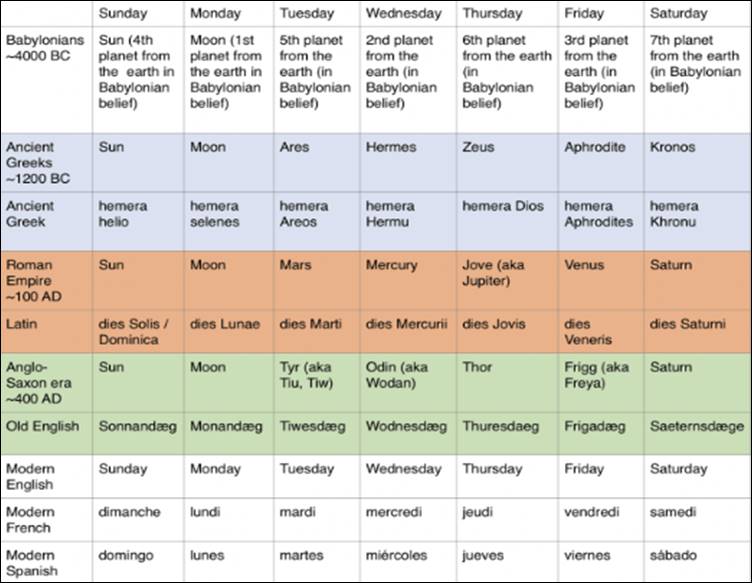
Have you ever wondered how the days of the week got their names? Well it’s a long, old story that started with the ancient Babylonians in the Persian Gulf around 4000 BC.

The Babylonians are responsible for the seven-day week. They named the days after the sun, the moon, and the five planets they could see in the sky.

Around the 12th century BC, the Greeks adopted the seven-day week from the Babylonians. They also named a day after the sun and moon, but they changed the names of the other five days to honor their gods.

Then, around the first century BC, came the Romans. They stuck with the same seven-day week, and they changed the names of the days that honored Greek gods to honor their Roman gods. At first, they also named a day for both the sun and the moon—until Emperor Constantine, a convert to Christianity, decided to change the name of the day of the sun to Dominicus, which means “Lord’s day.”

At the end of the 4th century AD, with the fall of the Roman Empire, Anglo-Saxons had their turn to name the days of the week. They liked the seven-day plan and the idea of naming days named after the sun and moon, but (surprise!) they changed the names of the other five days to honor their gods. And as their language evolved into Old English, the names of the days of the week started to sound a lot like our present-day English words:

Sunday = Sonnandæg

Monday = Monandæg

Tuesday = Tiwesdæg

Wednesday = Wodensdæg

Thursday = Thouresdæg

Friday = Frigadæg

Saturday = Saeternsdæg

So, what we have now, in English, is one day named for the sun, one day named for the moon, and five days named for Norse gods. English is such a glorious hodgepodge!

If you’re interested in seeing how the names changed with each language shift, read Grammar Girl’s article called How Did the Days of the Week Get Their Names? The super cool image below comes from her article and breaks the information down by civilization and language. You’ll notice that French and Spanish days of the week align more closely with the Roman civilization.

Happy Thor’s day!

Donna Bradley Burcher | Senior Technical Editor | Symitar®

8985 Balboa Ave. | San Diego, CA 92123 | Ph. 619.278.0432 | Ext: 765432

About Editor’s Corner

Editor’s Corner keeps your communication skills sharp by providing information on grammar, punctuation, JHA style, and all things English. As editors, we spend our days reading, researching, and revising other people’s writing. We love to spend a few extra minutes to share what we learn with you and keep it fun while we’re doing it.

Did someone forward this email to you? Click here to subscribe.

Don’t want to get Editor’s Corner anymore? Click here to unsubscribe.

Do you have a question or an idea for Editor’s Corner? Send your suggestions or feedback to Kara and <a href="mailto:DBurcher.

NOTICE: This electronic mail message and any files transmitted with it are intended
exclusively for the individual or entity to which it is addressed. The message,
together with any attachment, may contain confidential and/or privileged information.
Any unauthorized review, use, printing, saving, copying, disclosure or distribution
is strictly prohibited. If you have received this message in error, please
immediately advise the sender by reply email and delete all copies.

Posted by: Jack Henry | March 24, 2020

Editor’s Corner: Memes and more

I remember when the word meme started being used more frequently, and my exasperated husband tried to provide me with examples of what people were talking about. I know what a meme is now, but I thought this comparison of notion, meme, and trope was interesting, and I thought I’d share a condensed version with you. The full article is here on Grammarphobia.

Q: Is there a distinction between a meme, a trope, and a notion? This came up during a discussion I had with a couple of English professors. [KC – Mistake number one!] We would appreciate your advice and have agreed to follow it.

A: This is the kind of question that can lead into the great Grimpen Mire. Vogue words—and “meme” is especially hot right now—tend to blur as they’re tossed around indiscriminately.

But these three words do have distinct meanings. Simply put, a “notion” exists in a mental form, like an idea or a desire. A “meme” exists in a more tangible form and is contagious, like a quirky fashion or a video clip that goes viral. Finally, a “trope” exists in a literary form, like a figure of speech or a thematic device.

The definitions in standard dictionaries are fairly straightforward. We’ll use those from Lexico (formerly Oxford Dictionaries Online), along with examples of our own in italics.

  • notion: “A conception of or belief about something.” (That’s not my notion of an inexpensive lunch.) … “An impulse or desire, especially one of a whimsical kind.” (She had a notion to send him flowers.)
  • meme: “An element of a culture or system of behaviour passed from one individual to another by imitation or other non-genetic means.” (Robotic dogs were a cultural meme a few years ago.) … “An image, video, piece of text, etc., typically humorous in nature, that is copied and spread rapidly by Internet users, often with slight variations.” (Who ever thought that a funny cat photo would become a meme?)
  • trope: “A figurative or metaphorical use of a word or expression.” (The author’s favorite trope is hyperbole.) … “A significant or recurrent theme; a motif.” (The play’s references to wills and inheritance serve as a trope.)

As for their etymologies, all these words are derived from Latin or Greek.

“Notion” was a direct borrowing from Latin, according to the Oxford English Dictionary. In classical Latin, nōtiōn- or nōtiō meant “concept, idea, legal or intellectual examination,” the OED says, and in post-classical Latin it also meant “knowledge, understanding.”

Unlike “notion,” the noun “meme” is a modern invention. It was coined by the British evolutionary biologist Richard Dawkins and first appeared in his book The Selfish Gene (1976). He adapted it, the OED says, from the ancient Greek noun μίμημα (mīmēma, something imitated), which comes from the verb μιμεῖσθαι (mīmeisthai, to imitate)….

“Examples of memes are tunes, ideas, catch-phrases, clothes fashions, ways of making pots or of building arches.”

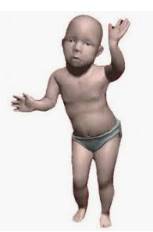
A generation later, “meme” acquired its internet meaning, which was first recorded in the late 1990s. The OED’s earliest example refers to an animation of a dancing baby: “The next thing you know, his friends have forwarded it on and it’s become a net meme.”
Finally we come to “trope,” the oldest of the three words. It was borrowed into Old English from Latin or Greek, apparently forgotten, and then reborrowed in the 16th century. As the OED explains, “trope” was “probably a borrowing from Latin” but “perhaps” came from the earlier Greek.

The Latin tropus (figure of speech) can be traced to the Greek noun τρόπος (tropos, turn, direction, or way), from the verb τρέπειν (trepein, to turn, direct, or change). The etymology makes sense if you think of a “trope” as a turn of phrase.

Today “trope” also has technical meanings in music, astronomy, philosophy, and mathematics. But it’s still used in many disciplines…to mean figurative or metaphorical language.

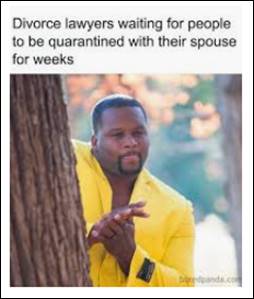
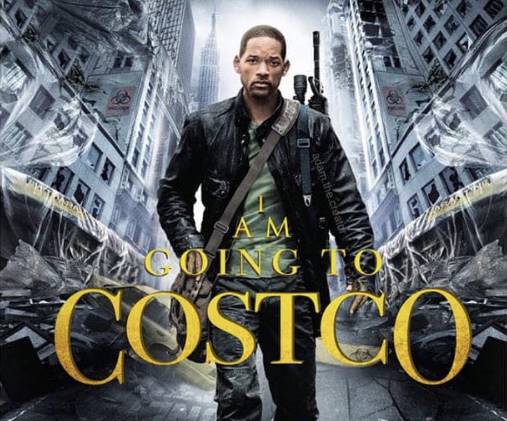
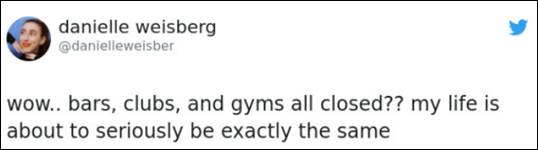
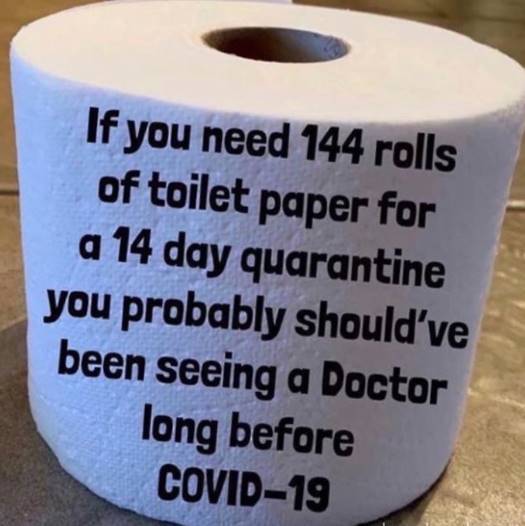
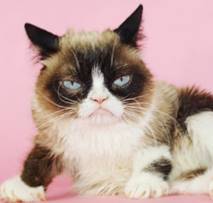
Other famous memes:
Kara Church

Technical Editor, Advisory

Symitar Documentation Services

« Newer Posts - Older Posts »

Categories