Posted by: Jack Henry | July 28, 2020

Editor’s Corner: Butter my what?

Dear Editrix,

I saw some movie and an older guy said “dagnabbit”. So, I was like, “Dagnabbit, where did that come from?” Sounds like a job for Super K, otherwise known as my friend Kara. Here are some other words I found like dagnabbit: blimey, butter my butt and call me a biscuit, Gordon Bennett, strike me pink, and tarnation.

Javier

My friend, Javier,

These look like examples of interjections—abrupt remarks, like an interruption or exclamation. I’d say as far as your list, they might also be used as more polite versions of some cursing that people do. In the case of dagnabbit, the dictionary describes it as a mixed-up alternative to a curse word with the same number of syllables and beginning with the word “god.” (I don’t want to offend, so those are all of the hints you’re going to get.) It reminds me of my grandma, who would say things like, “For the love of Pete,” or “For Pete’s sake,” instead of blaspheming.

Let’s check out some of the other words you mentioned. These definitions are all from Wiktionary.

  • Blimey: British
    A minced oath from [God] blind me, concurrent with or from an abbreviation of gorblimey. [KC –
    Gorblimey is from the Cockney pronunciation of God blind me.]
  • “Butter my butt and call me a biscuit”: Southern United States
    An expression of astonishment upon learning something unbelievable (usually positive).
  • Gordon Bennett: British
    An expression of surprise, contempt, outrage, disgust, or frustration.

From James Gordon Bennett, Jr., a New York newspaper proprietor and playboy during the late nineteenth and early twentieth centuries who became widely known for his extravagant lifestyle and shocking behaviour. The Oxford English Dictionary places the phrase in the 1890s as an alliteration of gorblimey and again to James Gordon Bennett Jr.

  • Strike me pink:
    (dated) Used to express astonishment or indignation.
  • Tarnation: U.S.

From darnation, influenced by tarnal (from eternal). [KC – And darn/darnation are euphemisms for damn/damnation.]

Used to express anger, irritation, disappointment, annoyance, contempt, etc.

Okay, we’ll that’s about all I can cover today without getting into some serious trouble with HR!

Kara Church

Pronouns: she/her/hers

Technical Editor, Advisory

Editor’s Corner Archives: https://episystechpubs.com/

Posted by: Jack Henry | July 23, 2020

Editor’s Corner: Neologisms

Good morning and happy Thursday! My friend Ron F. sent me a fun article about neologisms. My first question was, “What’s a neologism?” Well, I know that the prefix “neo” is Greek for “new” and “logos” is Greek for “speech or utterance.” Merriam-Webster defines neologism this way: “a new word, usage, or expression.”

The Washington Post has a neologism contest every year that concentrates on new usage. They ask readers to supply new meanings for existing words. 2019’s winners are pretty funny. I’ve copied and pasted the winners that were fit to share below. I hope they give you a chuckle.

The winners are:

  • Coffee (n.), the person upon whom one coughs.
  • Flabbergasted (adj.), appalled over how much weight you have gained.
  • Abdicate (v.), to give up all hope of ever having a flat stomach.
  • Esplanade (v.), to attempt an explanation while drunk.
  • Negligent (adj.), describes a condition in which you absentmindedly answer the door in your nightgown.
  • Lymph (v.), to walk with a lisp.
  • Gargoyle (n.), olive-flavored mouthwash.
  • Flatulence (n.), emergency vehicle that picks you up after you are run over by a steamroller.
  • Balderdash (n.), a rapidly receding hairline.
  • Rectitude (n.), the formal, dignified bearing adopted by proctologists.
  • Pokemon (n.), a Rastafarian proctologist.
  • Oyster (n.), a person who sprinkles his conversation with Yiddishisms.
  • Frisbeetarianism (n.), (back by popular demand), the belief that, when you die, your soul flies up onto the roof and gets stuck there.

The Washington Post’s Style Invitational also asked readers to take any word from the dictionary, alter it by adding, subtracting, or changing one letter, and supply a new definition.

The winners are:

  • Bozone (n.): The substance surrounding stupid people that stops bright ideas from penetrating. The bozone layer, unfortunately, shows little sign of breaking down in the near future.
  • Cashtration (n.): The act of buying a house, which renders the subject financially impotent for an indefinite period.
  • Sarchasm (n): The gulf between the author of sarcastic wit and the person who doesn’t get it.
  • Inoculatte (v): To take coffee intravenously when you are running late.
  • Osteopornosis (n): A degenerate disease.
  • Karmageddon (n): It’s like, when everybody is sending off all these really bad vibes, right? And then, like, the Earth explodes and it’s like, a serious bummer.
  • Glibido (v): All talk and no action.
  • Arachnoleptic fit (n.): The frantic dance performed just after you’ve accidentally walked through a spider web.
  • Caterpallor (n.): The color you turn after finding half a grub in the fruit you’re eating.

I hope the rest of your day is happy.

Donna Bradley Burcher | Senior Technical Editor | Symitar®

8985 Balboa Ave. | San Diego, CA 92123 | Ph. 619.278.0432 | Ext: 765432

About Editor’s Corner

Editor’s Corner keeps your communication skills sharp by providing information on grammar, punctuation, JHA style, and all things English. As editors, we spend our days reading, researching, and revising other people’s writing. We love to spend a few extra minutes to share what we learn with you and keep it fun while we’re doing it.

Did someone forward this email to you? Click here to subscribe.

Don’t want to get Editor’s Corner anymore? Click here to unsubscribe.

Do you have a question or an idea for Editor’s Corner? Send your suggestions or feedback to Kara and <a href="mailto:DBurcher.

NOTICE: This electronic mail message and any files transmitted with it are intended
exclusively for the individual or entity to which it is addressed. The message,
together with any attachment, may contain confidential and/or privileged information.
Any unauthorized review, use, printing, saving, copying, disclosure or distribution
is strictly prohibited. If you have received this message in error, please
immediately advise the sender by reply email and delete all copies.

Posted by: Jack Henry | July 21, 2020

Editor’s Corner: Myself

Hello, folks! Today I want to talk a little bit about myself. Not actually me, but the word myself. One of our coworkers is tired of people using the word at the wrong time and asked for one of the editors to cover it in Editor’s Corner, without a lot of mind-numbing grammar.

The main problem is that people seem to get confused about when to say me vs. myself. When in doubt, people like to opt for the longer word because it sounds fancier or more educated. But when you use it incorrectly, it has the opposite effect, and our coworker (who shall remain nameless) cringes and texts me to say, “It happened again.”

Here it is in a nutshell: The only time you should use myself is when you are referring back to the pronoun I. The only time you use yourself is when referring back to the pronoun you. And the same goes with himself, herself, and themselves, which refer to him, her, and they/them, respectively. Uh-oh. Mind numbing? Let’s see examples of what works and what is correct:

  • I made dinner and set the table myself.
  • She thinks of herself as a true intellectual.
  • You might think you learned a lesson, but you are fooling yourself.
  • The fire fighters exercise at the park to keep themselves in shape.
  • When I look at myself in the mirror, I wonder if the acne will go away when I retire.
  • He found himself staring at the ravioli, as if he hadn’t eaten for a week.

Now here is what you don’t say:

  • Give the cupcakes to Rick and myself.
  • Jason and myself are going to play bocce ball this weekend.

As you can see, those last two examples aren’t referring to I anywhere in the sentence, so they should not include myself. Here are some more examples of what works, what doesn’t, and a little secret that can help you remember when to use me instead of myself.

Correct:

Give the cupcakes to Rick and me.

Incorrect:

Give the cupcakes to Rick and I.

Give the cupcakes to Rick and myself.

Reread those sentences. This time, get rid of Rick! When you take him away, you are left with these results:

Correct:

Give the cupcakes to me.

Incorrect:

Give the cupcakes to I.

Give the cupcakes to myself. (Remember you need to be referring back to I here to use myself. There’s no Rick, there’s no I. Don’t do it!)

Next time you think of using myself, yourself, or another “self” pronoun, make sure it is referring to the correct subject (I, you, etc.) earlier in the sentence. If you find yourself saying something like, “Give the report to Joe or myself,” stop, recognize it is incorrect, and correct yourself before you wreck yourself: “Give the report to Joe or me.” It’s okay. Better to recognize your mistake and correct it than earn the wrath of your coworker (who shall still remain nameless).

For past lessons and the grammar, see these articles:

https://episystechpubs.com/2012/08/15/editors-corner-me-myself-and-i/

https://episystechpubs.com/2013/04/15/editors-corner-rule-4-the-return-of-me-myself-and-i/

Kara Church

Pronouns: she/her/hers

Technical Editor, Advisory

Editor’s Corner Archives: https://episystechpubs.com/

Posted by: Jack Henry | July 16, 2020

Editor’s Corner: Commas, cont.

Hello folks. I apologize for a missing comma and a missing “the” in my last Editor’s Corner. It’s summertime and I think my brain was at the beach.

Today, I have the comma rules sequel for you! Get comfortable, grab some tea, pretend there is a stirring concerto playing in the background, and join me for rules five through eight.

Rule 5

Use commas to separate two or more coordinate adjectives that describe the same noun.

Okay. What the heck am I talking about? Uncoordinated? No, that’s me, not the adjectives. Here is a little bit of information on coordinate and non-coordinate adjectives:

You can decide if two adjectives in a row are coordinate by asking the following questions:

  • Does the sentence make sense if the adjectives are written in reverse order?
  • Does the sentence make sense if the adjectives are written with “and” between them?

If you answer yes to these questions, then the adjectives are coordinate and should be separated by a comma.

Examples:

  • Joy was a clever, intelligent woman. (coordinate)
  • Lanie has a giant bread box. (non-coordinate)
  • I have two navy wool suits. (non-coordinate)
  • The street was lined with large, green Sycamore trees and red, white, and blue flags. (coordinate)

Rule 6

Use a comma near the end of a sentence to separate contrasted coordinate elements or to indicate a distinct pause or shift.

Oh, for the love of Pete! Too much coordination required! Now it is contrasted coordinate elements. What am I talking about? Have a look:

Examples:

  • He was merely ignorant, not stupid.
  • The hippopotamus seemed very reflective, almost human.
  • You and Maurice are close friends, aren’t you?

Rule 7

Use commas to set off all geographical names, the day and year in dates, addresses (except the street number and name), and titles in names.

Examples:

  • Birmingham, Alabama, gets its name from Birmingham, England.
  • My uncle lives at 234 Handyman Lane, Peoria, Illinois.
  • December 22, 1979 was a momentous day in his life.
  • Bono B. McDonald, MD, will be the principal speaker.

Note: When you use just the month and the year, no comma is necessary after the month or year: "The highest temperature in Springfield, Missouri, was 108° F, July 1986.”

Rule 8

Use commas wherever necessary to prevent possible confusion or misreading.

Example:

To Trevor, Noah was a generous man.

Commas are important!

Kara Church

Pronouns: she/her/hers

Technical Editor, Advisory

Editor’s Corner Archives: https://episystechpubs.com/

Posted by: Jack Henry | July 14, 2020

Editor’s Corner: Comma Refresher

Say hello to my little friend! No, not Al Pacino’s “little friend” in Scarface—my little friend, the comma! There are so many rules for this little piece of punctuation, I think it helps to review them now and then. Today we’ll look at half of my handy list and some examples. There are quite a few specific rules, but the following will give you a good starting point.

Rule 1

Use commas to separate independent clauses when joined by one of these seven conjunctions:

and, but, for, or nor, so, yet.

Examples:

  • Today is a beautiful day, so I am going for a swim.
  • I used conditioner on my hair, yet it is still tangled.

Rule 2

Use commas after introductory a) clauses, b) phrases, or c) words that come before the main clause. Common starter words for introductory clauses that should be followed by a comma include the following:

  • after
  • although
  • as
  • because
  • if
  • since
  • when
  • while

Examples:

  • When I see puppies, it fills my heart with glee.
  • I fell in love with him, because he sang me Green Day songs.

Rule 3
Use a pair of commas in the middle of a sentence to set off clauses, phrases, and words that are not essential to the meaning of the sentence. Use one comma before to indicate the beginning of the pause and one at the end to indicate the end of the pause. (You may remember a discussion about using parentheses and em dashes in a similar way. Just remember, this use is for nonessential information.)

Examples:

  • Clause: This Saturday, which happens to be the Fourth of July, is the day new car arrives at the dealership.
  • Phrase: There are a lot of rich people at this party. The donations, on the other hand, don’t reflect that at all.
  • Word: Joanne’s cooking is beautiful. In this case, however, it looks like it came out of a can.

Rule 4

Use commas to separate three or more words in a series. Yes, this is the serial comma that some of you resist, but this rule is in our JHA Style Guide and in the Chicago Manual of Style. Learn to love it! Embrace it! If you haven’t met it, I’d like to introduce you to your new little friend!

Example:

  • We love to serve fruit salad with cantaloupe, strawberries, watermelon, and grapes.
  • Caleb, Vinay, and Piper are coming to help us move.

Note: The serial comma is the comma after the second-to-last term and before the conjunction. In the phrase “parameters, fields, and privileges,” the serial comma is the comma after fields.

Al Pacino as Tony Montana, with his “little friend” the Colt AR-15 assault rifle.

Kara Church

Pronouns: she/her/hers

Technical Editor, Advisory

Editor’s Corner Archives: https://episystechpubs.com/

Posted by: Jack Henry | July 9, 2020

Editor’s Corner: On the Importance of Word Choice

Good morning, everyone! Today’s subject is the importance of word choice. If you’re ready, let’s dive right in.

Good writing is about choosing the best words and organizing them in the most efficient way to make a clear point. As business and technical writers who want to provide easy-to-access information, we should always use the most common word (for instance, everywhere instead of ubiquitous). And we should choose words with a neutral connotation.

You probably won’t be surprised to learn that we editors try to reduce the usage of words that have a violent connotation: words like kill and execute (as in “you will need to kill the process” and “you must execute the command”). Yes, we do realize that these terms are common, and we cannot always change them, but we ask you to be aware, and when possible, to use neutral words like stop and run, respectively.

We also try to replace words that have an undesirable connotation, like impacted (as in “the member was impacted”—I think you can see the problem there). We almost always replace impact and impacted with affect and affected. According to our friend Grammar Girl, “Although impact has taken root in the business world as a verb, as in ‘Cutting prices will impact our revenue,’ many people maintain that impact is only proper as a noun. They believe the verb impact only means to hit, and any other use is just irritating jargon.”

Which brings me to my final point today and that is that you should always choose common terms over jargon. Not only does every industry have its own jargon (we have plenty in the financial industry) but every department in every company has its own jargon. Jargon is OK to use when communicating with the people in your small group, but it can be difficult for all the people outside your group (or for newcomers) to understand—so you should avoid it in your writing.

If you need more motivation to stop using jargon and ten-dollar words, think of me in front of my keyboard, crying, as I try to figure out what you mean.

Donna Bradley Burcher | Senior Technical Editor | Symitar®

8985 Balboa Ave. | San Diego, CA 92123 | Ph. 619.278.0432 | Ext: 765432

About Editor’s Corner

Editor’s Corner keeps your communication skills sharp by providing information on grammar, punctuation, JHA style, and all things English. As editors, we spend our days reading, researching, and revising other people’s writing. We love to spend a few extra minutes to share what we learn with you and keep it fun while we’re doing it.

Did someone forward this email to you? Click here to subscribe.

Don’t want to get Editor’s Corner anymore? Click here to unsubscribe.

Do you have a question or an idea for Editor’s Corner? Send your suggestions or feedback to Kara and <a href="mailto:DBurcher.

NOTICE: This electronic mail message and any files transmitted with it are intended
exclusively for the individual or entity to which it is addressed. The message,
together with any attachment, may contain confidential and/or privileged information.
Any unauthorized review, use, printing, saving, copying, disclosure or distribution
is strictly prohibited. If you have received this message in error, please
immediately advise the sender by reply email and delete all copies.

Posted by: Jack Henry | July 7, 2020

Editor’s Corner: Late

Dear Editrix,

My friend was recently telling a story about her deceased husband and used the phrase “my late husband.” This is one I have heard often (e.g., my late parents, my late brother) and one I use regularly in my professional work. Do you know where it came from and why it is phrased as such?

Brittany

Hi Brittany,

I have wondered the same about using late in this way. I mean, the dead aren’t ever going to be late to tea again, are they? Let’s see where this euphemism comes from.

The Grammarphobia web site provides a very lengthy description with a lot of old English in it, so I’m going to cut and paste just the best bits of it for you.

…The sense you’re asking about (“designating a person recently deceased”) showed up in the early 15th century, according to the OED. The first known example in writing is from a petition dated sometime before 1422: “Elizabeth, ye Wyfe of ye seid late Erle.”

Here’s an adverbial example, from a 1435 will, that hints at the adjectival usage: “Thys is the will o Isabell Dove, lat [that is, “formerly”] the wyf of Thomas Dove”….

In the radio show “A Way with Words,” one of the hosts, Grant Barrett, provides this guidance, including how long you can use “late” to referred to someone who is dead.

Late Meaning Deceased

When is it appropriate to use the word late to describe someone who has died? Late, in this sense, is short for lately deceased. There’s no hard and fast time frame, although it’s been suggested that anywhere from five to 30 years is about right. It’s best to use the word in cases where it may not be clear whether the person is still alive, or when it appears in a historical context, such as “The Civil Rights Act was passed in 1964 in honor of the late John F. Kennedy.”

I hope that helps!

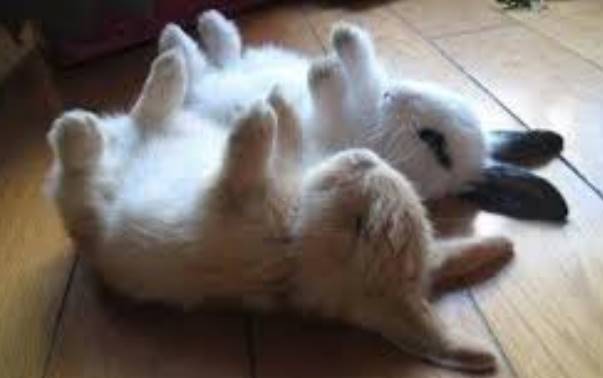
And I just found out that it isn’t just ‘possums and dogs that play dead. Bunnies can play dead, too!

ASPCA Alert: No animals were actually harmed during the writing of this Editor’s Corner.

Kara Church

Pronouns: she/her/hers

Technical Editor, Advisory

Editor’s Corner Archives: https://episystechpubs.com/

Posted by: Jack Henry | July 2, 2020

Editor’s Corner: It’s been a minute!

Good morning and happy summer!

One of you recently asked me about the phrase “It’s been a minute.” No, we’re not talking about the 60-second minute on your clock, but the idiomatic phrase, which basically means “It’s been a long time,” or “It’s been a while.”

The first time I heard this, I was at the old coffee cart, and someone I hadn’t seen for a few months said, “Hey, Kara! It’s been a minute!” I was caught off guard, because I hadn’t heard this phrase before, but judging by the use and circumstance, I figured it out. Since then, I’ve heard it a lot, and it’s always from someone who hasn’t seen another person, or gone to a place, or done something…in a long time.

When I tried to find out where this phrase came from, I found song lyrics and sites I couldn’t visit because they are in the JHA “no-fly zone,” so I really don’t know exactly where it came from. I know it’s the name of Sam Sanders’s radio show on NPR, and Google tells us its “young and cool.” But the origin escapes me.

I found several references to a hot minute and a red-hot minute, which used to mean a very short time. The phrase hot minute is in text all the way back to 1847, but until the 1990s it meant fast. On English Stack Exchange, which I don’t always trust, they say that it changed to meaning “a long time” with The Red Hot Chili Peppers’ song “One Hot Minute.”

Then there’s also a New York minute, which used to mean fast and still means fast. According to the Grammarist:

In a New York minute means right away, immediately, quickly and without hesitation. As you may suppose, in a New York minute is an American idiom, but it did not originate in New York City. Rather, the expression in a New York minute is a reflection of how people in other parts of the United States view New York. Compared to many areas of the country, New York City life is extremely fast paced.

The term in a New York minute was first recorded in the mid-twentieth century in Piney Woods, Texas, though exactly where in the Southern United States this phrase originated is unknown.

Johnny Carson, a popular American entertainer of the 1980s described a New York minute as “the time it takes for the light in front of you to turn green and the guy behind you to honk his horn.”

These observations of life in New York City are for the most part good-natured, and perhaps even carry a note of admiration.

I don’t know about admiration, but I do know that I’m not asking any of the young, cool kids what time it is! A happy and safe holiday to everyone!

Kara Church

Pronouns: she/her/hers

Technical Editor, Advisory

Editor’s Corner Archives: https://episystechpubs.com/

Posted by: Jack Henry | June 30, 2020

Editor’s Corner: Feeling Peevish

Good morning, folks!

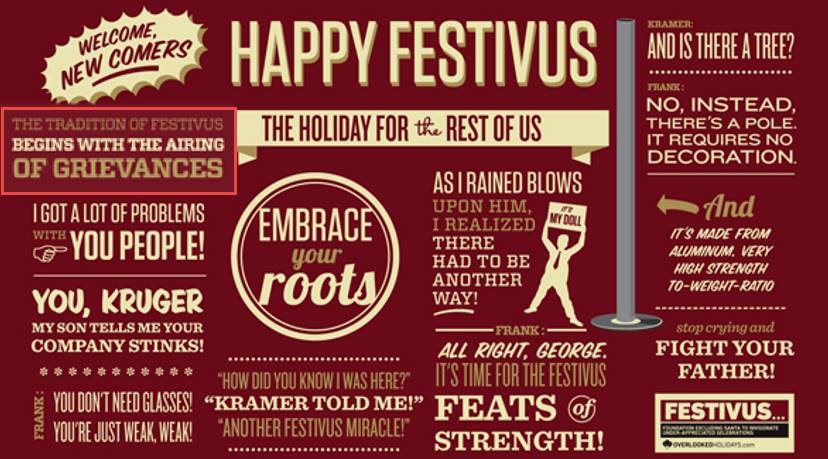
Generally, I like to share lessons, new words, English information, and a wee bit of fun with you. Today, however, I’m feeling a little sad and a little grumpy, so I’m going to air some grievances, even though we are months too early for Festivus (infographic below).

You may be familiar with some of this information, because we’ve mentioned these items in past Editor’s Corner articles. Without further ado, here are some of our peeves.

When you are writing about a topic, here at JHA we ask that you do not ever use the wishy-washy (s) in parentheses. What do I mean? I mean that you need to be confident in your writing!

Incorrect: When I talked to Daisy, she said she would bring the game(s) and the snack(s).

Correct: When I talked to Daisy, she said she would bring the games and the snacks.

It’s the message that is important; don’t use feeble parentheses around the “s” and try to guess what might happen. Be bold. (Really, when did Daisy ever let you down?) For more, see this Editor’s Corner article.

Next is the ellipsis (plural: ellipses). This is punctuation that looks like three periods (…) but it is its own being. Ellipses are used, primarily, to indicate missing content. You do not need to add spaces before or after ellipses.

Incorrect: He told me to wait … he had a secret to tell me.

Correct: He told me to wait…he had a secret for me.

To see more on ellipses and meet Mrs. Wiggles, check out this quick article here.

And a little more about spaces. Don’t go crazy with them! Okay, we’ve done what we can to convince you to use only one space after a period, but it seems that some people decided that they needed to add those spaces before and after en dashes in number ranges and before and after slashes.

Incorrect: J told me that he planned to eat 10 hotdogs during the competition hours (6 p.m. – 7 p.m.).

Correct: J told me that he planned to eat 10 hotdogs during the competition hours (6 p.m.–7 p.m.).

For a lesson on hyphens and dashes, click here.

Incorrect: Bruno said he needs $1200 / month for rent.

Correct: Bruno said he needs $1200/month for rent.

We’ve been writing about this for years. For one of my favorite articles on slashes see Jackie Solano’s Nifty Nuggets article here.

Thank you for your attention! If you are one of those people who relates to these habits, I recommend that you look at the links and take them to heart. The editors will appreciate you thoroughly for it!

Kara Church

Pronouns: she/her/hers

Technical Editor, Advisory

Editor’s Corner Archives: https://episystechpubs.com/

Posted by: Jack Henry | June 25, 2020

Editor’s Corner: Bang, Bang, Interrobang!

Good morning, gang!

Not long ago, I shared information about the 14 English Punctuation Marks. I received a few responses that led me down an interesting rabbit hole.

Thanks to Phil R.’s response, I found out that there are a multitude of names for the exclamation point. Phil told me that UNIX programmers use the nickname bang. I’ve heard people use this term before, and I like it. Not only is it shorter, but it just feels right since this piece of punctuation indicates strong feelings or shouting.

I did a little research and found that there are quite a few other nicknames for the exclamation point. According to Wikipedia, printers use screamer, gasper, slammer, and startler. Hackers use bang and shriek. The Brits often use pling.

And then Jane G. wondered why the very cool interrobang (a combination of the question mark and exclamation point)wasn’t included in the list of English punctuation marks. And call me silly, but for the first time I thought about why it’s called interrobang: interro is short for interrogation point, another term for question mark, and bang as I just mentioned is a nickname for exclamation point.

Some typefaces superimpose the question mark and exclamation point, like this:But it’s very common to use the two marks next to each other like this: ?! or !?. It doesn’t matter which order you use.

And although we do use interrobangs in our more informal writing, it is still considered unconventional or nonstandard. So, you’re not going to see it in Episys eDocs,but you might see it in marketing material, and you can certainly use it in your casual text messages, tweets, IMs, emails, letters to Aunt Ola, and holiday cards.

You want some examples of common use of the interrobang? Of course you do!

  • You don’t like chocolate?!
  • What the heck are you talking about!?
  • You call that dancing, Donna?!

Enjoy another lovely day in paradise.

Donna Bradley Burcher | Senior Technical Editor | Symitar®

8985 Balboa Ave. | San Diego, CA 92123 | Ph. 619.278.0432 | Ext: 765432

About Editor’s Corner

Editor’s Corner keeps your communication skills sharp by providing information on grammar, punctuation, JHA style, and all things English. As editors, we spend our days reading, researching, and revising other people’s writing. We love to spend a few extra minutes to share what we learn with you and keep it fun while we’re doing it.

Did someone forward this email to you? Click here to subscribe.

Don’t want to get Editor’s Corner anymore? Click here to unsubscribe.

Do you have a question or an idea for Editor’s Corner? Send your suggestions or feedback to Kara and <a href="mailto:DBurcher.

NOTICE: This electronic mail message and any files transmitted with it are intended
exclusively for the individual or entity to which it is addressed. The message,
together with any attachment, may contain confidential and/or privileged information.
Any unauthorized review, use, printing, saving, copying, disclosure or distribution
is strictly prohibited. If you have received this message in error, please
immediately advise the sender by reply email and delete all copies.

« Newer Posts - Older Posts »

Categories