Posted by: Jack Henry | October 28, 2021

Editor’s Corner: Commonly Misused Idioms

Idioms are so useful and so good at getting a point across, but they are also often misused. Someone told me the other day that I should “nip it in the butt.” I laughed, but I can see why the person got it wrong. While the actual idiom is “nip it in the bud,” it makes sense either way.

Let’s start with a definition of idiom from Wikipedia: “An idiom is a common phrase which means something different from its literal meaning but can be understood because of popular use…Idioms are made of normal words that have a special meaning known to almost everyone.”

Like the mondegreens Kara sometimes shares (remember mondegreens are misheard song lyrics), misused idioms can be funny, but they can also be embarrassing to people who use them incorrectly—when either speaking or writing. So, to make sure you’re not embarrassed by using an incorrect idiom, I thought I’d share some of the most common ones. I gathered this partial list from a few different online resources.

Incorrect Correct
A blessing in the skies A blessing in disguise
Bare with me Bear with me [dbb – Bare means naked. Oops.]
Chomping at the bit Champing at the bit [dbb – Champing is what a horse does to the bit in its mouth.]
Complete 360-degree change Complete 180-degree change
Could care less Couldn’t care less
Deep seeded Deep seated
Do diligence Due diligence
Doggy dog world Dog eat dog world
Escaped goat Scape goat
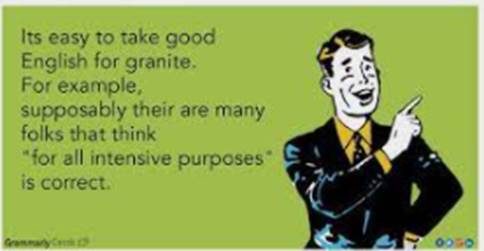
For all intensive purposes For all intents and purposes
Getting off scotch free Getting off scot free [dbb – A scot is a tax payment.]
Hunger pains Hunger pangs [dbb – Pangs are brief and piercing.]
Jive with Jibe with [dbb – Jibe means agree.]
Peak my interest Pique my interest
Piece of mind Peace of mind
Pour over Pore over [dbb – Pore means to examine closely.]
Slight of hand Sleight of hand [dbb – Sleight means cunning.]
Statue of limitations Statute of limitations
Tow the line Toe the line [dbb – You put your toe on the starting line.]
Wet your appetite Whet your appetite [dbb – Whet
means to make keen or more acute.]

Have I piqued your interest? If you want to see more, check out this list of (mostly) different misused idioms I shared a few years back: 12 Idioms You Might be Getting Wrong.
Donna Bradley Burcher |Technical Editor, Advisory | Symitar®

8985 Balboa Ave. | San Diego, CA 92123 | Ph. 619.278.0432 | Ext: 765432

Pronouns she/her/hers

About Editor’s Corner

Editor’s Corner keeps your communication skills sharp by providing information on grammar, punctuation, JHA style, and all things English. As editors, we spend our days reading, researching, and revising other people’s writing. We love to spend a few extra minutes to share what we learn with you and keep it fun while we’re doing it.

Did someone forward this email to you? Click here to subscribe.

Don’t want to get Editor’s Corner anymore? Click here to unsubscribe.

Do you have a question or an idea for Editor’s Corner? Send your suggestions or feedback to Kara and <a href="mailto:DBurcher.

NOTICE: This electronic mail message and any files transmitted with it are intended
exclusively for the individual or entity to which it is addressed. The message,
together with any attachment, may contain confidential and/or privileged information.
Any unauthorized review, use, printing, saving, copying, disclosure or distribution
is strictly prohibited. If you have received this message in error, please
immediately advise the sender by reply email and delete all copies.

Posted by: Jack Henry | October 26, 2021

Editor’s Corner: Colors around the world

Good morning, folks!

I recently received an article from Daily Writing Tips about colors and their meanings. I know back in January I talked about “fancy colors,” and in years past I have probably written half a dozen other articles on color, but there is always something new. The Daily Writing Tips article mentioned colors in several literary works, but I noticed they were all Western classics, and the examples were all from English-speaking countries. I did some extra research and found a blog called What Colors Mean in Other Cultures.

Suddenly, I found myself with enough information to start putting a term paper together. But this is supposed to be interesting and fun, not tedious! This is the quote from Daily Writing Tips that piqued my interest:

In Gone with the Wind by Margaret Mitchell, our first view of Scarlett O’Hara (her very name conjures up the image of a dangerous woman) emphasizes her green eyes. Because colors can have more than one type of connotation, green in the description of Scarlett has nothing to do with plants. Negative associations with green include envy and deviousness.

“The green eyes in the carefully sweet face were turbulent, willful, lusty with life, distinctly at variance with her decorous demeanor.”

I’m sure many of you have read Gone with the Wind and seen the movie. This description captures so much about Scarlett’s look, personality, and being. The use of colors in descriptions can set a mood. Inspired by the two references on color mentioned above, I would like to delve deeper into the ways different cultures feel about colors. Let’s start this series with the color red.

For those of you who are fully or partially colorblind, I hope you will still find value in this information.

Western Details (from Daily Writing Tips)

Red
Positive: excitement, passion, life
Negative: danger, guilt
Idioms: red light (warning to stop); red flag (a sign of danger); red-handed (in the act); red in the face (embarrassed)

Other Cultures’ Details (from What Colors Mean in Other Cultures)

Red is the most powerful of all colors in Indian culture and holds many important meanings. Among them are fear and fire, wealth and power, purity, fertility, seduction, love, and beauty. Red is also representative of a certain time and place in one’s personal life, including when a woman gets married. A married woman can be identified by the red henna on her hands and the red powder, known as sindoor, worn along her hairline.

In South Africa, red is associated with mourning, and the section of red in the country’s flag symbolizes violence and sacrifices that were made during the struggle for independence.

In Thai tradition, each day of the week is assigned a specific color and is linked with a particular God. Red is the color for Sundays, and it’s associated with Surya, a solar God, who was born on this day. Many Thai people pay their respects to Surya by wearing red on his birthday each year.

In Chinese culture, red is traditionally worn on the New Year, as well as during funerals and weddings. It represents celebration and is meant to bring luck, prosperity, happiness, and a long life to the people.

Next time we’ll have a look at the two other primary colors: yellow and blue.

Kara Church

Pronouns: she/her

Technical Editor, Advisory

Editor’s Corner Archives: https://episystechpubs.com/

Posted by: Jack Henry | October 21, 2021

Editor’s Corner: Sins and Sinisterity

One of you wonderful people introduced Donna and me to a daily email called “A.Word.A.Day with Anu Garg.” One of the recent words, sinisterity, made me very curious because of my Catholic upbringing and my left-handed brother. I don’t know if the church still teaches that left-handedness and the left side are evil, but the definition of sinisterity led me down that rabbit hole I often end up in.

To prevent the rest of you from getting too dirty, I created this table. Information from the emails and my favorite etymology site: Online Etymology Dictionary.

Word Definition Etymology
sinisterity 1. Left-handedness.
2. Skillfulness in the use of the left hand.
3. Awkwardness or clumsiness.
4. Evilness, unluckiness, etc.
From Latin sinister (left, left hand, unlucky). Earliest documented use: 1623. Some related words are ambisinistrous/ambisinister (clumsy with both hands) and dexterous.
dexterity skill in performing tasks, especially with the hands. 1520s, "manual skill, skill in using the hands; physical adroitness in general," from French dexterité (16c.), from Latin dexteritatem (nominative dexteritas) "readiness, skillfulness, prosperity," from dexter "skillful," also "right (hand),"
dexterous 1. Skillful or adroit, mentally or bodily.

2. Right-handed.

From Latin dexter (right-hand, skillful).
ambidextrous 1.Able to use both hands equally.
2. Unusually skillful

3. characterized by duplicity; double-dealing

Medieval Latin ambidexter, literally "right-handed on both sides," from ambi- "both, on both sides" (see ambi-) + dexter "right-handed" (from PIE root *deks- "right; south"). An earlier English use of ambidexter (adj.) meant "double-dealer, one who takes both sides in a conflict" (late 14c.).
ambisinistrous, ambisinister, ambilevous Clumsy with both hands. Modeled after ambidextrous (able to use both hands with equal ease), from Latin ambi– (both) + sinister (left). Earliest documented use: 1863.

Ambilevous: from Latin laevus (left). A similar expression is “to have two left feet” (to be clumsy, especially while dancing).

And back to Catholicism for a minute. From the 1920s all the way through the 1970s, Catholic schools still taught that “left” was evil. My grandfather and brother were both forced to write with their right hands, even though they were already identified as “lefties.” The result for both? Ambidexterity. Grandpa could even write at the same time with both hands.

Kara Church

Pronouns: she/her

Technical Editor, Advisory

Editor’s Corner Archives: https://episystechpubs.com/

As neighborhood Halloween decorations go up, I’ve been wondering what kind of tricks and treats to provide you this year. One of our coworkers, Alan, was kind enough to send this article, Why We Knock on Wood, and the Origins of 7 Other SuperstitionsHere are two of my favorites, but the others are available online. Thank you, Alan!

Spilling Salt

Salt is essential to human life and was once an extremely valuable commodity, so much so that the word “salary” derives from it. The crystalline mineral was used in ancient Jewish, Greek, and Roman sacrifices, and it was the primary means of preserving food before refrigeration came along. Over the years, salt became associated with purity, incorruptibility, and sanctity—good for both staving off rot and evil spirits. It stood to reason, then, that spilling salt was bad for both the budget and soul.

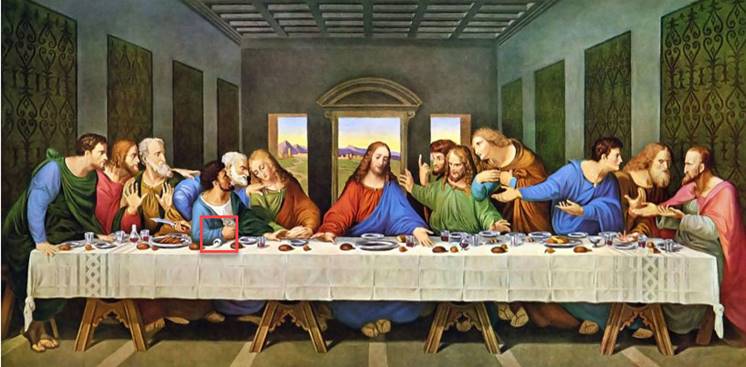
During the Renaissance, Leonardo da Vinci strengthened the association between spilled salt and misfortune by depicting Judas with a saltcellar knocked over next to him in his painting “The Last Supper.” [KC – See Judas below, spilled salt next to him; red square mine, not Leonardo’s.]

At some point, a belief arose that taking a pinch of salt with the right hand and throwing it over the left shoulder would counteract any bad luck caused by spilling the stuff. The idea comes from an imagined link between the left side and the devil—as well as the idea that Satan just can’t stand salt. [KC – Who knew?]

Friday the 13th

This superstition marries ideas about both Friday and the number 13 to create what is supposedly the unluckiest day of the calendar. The aura of doom around the number 13 may go back to early civilizations who based their numerical systems on the number 12. (That’s how we got 12-month calendars and days divided into 12-hour segments, for one thing.) Because it came right after 12, 13 was seen as a problematic or strange leftover.

Odd as it may seem, the association is reinforced by two stories of ancient dinner parties. In Norse mythology, evil was introduced into the world when the trickster god Loki showed up as the 13th guest at a dinner in Valhalla. Judas Iscariot, who betrayed Jesus, was also the 13th guest to arrive at the Last Supper. That led to a belief, starting around the 17th century, that it was unlucky to have 13 guests at a table. Incidentally (or not), it was also imagined that witches’ covens usually numbered 13.

Friday, meanwhile, was the day Jesus was crucified. By tradition, it was also thought to be the day Eve gave Adam the apple and they were cast out of the Garden of Eden. In Britain, Friday was also Hangman’s Day, when those condemned to die met their fate. Somehow, over the centuries, these ideas combined to give Friday a bad rep…

Yet it was only the Victorians who combined the ideas around Friday and the number 13 to create the idea of Friday the 13th as being uniquely unlucky. Of course, these days the American horror film franchise may have reinforced the idea.

Knock on wood, I wish the best of luck to you on Halloween!

Kara Church

Pronouns: she/her

Technical Editor, Advisory

Editor’s Corner Archives: https://episystechpubs.com/

Posted by: Jack Henry | October 14, 2021

Editor’s Corner: Let’s Call It a Driving License

Not long ago, in an article I wrote about apostrophes and possessive words, I discussed “driver license” vs. “driver’s license.” I said then that the correct term is “driver’s license.” Quite a few of you checked your licenses and promptly let me know that “Driver License” is written, as clear as day, right at the top of your license.

Here’s the not so funny part—my California license is called a “Driver License.” How did I never notice that? (It could be because the photo is so bad, that I don’t notice anything else.) You won’t be surprised to know that the states are not consistent about what they call this license.

I did some more digging to find out why some states don’t use the possessive term, “driver’s license,” and here’s what I found, according to Wikipedia:

  • A “driver’s license” is a license that belongs to a driver.
  • A “driver license” is a license to drive.

So, I can show you my personal driver’s license (it is mine; it belongs to me), but the DMV issueds me a driver license (a license to drive). No wonder people are confused!

My manager, Ben, put it this way: he said that states that call it a driver license “…might want to emphasize that the license doesn’t belong to a driver (since no one has an innate right to drive). Rather, the license turns a nondriver into a driver.” OK. That makes sense, but it doesn’t explain why some states call it a driver’s license, some call it a driver license, and some call it an operator license. Oh, the inconsistency!

In the UK, it is called a “driving license.” That solves the problem. I’m going with that.

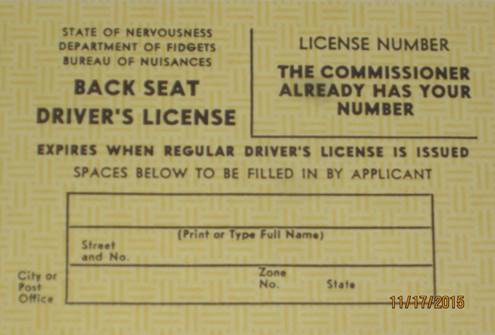
Oh, and I also have one of these:

Donna Bradley Burcher |Technical Editor, Advisory | Symitar®

8985 Balboa Ave. | San Diego, CA 92123 | Ph. 619.278.0432 | Extension: 765432

Pronouns: she/her/hers

Editing: Symitar Documentation Services

NOTICE: This electronic mail message and any files transmitted with it are intended
exclusively for the individual or entity to which it is addressed. The message,
together with any attachment, may contain confidential and/or privileged information.
Any unauthorized review, use, printing, saving, copying, disclosure or distribution
is strictly prohibited. If you have received this message in error, please
immediately advise the sender by reply email and delete all copies.

Posted by: Jack Henry | October 12, 2021

Editor’s Corner: Time

As writers and editors, we tend to spell things out a little more than most. We explain what acronyms stand for the first time we use them; we avoid “info” and write information, we spell out documents instead of writing “docs”; and we avoid abbreviations.

Sometimes, however, we make exceptions, but we still like being consistent with those exceptions. This brings me to the topic of today: 24 hours a day, 7 days a week, and 365 days a year. Imagine if you will, a document that mentions this full coverage ten different times. What a mouthful and an eyeful! Read that often enough and you could be asleep very quickly. At some point, all of these amounts of time were whittled down to the numbers 24/7 or 24/7/365. Hip hip hooray!

Here is where the editors come in. Remember we are one company, and we want to represent time consistently. Here are a few reminders for you.

Correct:

24/7 or 24/7/365

Incorrect:

24 x 7 x 365

24x7x365

24 / 7 / 365

24*7*365

The slashes are the only correct symbol to use between the numbers, and you do not need spaces before or after the slashes.

The time of day is a little more flexible. We prefer hours and minutes, with a.m. and p.m. in lowercase and with periods. Time zones should be written in capital letters and without representing Daylight or Standard time. Here are some examples.

Correct:

7:30 a.m.

7 a.m.–3 p.m.

5:15 p.m. ET

Incorrect:

5:15 PST (do not mention Standard time)

6 A.M. (do not use capital letters with periods)

7:30 AM – 9:30 PM (do not use capital letters without periods; do not use spaces on either side of the en dash)

In case you forget the different zones, here you go:

Eastern Time: ET

Central Time: CT

Mountain Time: MT

Pacific Time: PT

Wherever you are and whatever time it is, I hope you have a lovely day!

Kara Church

Pronouns: she/her/hers

Technical Editor, Advisory

Editor’s Corner Archives: https://episystechpubs.com/

Posted by: Jack Henry | October 7, 2021

Editor’s Corner: Amongst, Amidst, and Whilst

Dear Editrix,

Are there ever any good reasons to use words like “whilst” or “amongst?” I consider such words archaic and would avoid their use, but I see them in current writings by educated people.

Dearest Reader,

My response to you was going to be, “Yes, I agree. They sound a bit old and stuffy for today.” But then I decided I didn’t really know much about these words, so I thought I should look a little deeper into these three pairs:

  • Among/amongst
  • Amid/amidst
  • While/whilst

Writer and teacher Brian Wasko begins his article about these couplets with the question: Which do you prefer? The following are selected tidbits from his answer that might help you decide if you want to avoid them or start sprinkling your speech with them.

Let’s be clear: this is a matter of preference, not correctness. Amongst is a legitimate and commonly used alternative to among. And the same goes for amidst and whilst.

These -st forms come across as old-fashioned to many—mostly American—ears. They have a King James/Shakespearean ring to them. But according to the OED blog, among and while are older than amongst and whilst, which were formed during the Middle Ages….You may consider them outdated, but it’s not legitimate to dismiss amongst, amidst, and whilst as archaic, both because among, amid, and while are actually older forms, and because all three are still in common popular use….

In terms of dictionary definition, there is no difference between among and amongst, amid and amidst, or while and whilst. They are interchangeable. On both sides of the Atlantic, the truncated versions are more common, but you are much more likely to hear amongst, amidst, and whilst in the United Kingdom than in the States….

This doesn’t stop people from feeling strongly one way or the other, of course. Some insist that the -st versions are outmoded, pointless, and/or pretentious and should always be replaced by their shorter contemporary forms. Others argue that amongst, amidst, and whilst are more elegant, trip easier off the tongue, or are subtly distinct in meaning and should be preserved.

Amidst the noise and flying fur, I will sit amongst my dogs whilst you consider which you prefer.

Kara Church

Pronouns: she/her/hers

Technical Editor, Advisory

Editor’s Corner Archives: https://episystechpubs.com/

Posted by: Jack Henry | October 5, 2021

Editor’s Corner: Calque

Recently I sent out a couple of idiomatic phrases to you and briefly explained why they are sometimes difficult to understand. For example, when someone says it’s “raining cats and dogs” that means it is raining really hard; it has nothing to do with dogs and cats falling from the air. Today I’d like to talk about something different. Today’s words and phrases are called calques. A calque is a word or phrase from another language that is translated word-for-word in English. Calque is the French word for a copy of something. The word calquer means “to trace” in French.

An article from Daily Writing Tips gives us several examples. Here are two that I liked:

Another calque for writers comes from Czech psát do šupliku, “write for the drawer.” This is an expression that developed along with the Russian word samizdat, which refers to the practice of underground publishing of state-proscribed materials, often by hand, and passed around from reader to reader. In English, writing for the drawer can refer to any writing not intended for immediate publication.

Crab mentality is a calque from Tagalog isip talangka. It derives from the behavior of crabs in a pot. As one tries to escape over the side, it’s pulled down by the others in the pot. Applied to people, it refers to the unfortunate tendency of group members to resent or obstruct the progress of a colleague seen to be rising above the performance of the others.

Wikipedia provides calque examples from several languages. Here are some of the German ones they list. You should be able to see the relationship between the original German word and its translation to English.

· Beer garden calques Biergarten

· Concertmaster and concertmeister calque Konzertmeister

· Earworm calques Ohrwurm

· Flamethrower calques Flammenwerfer

· Intelligence quotient calques Intelligenzquotient

· Loanword calques Lehnwort

· Nostalgia calque Heimweh "home sore"

· Overman and superman (i.e., self-transcending human) calque Übermensch

· Rainforest calques Regenwald

· Stormtroopers calques Sturmtruppen

· Watershed calques Wasserscheide

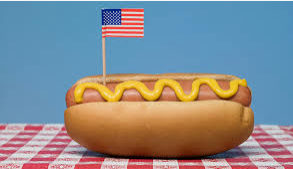
This is one of the pictures I found when searching for a funny calque meme. I have no idea what the connection is, but a hot dog sounds delicious right now. (Okay, I’m fasting. Anything sounds good right now!)

Kara Church

Pronouns: she/her/hers

Technical Editor, Advisory

Editor’s Corner Archives: https://episystechpubs.com/

Posted by: Jack Henry | September 30, 2021

Editor’s Corner: Lollapalooza

A couple of months ago, my mom asked me what the definition and history of the word lollapalooza was. My response was, “You mean the music festival, like Coachella?” She laughed and said, “There’s a music festival called Lollapalooza? No, I mean the word. We used it when I was a kid in Pennsylvania.”

Well, it’s taken me a while (okay, I forgot to put it on my list) but here’s what I found. First, from Merriam-Webster:

lollapalooza

or less commonly lalapalooza or lollapaloosa or lallapalooza

: something extraordinarily impressive: an outstanding example

And then from the Online Etymology Dictionary:

lollapalooza (n.)

"remarkable or wonderful person or thing," 1901, American English, fanciful formation. The annual North American alternative pop music concert of the same name dates from 1991. [KC – A different resource said it was first used in 1896.]

And yet another definition from Dictionary.com:

an extraordinary or unusual thing, person, or event; an exceptional example or instance.

Here are some examples:

  • Rocco is a real lollapalooza of a dancer—he does everything from the Argentine Tango in the ballroom, to breakdancing on cardboard in the street.
  • The engagement ring that Troy gave to Alex was a titanium and diamond lollapalooza; it was more expensive than their thirty-day European honeymoon.
  • Antoni Gaudi rarely designed anything that wasn’t a lollapalooza of a building.

As far as the music festival, there is a history of it on Wikipedia, but here is a condensed version:

Lollapalooza is an annual four-day music festival held in Grant Park in Chicago, Illinois. It started as a touring event in 1991. Music genres include but are not limited to alternative rock, heavy metal, punk rock, hip hop, and electronic music. Lollapalooza has also featured visual arts, nonprofit organizations, and political organizations. The festival in Chicago’s Grant Park hosts an estimated 400,000 people each July and sells out annually. Lollapalooza is considered one of the largest and most iconic music festivals in the world and one of the longest running in the United States.

Sounds like a lollapalooza of a time! Sign me up for a couple of days, a riverboat ride, and some deep-dish pizza!

Antoni Gaudi’s Lollapalooza: Casa Batllo in Barcelona

Kara Church

Pronouns: she/her/hers

Technical Editor, Advisory

Editor’s Corner Archives: https://episystechpubs.com/

Posted by: Jack Henry | September 28, 2021

Editor’s Corner: Apostrophe Reboot

My friend Samuel D. and I were discussing apostrophe usage recently. Sam is seeing more and more people using the term “driver license” rather than the correct term “driver’s license.” The latter is considered correct because of the apostrophe rule about possessive nouns: the license belongs to the driver, so an apostrophe is necessary to show possession. It is a driver’s license.

We’ve covered apostrophe usage a few times, but I still get a lot of questions, so I think it’s time for a refresher.

The rules about apostrophes are easier than you might think. There are only two uses: to form contractions and to form possessions. Let’s look at each.

Apostrophes with Conractions

Contractions are used to shortened words or groups of words. You simply use the apostrophe in place of missing letters:

  • Cannot becomes can’t
  • She would becomes she’d
  • They are becomes they’re
  • Let us becomes let’s
  • You all becomes y’all

It works the same for numbers:

  • The 1990s becomes the ‘90s

Apostrophes with Possessives

I think this is where most people get confused because there is some variation. Here are the rules:

  • For most singular nouns, add the apostrophe and an s:
    • That is my brother’s bike. [dbb – I’m talking about one brother and his bike.]
  • For most plural nouns, add only an apostrophe:
    • Those are my brothers’ bikes. [dbb – I’m talking about two or more brothers and their bikes.]
  • For plural nouns that do not end in s (irregular plural nouns) add the apostrophe and an s:
    • Pick up the children’s toys.
  • For singular nouns that end in s, the rule varies depending on what style guide you follow. We follow the Chicago Manual of Style, which says to add the apostrophe and an s:
    • Kansas’s claim to fame is its sweet, tangy barbecue sauce.
    • Chris’s jacket is plaid.

That’s the crux of it, folks. There is just one more thing you need to remember—you do not need an apostrophe for plural nouns that are not possive:

  • The Burchers are in.
  • Her dogs have a lot of toys.
  • Some editors are introverts.

And now for a cartoon and some apostrophe fails:

Donna Bradley Burcher | Senior Technical Editor | Symitar®

8985 Balboa Ave. | San Diego, CA 92123 | Ph. 619.278.0432 | Ext: 765432

Pronouns she/her/hers

About Editor’s Corner

Editor’s Corner keeps your communication skills sharp by providing information on grammar, punctuation, JHA style, and all things English. As editors, we spend our days reading, researching, and revising other people’s writing. We love to spend a few extra minutes to share what we learn with you and keep it fun while we’re doing it.

Did someone forward this email to you? Click here to subscribe.

Don’t want to get Editor’s Corner anymore? Click here to unsubscribe.

Do you have a question or an idea for Editor’s Corner? Send your suggestions or feedback to Kara and <a href="mailto:DBurcher.

NOTICE: This electronic mail message and any files transmitted with it are intended
exclusively for the individual or entity to which it is addressed. The message,
together with any attachment, may contain confidential and/or privileged information.
Any unauthorized review, use, printing, saving, copying, disclosure or distribution
is strictly prohibited. If you have received this message in error, please
immediately advise the sender by reply email and delete all copies.
« Newer Posts - Older Posts »

Categories