Posted by: Jack Henry | March 31, 2022

Editor’s Corner: Haiku and Contest!

The other day I mentioned a Japanese poetry type called waka. Today I want to go back to the other type of poetry from Japan that many of us are more familiar with: haiku. As I mentioned, haiku is three lines with the pattern of five syllables for the first and third lines and seven syllables in the middle. Traditional haiku was restricted to one of the seasons or topics in nature. Since we are getting closer to the weekend, I thought we should look at some more modern haiku, which are comedic. I hope you enjoy the ones I selected from Your Dictionary.com:

Haiku for Room Cleaning Motivation

I hid a twenty

In your messy room somewhere.

Just clean to find it.

Birthday Haiku

For your birthday, friend,

I wrote this haiku for you.

Worst present ever.

Haiku for Sweet Corn

The joy of sweet corn,

Taste of summer and butter.

I forgot to floss.

Haiku for Babies

You’re so cute, but why

Should I write a haiku for you?

You can’t even read.

T-Rex Hug Haiku

The T-Rex likes you,

But he can’t give you a hug.

His arms are too short.

Haiku for Bacon

That’s too much bacon.

Please just bring me some kale chips.

Said no one ever.

Good Morning Haiku from the Cat

In the morning light,

You sleep despite my meow.

I stand on your face.

You know what? It’s been a long time since I’ve had a contest. Let’s do one now! Here are the rules:

Who: You, Editor’s Corner readers (and any new folks you get to subscribe to Editor’s Corner).

What: Write a haiku following the 5-7-5 syllable rule. Funny ones would be delightful, but more traditional are okay, too. And please don’t plagiarize, we’re using the honor system here.

What Else: For prizes I will draw a winner randomly from each category. The funny one wins He Smokes Like a Fish and Other Malaphors; for the more serious winner I will send The Disheveled Dictionary. Both books are “slightly used” because I buy used books when they are available, for the environment’s sake. Don’t worry, they don’t have any blood or coffee stains on the pages.

Where: From your office or your house, just send me your best.

When: Get them to me by Friday, April 15, 2022. I will announce the winners on Tuesday, April 26, 2022.

Why: Because it doesn’t take long, it gets those creative juices flowing, and it’s fun!

Kara Church

Pronouns: she/her

Technical Editor, Advisory

Editor’s Corner Archives: https://episystechpubs.com/

Posted by: Jack Henry | March 29, 2022

Editor’s Corner: Waka

Good morning!

Todays topic is more about literature and writing than it is about English. I was just excited to learn this new word, and thought Id share. Most of you are probably familiar with the term haiku, which is a three-lined Japanese poem. The first and third lines are five syllables; the second line has seven syllables. What Im here to talk about today is waka poetry.

Waka is also a Japanese type of poem. A waka has five lines, and each line has five or seven syllables, like the haiku. A waka starts out the same as a haiku (5-7-5 syllable pattern), but then the last two lines are both seven syllables (5-7-5-7-7).

Here is an example of a haiku:

The Old Pond by Matsuo Bash

An old silent pond

A frog jumps into the pond

Splash! Silence again.

And here are some examples of wakas:

The heron pauses
In solitary vigil
Eyes a falling leaf
The dusk comes so early now
At the Sandy Bottom lakes

(by Otagiri Tatsuzou)

When cool breezes blow
portending the changing leaves
ladies fan themselves
in shimmering colored silks
…one cannot but enjoy life

(by Date Saburou Yukiie)

The flowers withered,
Their color faded away,
While meaninglessly
I spent my days in the world
And the long rains were falling.

(by Ono no Komachi)

I hope that you all

Have a happy, joyous day

At work or at home

Staying cozy, safe, and warm

As the sun sets on the day.

Kara Church

Pronouns: she/her

Technical Editor, Advisory

Editors Corner Archives: https://episystechpubs.com/

Posted by: Jack Henry | March 24, 2022

Editor’s Corner: Whoever Heard of Dr. Soice?

Good morning, readers and writers!

I have some surprising information for you today (at least it was surprising to me!). Did you know that most of us have been pronouncing Dr. Seuss’s name incorrectly? Dr. Seuss’s birthday is this month, so I thought we’d take this opportunity to clear up the mispronunciation.

As you probably know, Dr. Seuss’s real name is Theodor Geisel. Seuss is his mother’s maiden name, and the correct German pronunciation rhymes with voice, not moose. From the beginning, the mispronunciation was so widespread, and it went on for so long, that the good doctor eventually just accepted it. However, Alexander Lang, a college friend who worked with Geisel on the Dartmouth Jack-O-Lantern commemorated him this way:

You’re wrong as the deuce

And you shouldn’t rejoice

If you’re calling him Seuss

He pronounces it Soice (or Zoice)

Early on in his career, Geisel illustrated many political cartoons and worked in the animation and film department of the U.S. Army. He even won an academy award in 1947 for Best Documentary Feature. Geisel published over 60 books, which have been translated into many languages and adapted into 11 television specials, five feature films, a Broadway musical, and four television series. National Read Across America Day, a reading initiative created by the National Education Association, is celebrated on his birthday each year (March 2).

His work is not without controversy, though. Although Dr. Seuss portrayed many positive values in many of his books, and while he remains popular, last year, six of his books were pulled from publication due to racist images. When the books were pulled, Dr. Seuss Enterprises said, “These books portray people in ways that are hurtful and wrong.” They said they are committed to ensuring that the Suess catalog represents and supports all communities and families. 

We can all take a lesson from Dr. Seuss’s book The Sneetches, which sends the message that all people are to be valued, just the way they are: “…no kind of Sneetch is the best on the beaches.” 

Donna Bradley Burcher |Technical Editor, Advisory | Symitar®

8985 Balboa Ave. | San Diego, CA 92123 | Ph. 619.278.0432 | Ext: 765432

Pronouns she/her/hers

About Editor’s Corner

Editor’s Corner keeps your communication skills sharp by providing information on grammar, punctuation, JHA style, and all things English. As editors, we spend our days reading, researching, and revising other people’s writing. We love to spend a few extra minutes to share what we learn with you and keep it fun while we’re doing it.

Did someone forward this email to you? Click here to subscribe.

Don’t want to get Editor’s Corner anymore? Click here to unsubscribe.

Do you have a question or an idea for Editor’s Corner? Send your suggestions or feedback to Kara and <a href="mailto:DBurcher.

NOTICE: This electronic mail message and any files transmitted with it are intended
exclusively for the individual or entity to which it is addressed. The message,
together with any attachment, may contain confidential and/or privileged information.
Any unauthorized review, use, printing, saving, copying, disclosure or distribution
is strictly prohibited. If you have received this message in error, please
immediately advise the sender by reply email and delete all copies.

Posted by: Jack Henry | March 22, 2022

Editor’s Corner: The Asterisk, revisited

Most of us know what an asterisk (*) looks like, but what is it? How should it be used?

The word asterisk is from the Greek word asteriskos, which means little star. According to an article I read on ThoughtCo, there are several uses for what the article calls the most ancient punctuation mark (around 5000 years old):

  • To call attention to a footnote
  • To indicate an omission
  • To point to disclaimers (which often appear in advertisements)
  • To note constructions that are ungrammatical
  • To dress up company logos

Let’s have a look at these uses.

Footnotes

An asterisk is placed beside text to indicate that there is more information on the word or passage it marks. The additional information can be found at the bottom of the page where it appears. According to our style guide, Chicago Manual of Style, it’s okay to use asterisks for footnotes if there are only a few in an entire paper. When you have multiple items per page or throughout a book, however, it is much cleaner to use numbered footnotes.

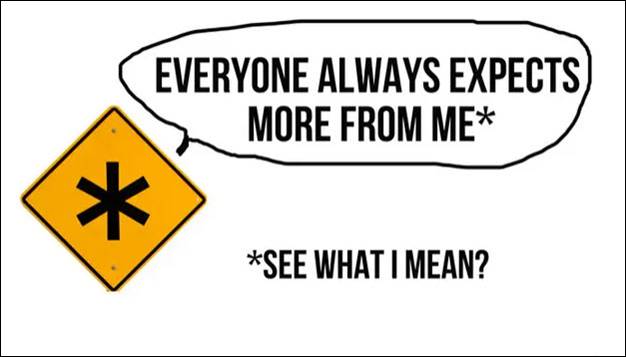
As an editor, one of the biggest faux pas I see with asterisks is people using them in documents, but not including anything at the bottom of the page to explain why the text was marked! If the asterisk doesn’t clarify what it marks on that page, it’s useless. An example is a series of fields that say Enter the date*. At the bottom of the page, you might expect clarification on which date, such as:

*The date the form was filled.

Omissions

“We’re werewolves, not swearwolves!” (From What We Do in the Shadows, the movie.)

Asterisks, (like the grawlix %@$&*!) can be used in place of profanity. When you’re reading an article or story and you don’t want to offend the reader, you may see something like, “He’s being a real a**.” You know what the missing letters are, but it’s considered less offensive than coming right out and cussing at the reader.

Other Uses

The “other uses” aren’t recommendations, but they are things you might notice when you’re out and about.

  • Disclaimers: Sometimes you might see an advertisement with an asterisk that guides you to the tiniest of disclaimers—the written equivalent of the TV or radio ad where the spokesperson is speaking in quadruple time and mentioning all of the things they must say legally, but don’t want to.
  • Ungrammatical uses: I’ve never seen this, but apparently people will call attention to bad grammar by marking it with an asterisk. For example:

    *Bill and Ted was having an adventure.

    Don’t use bad grammar and nobody will put an asterisk by your work. 😊

  • Company logos: E*TRADE is an example of someone using an asterisk as a “stylized hyphen.” The late copy chief at the Washington Post responded to this perfectly: “Punctuation is not decoration.” Agreed. Just don’t do it.

Kara Church

Pronouns: she/her

Technical Editor, Advisory

Editor’s Corner Archives: https://episystechpubs.com/

Posted by: Jack Henry | March 17, 2022

Editor’s Corner: Cutting Idioms

My 13-year-old dog can hardly walk on her back legs, but she likes to keep her front legs fit and trim by digging holes in the back yard—and trying to dig holes in the rugs on our bedroom floor. The latest couple of rugs have not stood up well to her abuse. There are always strands of fiber she’s pulled out that are big enough to catch your toe on.

Part of my weekly maintenance is to get on the floor and cut off the strings. As I did this last weekend, I realized I was “cutting a rug,” and my mind went to the idiom “to cut a rug” meaning to dance. That just didn’t sound right! I looked it up, and indeed it is an idiom, which Merriam-Webster categorizes as “old-fashioned slang.” Well, that made me feel less than young! Even worse, my thoughts jumped to the last time I saw anybody “cutting a rug.” It was the 1946 Christmas film, It’s a Wonderful Life.

When another idiom with the word “cut” came up in my mailbox, I thought it was a message from the universe to do an article for Editor’s Corner. The second idiom was “cut to the chase.” Here is an explanation and a little history from Grammarphobia:

Cut to the chase

The expression “cut to the chase,” which was first recorded in the early 20th century, is derived from the use of the verb “cut” in filmmaking to mean move rapidly from one scene to another.

The Oxford English Dictionary defines this sense of “cut” as “to make a quick transition from one shot to the next.” The earliest example that we’ve seen for the usage is from an early 20th-century book on motion-picture technique:

“Perhaps we can cut to Sam wondering what effect the marriage will have on his chances” (from Technique of the Photoplay, 2d ed., 1913, by Epes Winthrop Sargent).

The OED, an etymological dictionary based on historical evidence, says the expression “cut to the chase” was originally a film usage meaning “to cut to a chase scene; (hence) to cut to an interesting or fast-paced part of a film….”

In a few years, the usage took on its usual current sense, which the OED defines as “to get to the point, to get on with it; to concentrate on the essential elements of an issue, etc.”

Wishing you a happy St. Patrick’s Day! Here’s hoping you have a chance to cut a rug or dance a jig today in celebration!

Kara Church

Pronouns: she/her

Technical Editor, Advisory

619-542-6773 | Ext: 766773

Editing: Symitar Documentation Services

Editor’s Corner Archives: https://episystechpubs.com/

NOTICE: This electronic mail message and any files transmitted with it are intended
exclusively for the individual or entity to which it is addressed. The message,
together with any attachment, may contain confidential and/or privileged information.
Any unauthorized review, use, printing, saving, copying, disclosure or distribution
is strictly prohibited. If you have received this message in error, please
immediately advise the sender by reply email and delete all copies.

Posted by: Jack Henry | March 15, 2022

Editor’s Corner: Orange and Oranges

Good morning, folks!

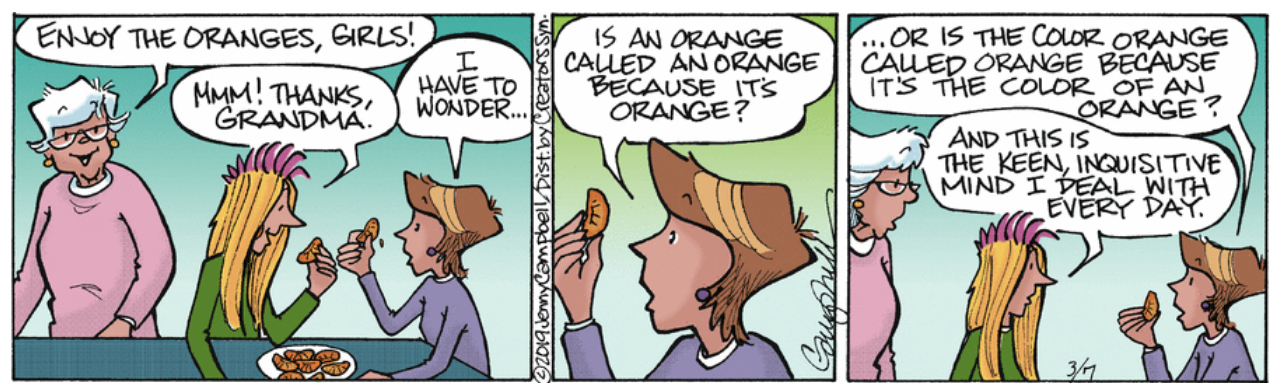
The other day, the editors received this comic strip and a challenge to deal with it in Editor’s Corner. I’m always up for a challenge, and I wanted to know the answer to this question: Which came first, orange the color, or orange the fruit?

An article from Mental Floss gets right to it:

The citrus definitely got named first. The earliest recorded use of orange the fruit in English is from the 1300s and came to us from the Old French orenge, adapted from the Arabic nāranj, from the Persian nārang, from the Sanskrit nāranga ("orange tree"). The Sanskrit word’s origin is unclear, but it might come from a Dravidian word meaning "fragrant."

The word’s use as a color name doesn’t crop up for another 200 years, in the early 1500s. English speakers probably didn’t have a specific name for the color until the fruit was widely available in their markets and inspired one. Before then, linguists believe people generally referred to orange as "yellow-red," ġeolurēad in Old English.

Noting the two different directions the word took (orenge and naranj/naranga) and having taken French and Spanish, I decided to look at what other countries near France and Spain called orange and oranges. The closer to France and northern Europe, most countries have a variant of orenge:

· oranje (Dutch)

· orange (French)

· orange (German)

· oransje (Norwegian)
· orange (Swedish)
· oranžová (Slovak) [KC – Okay, not northern or near France, but the Slovak in me liked this name.]
The closer to Spain and Portugal, the countries stick closer to naranj/naranga:
· taronja (Catalan)
· laranja (Portuguese)
· naranja (Spanish)
In between orange and naranja, is Italy with arancia.

The Online Etymology Dictionary reported a history of the word orange similar to Mental Floss, but it also included some interesting information about the fruit itself, so I thought I’d pass that on too.

The tree’s original range probably was northern India. The Persian orange, grown widely in southern Europe after its introduction in Italy 11c., was bitter; sweet oranges were brought to Europe 15c. from India by Portuguese traders and quickly displaced the bitter variety, but only Modern Greek still seems to distinguish the bitter (nerantzi) from the sweet (portokali "Portuguese") orange. [KC –Greeks use the word
portokali for the color orange; next door, the Turks use portokal.]

Portuguese, Spanish, Arab, and Dutch sailors planted citrus trees along trade routes to prevent scurvy. On his second voyage in 1493, Christopher Columbus brought the seeds of oranges, lemons and citrons to Haiti and the Caribbean. (They were)…introduced in Florida (along with lemons) in 1513 by Spanish explorer Juan Ponce de Leon.

And that’s what happens when you present a comic strip to an editor.

Kara Church

Pronouns: she/her

Technical Editor, Advisory

Editor’s Corner Archives: https://episystechpubs.com/
Posted by: Jack Henry | March 10, 2022

Editor’s Corner: Wintery Words

Good morning to you. Spring is just around the corner, but before we say goodbye to winter, I thought you might appreciate a collection of wintery words that you may not knowat least not all of them. Quite a few are new to me, but then I live in southern California where we havent got a clue what a real winter is like. We have heard all about it and seen it on TV and in movies though, which is probably just about the same. (Im kidding! I know Im a winter wimp!)

I found this list on Thesaurus.com. I hope you enjoy it along with the last vestiges of the season.

  • hibernal: of or relating to winter; wintry
    Hibernal comes from the Latin hbernus, meaning wintery. In Latin, hiems means winter. There is another word that traces back to this root: hibernate, like bears do during the winter.
  • apricity: the warmth of the sun in the winter
    This word comes from the Latin aprcri, to bask in the sun. The word largely fell out of use by the end of the 19th century, but it has seen an uptick in recent years in branding and marketing.
  • brume: mist; fog
    The word brume comes from the Latin for winter, brma. If you have ever walked through a brume, you know how damp and chilly it is.
  • brumal: Confusingly, the word brumal does not mean misty or foggy, as you might expect from the meaning of brume. Brumal goes back to that same Latin root, brma, for its meaning. Therefore, brumal means wintry.
  • hoarfrost: Known more generally as simply frost. The hoar- part of the word literally means white-haired with age or old. However, it is also used to refer to a white coating or veneer. In other words, hoarfrost is a layer of white frost.
  • rime: an opaque coating of tiny, white, granular ice particles, caused by the rapid freezing of supercooled water droplets on impact with an object
    If you have ever seen frost that makes the trees look like they are covered in spikes, that is likely rime.
  • nv: granular snow accumulated on high mountains and subsequently compacted into glacial ice
    Another word for this kind of snow is firn, from Swiss German for last years [snow], or simply old snow. Nv ultimately comes from the Latin nivtus, meaning snow-cooled.
  • gelation: solidification by cold; freezing
    The word gelation ultimately comes from the Latin geltus. If this Latin word looks familiar, that may be because it is also at the root of the word gelatin.
  • cauldrife: susceptible to cold; chilly
    It can also mean lifeless, as in a corpse. The cauld- part of the word simply means cold in Scottish, while the -rife part of the word means abundantly, copiously, from the same root as the English rife.
  • wintertide: wintertime
    You may have come across other examples of words that end in -tide, including noontide, eventide, and yuletide. In all of these examples, -tide means time, from the Old English td, meaning time or hour.
  • isocheim: a line on a map connecting points that have the same mean weather temperatureNot every part of the world experiences winter at the same time. In 19th-century climatology, one way winter weather was analyzed referred to the isocheim [ ahysuh-kahym
    ]. Iso- is a combining form meaning equal, and -cheim comes from the Greek for winter. Isocheim literally means, then, equal winter.
  • latibulize: to retire into a den and lie dormant
    The word latibulize comes from the Latin latibulum, meaning a hiding place.
  • arctic: of or relating to the North Pole
    The word arctic (without a capital letter) is used more generally to mean characteristic of the extremely cold, snowy, windy weather; frigid; bleak. In other words, even if you arent literally at the North Pole, it can sometimes feel that way.
  • Samhain: a festival observed by the ancient Celts
    The beginning of winter was marked with the festival of Samhain [ sah-win ]. You may be familiar with some elements of Samhain, because many of the traditions associated with Halloween are thought to have originated with this holiday. However, unlike Halloween, Samhain is typically observed on November 1.

Donna Bradley Burcher |Technical Editor, Advisory | Symitar

8985 Balboa Ave. | San Diego, CA 92123 | Ph. 619.278.0432 | Ext: 765432

Pronouns she/her/hers

About Editors Corner

Editors Corner keeps your communication skills sharp by providing information on grammar, punctuation, JHA style, and all things English. As editors, we spend our days reading, researching, and revising other peoples writing. We love to spend a few extra minutes to share what we learn with you and keep it fun while were doing it.

Did someone forward this email to you? Click here to subscribe.

Dont want to get Editors Corner anymore? Click here to unsubscribe.

Do you have a question or an idea for Editors Corner? Send your suggestions or feedback to Kara and <a href="mailto:DBurcher.

NOTICE: This electronic mail message and any files transmitted with it are intended
exclusively for the individual or entity to which it is addressed. The message,
together with any attachment, may contain confidential and/or privileged information.
Any unauthorized review, use, printing, saving, copying, disclosure or distribution
is strictly prohibited. If you have received this message in error, please
immediately advise the sender by reply email and delete all copies.

Posted by: Jack Henry | March 8, 2022

Editor’s Corner: British Story, French Words

Hello, my coworkers and friends! I hope this finds you healthy and happy! Today I have a few more words from recent movies I’ve seen that I’d like to share with you. These words all have recent ties to French, but I believe I heard them in the movie Spencer, about Princess Diana and her nerve-wracking time with the British monarchy (aka the royal family). I did not like the movie, but here are the words I’ll cover: luthier, archetier, and equerry. (There’s also a small chance one of the words might be from The Power of the Dog.)

A luthier (pronounced LOO-tee-er) is someone who makes or repairs string instruments “that have a neck and a sound box.” (From Wikipedia) The name comes from the French word for lute, but it graduated over time to cover violins, cellos, guitars, and other similar instruments.

The craft itself (called lutherie) is divided into two different categories, depending on whether the instrument is plucked or strummed (like a guitar) or played with a bow (like a violin). Once there is a bow involved, there is another French word and title you’ll come across: archetier. An archetier is a bow maker for the lutherie instruments. Interestingly, our English words archery (shooting arrows with a different kind of bow) and archer are also from the same root.

The final word is equerry. Like our English word equine (related to horses), equerry comes from Latin and then French. Also from Wikipedia, “An equerry is an officer of honor. Historically, it was a senior attendant with responsibilities for the horses of a person of rank. In contemporary use, it is a personal attendant, usually upon a sovereign, a member of a royal family, or a national representative.” Here’s the etymology from the Online Etymology Dictionary:

equerry (n.)

royal officer, especially one charged with care of horses, 1590s, short for groom of the equirrie, from esquiry "stables" (1550s), from French escuerie (Modern French écurie), perhaps from Medieval Latin scuria "stable," from Old High German scura "barn" (German Scheuer); or else from Old French escuier "groom," from Vulgar Latin *scutarius "shield-bearer." In either case, the spelling was influenced by Latin equus "horse.”

After all of this movie vocabulary, I thought I would find the date for the Academy Awards for you. When we were in the office, it used to be a fun time of year with some who would dress up and others who put together a contest we’d run during Toastmasters. This year, you can catch the awards on Sunday, March 27, 2022.

No matter what you see or read or hear, there’s always time to learn a few new words!

Kara Church

Pronouns: she/her

Technical Editor, Advisory

Editor’s Corner Archives: https://episystechpubs.com/
Posted by: Jack Henry | March 3, 2022

Editor’s Corner: Thanatology

Good morning, everyone!

I have another word from my recent movie-watching for you: thanatology. Thanatology is the scientific study of death and the practices associated with it. I wish I could tell you which movie it’s from, but I’ve watched a bunch of movies involving death lately, so I’d just be guessing.

This word caught my ear because of the “thana” prefix. I first though, “Hmmm…is this related to the Marvel character Thanos, the powerful villain with god-like powers?” And then I thought of my friend Thanasi, a guy in Greece that I used to ride around with on his motorcycle. Thana and thanos sure sound Greek, so I thought it was time to look up the etymology of thanatology and find out more about it.

According to the Online Etymology Dictionary:

thanatology (n.)

"scientific study of death," 1837, from thanato- "death" + -logy. In 1970s, some undertakers made a bid to be called thanatologists; but from 1974 that word has been used principally in reference to specialists in the needs of the terminally ill.

Indeed, the Greeks have several words that mean death, and one of them is thanatos (θάνατος). Now for thanatology specifically, I thought maybe Wikipedia could shed some light on this. The definition for thanatology is “the scientific study of death and the losses brought about as a result. It investigates the mechanisms and forensic aspects of death, such as bodily changes that accompany death and the postmortem period, as well as wider psychological and social aspects related to death.”

Thanatology doesn’t just take a forensic, physical look at death, but it considers humans’ awareness of our morality, how death looks in the world as the globe ages, medical technologies, hospice care, and many other topics.

Suddenly I feel like I might not be someone fun to watch a movie with.

Kara Church

Pronouns: she/her

Technical Editor, Advisory

Editor’s Corner Archives: https://episystechpubs.com/

Posted by: Jack Henry | March 1, 2022

Editor’s Corner: Frosty Hot Tub

Good morning! At the turn of the new year, one of you mentioned that “the frost was on the hot tub,” which you said reminded you of the phrase “the frost is on the pumpkin.” Then you asked me where that was from and if it meant something in particular. I thought, “It just means that the weather was getting colder.” Then I started asking around, wondering if I was missing something.

First, a coworker told me the same thing, “The phrase means winter is coming.” Well, dang! The folks in Game of Thrones made it sound much more ominous than a frosty pumpkin! Next, I asked my mom during our daily walk. “Are you familiar with this phrase, ‘the frost is on the pumpkin’?” She replied, “Winter is coming.” Then she chided me and said, “You people in San Diego don’t know what frost is, do you? Poor babies. People up north and on the East Coast know. And if your pumpkin is sporting frost, you’d better start wearing a coat and gloves!”

Of course, that wasn’t enough for me. I know what frost and pumpkins are, but what about this saying? Indeed, it is a more poetic way of saying that the weather is getting colder or that seasons are changing. You know exactly what time of the year it means by the visual: sometime after Halloween and moving toward winter (let’s say early November).

But the phrase doesn’t just sound poetic. It’s a line from a famous poem by American poet James Whitcomb Riley. Here is the first stanza of “When the Frost Is on the Punkin”:

When the frost is on the punkin and the fodder’s in the shock,

And you hear the kyouck and gobble of the struttin’ turkey-cock,

And the clackin’ of the guineys, and the cluckin’ of the hens,

And the rooster’s hallylooyer as he tiptoes on the fence;

O, it’s then’s the times a feller is a-feelin’ at his best,

With the risin’ sun to greet him from a night of peaceful rest,

As he leaves the house, bareheaded, and goes out to feed the stock,

When the frost is on the punkin and the fodder’s in the shock.

According to Wikipedia, Riley, born in the Midwest in 1849, was not a lover of school. He spent a lot of time in trouble and didn’t graduate from the eighth grade until he was 20. Because of that, he tended to write his humorous and sentimental poems (nearly 1,000 of them) in the local dialect. Critics “pointed to his poor education as the reason for his success in writing; his prose was written in the language of common people which spurred his popularity.”

Riley influenced “the creation of a Midwestern cultural identity” and “contributed to the Golden Age of Indiana Literature.” His popularity with people earned him the nickname “The Hoosier Poet.”

I bet you didn’t suspect a frosty hot tub would lead us here!

Hot or cold, enjoy your day!

Kara Church

Pronouns: she/her

Technical Editor, Advisory

Editor’s Corner Archives: https://episystechpubs.com/
« Newer Posts - Older Posts »

Categories