Kara Church would like to recall the message, “Editor’s Corner: Scottish Slang”.
NOTICE: This electronic mail message and any files transmitted with it are intended exclusively for the individual or entity to which it is addressed. The message,
together with any attachment, may contain confidential and/or privileged information.
Any unauthorized review, use, printing, saving, copying, disclosure or distribution is strictly prohibited. If you have received this message in error, please immediately advise the sender by reply email and delete all copies.
Posted by: Jack Henry | June 27, 2023
Recall: Editor’s Corner: Scottish Slang
Posted in Articles
Posted by: Jack Henry | June 27, 2023
Editor’s Corner: Scottish Slang
Since the Writers Guild of America is on strike and I had a few days to sit around and recover from some surgeries last month, I needed something to watch as I recovered. Something soothing, sweet, and relaxing—and I found it in Australia’s show, City Homicide.
As my body healed, I watched some of this series and kept a list by my side. Here are some of the phrases that I have learned so far. Here’s what I’ve found in seasons one and two.
| Australian English | American English |
| jacks | police |
| Fell pregnant | Got pregnant |
| Glasgow smile [KC – I apologize to those of Scottish descent.] |
Knife cut from corner of mouth up to ears
Tommy Flanagan, actor |
| Glasgow kiss [KC – And again, mea culpa.] | A headbutt to the nose, usually causing the nose to break |
| dish-licker | dog |
| secondment [KC – Not specifically Australian slang. I’d just not heard this word before.] | From Merriam-Webster: the detachment of a person (such as a military officer) from their regular organization for temporary assignment elsewhere |
| Back in a tick | Back in a second |
| clothes peg | clothes pin |
| dunny | toilet |
| walking frame | walker
|
| servo | Service station; gas station |
| footy | Australian rules football (contact sport; roots from rugby) |
| bikies | bikers |
| bikkies | cookies |
| You look like a dog’s breakfast | You look very messy |
| yabby (yabbies) | Australian crayfish (crawdad; crawfish) |
| gurgler | drain |
| Down the gurgler
[KC – With your bad luck in Vegas, that paycheck is down the gurgler.] |
Down the drain; wasted |


That’s what I’ve gathered so far! I find it interesting that contact sports, headbutts, face-slicing, and motorcycle gang members all sound so cute: footy, kisses, smiles, and bikies. Australia might be a difficult place to figure out if you don’t do some research first. 😊
Enjoy your day!
Kara Church | Technical Editor, Advisory | Technical Publications
Pronouns: she/her | Call via Teams | jackhenry.com
Editor’s Corner Archives: https://episystechpubs.com/
Posted in Articles
Posted by: Jack Henry | June 22, 2023
Editor’s Corner: Summer Solstice
Good morning! Back in March, I wrote to wish you a happy vernal equinox. Back then, I mentioned that the equinox occurs twice each year (in March and September in the Northern Hemisphere) when the amount of daylight and nighttime are about equal in length.
Today, Im wishing you a happy (slightly belated) summer solstice! According to Dictionary.com, The word solstice ultimately derives from the Latin slstitium, which comes from the parts sl, sun, and sistere, to stand still. This means that slstitium literally translates to something like the standing still of the sun.
The summer solstice (around June 21 in the Northern Hemisphere) represents the longest day of the year. Around the world, people and cultures have beautiful ways to celebrate. England boasts one of the oldest and most well-known celebrations at Stonehenge. Thousands of druids, pagans, and other celebrants gather to admire the spectacular sunrise over the sacred site, where the stones align perfectly with the movement of the sun.

Summer solstice sunrise at Stonehenge
In Sweden, the celebration is known as Midsummer. The celebration involves dancing around a maypole, decorating houses with greenery, and enjoying delicious food and drink.
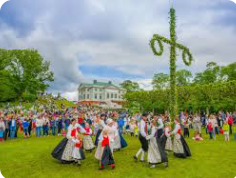
Dancing around the maypole in Sweden
(You may be familiar with a 2019 horror/thriller movie called Midsommar. I cant recommend it because Im a scaredy cat when it comes to horror films, but it is critically acclaimed.)
In Bolivia, along the shores of Lake Titicaca, on the Isla del Sol, the Indigenous people gather for summer solstice ceremonies that include musical performances, native dances, and rituals to honor Pachamama (Mother Earth).
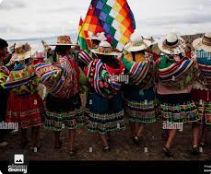
Indigenous women perform a ceremonial dance at Lake Titicaca in Bolivia
If youre interested in learning about the many other countries and cultures that celebrate the summer solstice, you can read more here.
As we move into summer, I wish you a perfect blend of sunny days and warm nights. Happy summer solstice.
Donna Bradley Burcher |Technical Editor, Advisory | jack henry
Pronouns she/her/hers
9660 Granite Ridge Drive, San Diego CA 92123
Symitar Documentation Services


About Editors Corner
Editors Corner keeps your communication skills sharp by providing information on grammar, punctuation, JHA style, and all things English. As editors, we spend our days reading, researching, and revising other peoples writing. We love to spend a few extra minutes to share what we learn with you and keep it fun while were doing it.
Did someone forward this email to you? Click here to subscribe.
Dont want to get Editors Corner anymore? Click here to unsubscribe.
Do you have a question or an idea for Editors Corner? Send your suggestions or feedback to Kara and <a href="mailto:DBurcher.
NOTICE: This electronic mail message and any files transmitted with it are intended
exclusively for the individual or entity to which it is addressed. The message,
together with any attachment, may contain confidential and/or privileged information.
Any unauthorized review, use, printing, saving, copying, disclosure or distribution
is strictly prohibited. If you have received this message in error, please
immediately advise the sender by reply email and delete all copies.
Posted in Articles
Posted by: Jack Henry | June 20, 2023
Editor’s Corner: -Nym Words, Part Two
Hello folks!
Last week I promised to send you part two of this article on words ending with -nym, translated from Greek as “name.” Let’s get right back to it!
eponym
A name from which another word is derived. Romulus (twin brother of Remus) gave us the name for Rome.
Examples from The Wordpoint
- Caesar Salad: Restaurateur Caesar Cardini created the salad that now bears his name.
- Boycott: This word is named for an Irish land agent, Captain Charles C. Boycott.
- Fahrenheit: Gabriel Daniel Fahrenheit is the physicist for whom this temperature measurement is named.
- Cardigan: This is named after the 7th Earl of Cardigan. He led troops who wore this garment into battle.
- Sandwich: While some of the backstories may be lore, it is true that the word sandwich is named for the Earl of Sandwich.
- Nicotine: Jean Nicot sent powdered tobacco leaves and seeds back to France when he visited Portugal as an ambassador.
endonyms and exonyms
endonym (Greek: endo [inside] + nym [name])
The name a group of people use to refer to themselves.
exonym (Greek: exo [outside] + nym [name])
A name for a place or group of people that is only used outside that place or group.
A Few Examples from Omniglot:
In the following list, the exonyms are what we call countries in English; the endonyms are how each country refers to themselves.
| Exonym | Endonym |
| Croatia | Hrvatska |
| Finland | Suomi |
| Germany | Deutschland |
| Hungary | Magyarország |
| Poland | Polska |
| Spain | España |
| Sweden | Sverige |
| Wales | Cymru |
| Copenhagen | København |
| Greece | Ελλάδα (Elada) |
| Moscow | Москва/Moskva |
| Prague | Praha |
| The Hague | Den Haag |
| Munich | München |
| Vienna | Wien |
| Cologne | Köln |
| Canton | 广州 (Guǎngzhōu in Mandarin, Gwóngjàu in Cantonese) |
| Amoy | 厦门 (Xiàmén) |
| Macau | 澳門 (Ngoumún) |
| China | 中国 (Zhōngguó) |
| Japan |
日本 (Nihon) |
I hope you’ve enjoyed our tour of -nym words!
NOTICE: This electronic mail message and any files transmitted with it are intended
exclusively for the individual or entity to which it is addressed. The message,
together with any attachment, may contain confidential and/or privileged information.
Any unauthorized review, use, printing, saving, copying, disclosure or distribution
is strictly prohibited. If you have received this message in error, please
immediately advise the sender by reply email and delete all copies.
Posted in Articles
Posted by: Jack Henry | June 15, 2023
Editor’s Corner: -Nym Words
Hello there, folks! I hope today finds you happy, healthy, and almost ready for the weekend!
I was just looking back in my “to do” folder for Editor’s Corner and I stumbled on a cryptic note to myself: “trionym, aptronym, inaptonym.” Once I got started, I found several items we’d covered before with the suffix -nym (from Greek όνομα (onoma)—name). Most of the following definitions are from Dictionary.com, many of the examples are from my head bone, and the rest of the examples are from sites that I’ve noted.
euonym, aptronym, aptonym, charactonym
A person’s name that is well suited to the person, place or object which bears it; a person’s name that is regarded as amusingly appropriate to their occupation.
Examples:
- Flora Gardener, owner of a flower shop
- William Wordsworth, the poet
- Charity for a woman who gives her time and money
- Dr. Cutt the surgeon
- Crusty Baker, the pie shop owner
- Michael Fast, an Olympic runner
- Rusty Ford, the repair shop owner
inaptonym
This one wasn’t acknowledged as a real word by most dictionaries, but I like it, so it made the cut.
A name that is poorly suited to the nature, career, or other personal characteristics of the person so named.
Examples:
- Mr. Lucky proved to be an inaptonym for a man who suffered a series of misfortunes that left him destitute and alone.
- Johnny Good was the name of the criminal arrested for the assault, battery, and murder of a dozen people.
- Mr. Black worked many jobs, always spending money until the company was in the red.
- Mrs. Fields lived on a mountain during the winter, at the desert in the spring, and by the sea in the summer.
trionym
A trionym is a name consisting of three terms. This word is mostly used to refer to scientific names. For example, modern humans may sometimes be referred to by the trionym Homo sapiens sapiens in anthropology.
So as not to tire you out, I’ll save the rest of our -nym words for Tuesday. I hope you enjoy your day.
Kara Church | Technical Editor, Advisory | Technical Publications
Pronouns: she/her | Call via Teams | jackhenry.com
Editor’s Corner Archives: https://episystechpubs.com/
Posted in Articles
Posted by: Jack Henry | June 13, 2023
Editor’s Corner: Weaving Connections
A friend of Editor’s Corner sent me an article from The New York Times about children’s books, the opener was this:
The Threads That Bind Us
A boy embroiders the moon, a girl makes coats for canines, and a knitted-cape crusader saves the day.
I read a little bit more:
Tao Nyeu’s The Legend of Iron Purl is more fanciful [KC – More fanciful than the precious book in this article], its young forest animals riveted by Granny Fuzz’s tales of a caped crusader whose weapon of choice is knitting. Don’t scoff: It’s no weirder than a superhero who slings spider webs. Purl’s identity is concealed by a hand-knit hooded cape, and her utility belt includes yarn and knitting needles. While Bandit Bob is a tepid villain, the “Busy World”-style illustrations are fun, and I appreciated the big reveal: Purl is Granny Fuzz! It’s subversive, one might say crafty, to cast an older woman, whose invisibility is rarely deemed a superpower, as a crack crime-fighter.
I was sold. Those of you who know me know that I love to knit. I learned at public school when I was eight and I’ve been doing it since. Maybe a little less in San Diego—Seattle was more suited to scarves and hats and blankets—but it’s one of my favorite hobbies.
But today’s topic isn’t knitting. It is from the subtitle of the article. Today we’re going to have a look at English terms related to the textile industry.
From The George Washington University Museum:
Batik: Indonesian term for the wax-resist dyeing process, or a fabric patterned with this process. Such fabrics reached fantastic heights of virtuosity on the island of Java in Indonesia in the late-19th and early-20th centuries after the introduction of machine-made cotton fabrics permitted more finely controlled designs.

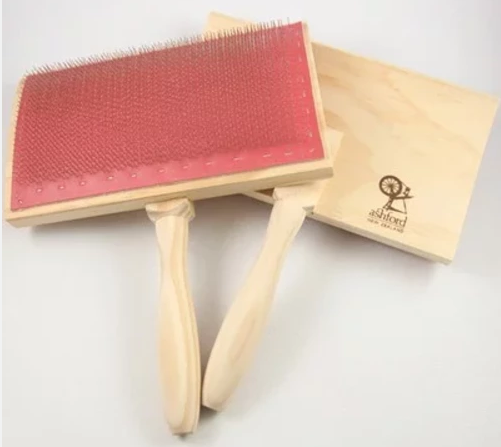
Carding: A method of preparing fibers for spinning. It is used to even out the density of short fibers, most often wool, by laying them on the teeth of a wire brush (called a card) and scraping them with another matching wire brush. Cards with metal teeth are first recorded in Europe in the 13th century.
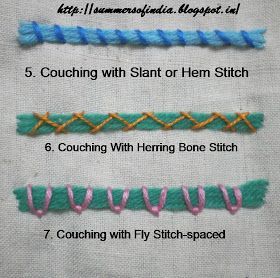
Couching: A patterning process in which a yarn or object is attached to the surface of a fabric with one or more stitches. [KC – Like embroidery.]
Embroidery: The embellishment of fabrics by means of needle-worked stitches. An extensive variety of stitches and materials are used in embroidery. [KC – In embroidery, the thread is referred to as “floss.”]

Felt: A fabric made of loose, haphazardly arranged wool fibers, which have surface scales that stick to each other as a result of the felt-making process. In Central Asia, nomadic peoples live in circular tents called yurts, the roofs and walls of which are covered in felt.

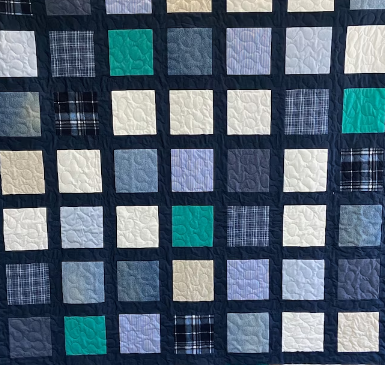
KC – I learned how to make felted purses and slippers and other items from yarn. It was so addictive, I broke my washing machine’s clutch and ended up finishing the job on the stove. (My husband asked what stinky thing I was cooking for dinner.) The process of heating the wool in water makes it shrink and thicken so that it resembles the texture of the felt squares (above) rather than the original texture—something more like a knit scarf. It’s like magic!
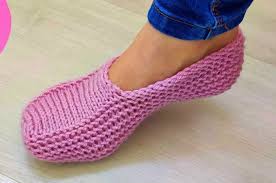
knit

knit and felted
Piecing: The joining of pieces of fabric to make a larger textile. The top layer of “patchwork” American quilts is pieced before being quilted.
Spindle: A narrow tapered stick that is twirled in the spinning process, and onto which the spun yarn is wound. Hand spindles usually have a weight, or whorl, to help provide momentum.

whorl drop spindle
This is just a handful of terms related to textiles. For more, see the website above, The George Washington University Museum.
Jolie, thank you for the topic suggestion!
Kara Church | Technical Editor, Advisory | Technical Publications
Pronouns: she/her | Call via Teams | jackhenry.com
Editor’s Corner Archives: https://episystechpubs.com/
Posted in Articles
Posted by: Jack Henry | June 8, 2023
Editor’s Corner: Words with Multiple Meanings
Hello to my favorite people! I was just looking through some of my emails and I stumbled on one about words with multiple meanings. In English, that’s pretty darn common, so why did I choose these? Well, I follow this fellow Anu Garg (at wordsmith.org) and he discusses five words a week that have a general theme. These two words amused me personally, so I’m sharing them with you.
I know what decolletage is, but I was curious how it might relate to decollate. Now you’ll find out too!
decollate
1. To behead.
2. To separate sheets of paper, from a multiple-copy printout, for example.
ETYMOLOGY:
For 1: From Latin decollare, from de– (from) + collum (neck). Earliest documented use: 1599.
For 2: From de– (from) + collate (to gather, merge, etc.), from conferre (to bring together). Earliest documented use: 1967.
NOTES:
Sometimes the word decollate is used as an alternate spelling for the decollete (which is short for decolletage: a low neckline on a woman’s dress). But when you need to refer to a low neckline in a formal context—an office memo, a research paper, a court brief, a patent application, etc.—it’s best to go with decollete. [KC – Hmm…I don’t think this will be in any of our office memos!]
This next one (with multiple meanings and spellings) reminds me of my mom. She’s the one that taught me what a dickey was when I was a little kid. She went to an all-girl Catholic college where they had to wear their black graduation gown over their clothes for certain events. Once you see the first definition for dickey, you’ll understand why it might’ve been useful for a quick change with the graduation gown.
dickey, dicky, or dickie
| noun: | 1. A detachable shirtfront, collar, bib, etc. |
| 2. A small bird. | |
| 3. A donkey. | |
| 4. The driver’s seat or rear seat in a carriage. | |
| 5. The luggage compartment of a vehicle; also known as trunk or a boot. | |
| adjective: | 1. Not working properly. |
| 2. In poor health. |
ETYMOLOGY:
For noun: A diminutive of Dick, a nickname for Richard. Earliest documented use: 1753.
For adjective: Of uncertain origin. Earliest documented use: 1788.
And now you can buy a four-pack of dickeys from Amazon, for under $20!


Kara Church | Technical Editor, Advisory | Technical Publications
Pronouns: she/her | Call via Teams | jackhenry.com
Editor’s Corner Archives: https://episystechpubs.com/
Posted in Articles
Posted by: Jack Henry | June 6, 2023
Editor’s Corner: AI and Writing
A few months ago, our manager had us try ChatGPT and test how this artificial intelligence might work for documentation in the future. We produced a few fun items, but we found that ChatGPT is not able to write detailed instructions very well. In addition, you don’t want to test with company material because it becomes part of ChatGPT’s “encyclopedia” of information for the public.
Outside of testing ChatGPT, I’ve received numerous emails about how AI is going to make writers and editors unnecessary, and other emails about how you can’t just throw writers and editors away, because AI cannot understand the subtleties of writing and being human.
I heard an interview the other day with David Simon, the writer of the scripts for The Wire, among other shows. The interviewer was trying to get Mr. Simon to admit he might try AI for writing scripts. Simon’s response was one of disgust and he said, essentially, he’d rather be dead.
And I agree. It will be some time before creativity can be programmed…and why? It’s a great thing to be a human and be able to write stories, make things with your hands, and use your imagination. But I digress. I read a great article that my former manager sent my way. I’m only going to include some of it here, but the link is below if you’d like to all of it.
Why Learning to Write Well Is Still Important in the Age of A.I.
…It’s clear A.I. is advancing incredibly rapidly and soon will transform how a lot of white collar work gets done.
What exactly those changes will look like is the subject of fierce debate and is probably anybody’s guess at this point. But already impressive tools like ChatGPT make plain that a lot of routine writing will probably be done by bots in the future.
Marketers are already experimenting with having chatbots write social-media posts and ads. College professors are rethinking the essay for the age of A.I. Real estate agents are handing off writing listings to the bots. So if you’re a young person today, should you conclude that it’s time to decrease the time and effort you invest in learning to write well?
Writing makes you smarter.
Actually no, answers a chorus of experts. …(W)riting isn’t just banging out the right string of words to get your meaning across…. The most important function of writing isn’t to teach others, but to teach yourself.
"Writing is the process by which you realize that you do not understand what you are talking about. Importantly, writing is also the process by which you figure it out," writes Farnam Street blogger Shane Parrish. "Writing about something is one of the best ways to learn about it."
…(E)ven those with not a shred of literary ambition—should perfect their writing. Not to persuade others, but to make themselves smarter.
"Everyone is full of ideas they’re not aware of. They’re gut feelings. Intuitions. You use them a dozen times a day. But you’d shrug your shoulders if someone asked why. How you react to career risk. Why you invest the way you do. Why you like some people and question others. We’re all brimming with opinions on these topics that we may never discuss, even with ourselves," Housel argues. Writing is the way to turn that "phantom intelligence" of hunches and half-formed opinions into usable tools for the betterment of yourself and your career….
If you want to learn to think, you need to learn to write.
One day in the not-too-distant future, a chatbot may be able to write a convincing email to your boss or polish up that important presentation in minutes. Use those abilities to your advantage. But no bot is going to figure out how complex ideas fit together and apply that to your specific situation any time soon. No bot can help you pick your way through a challenging intellectual puzzle. [KC-Emphasis mine. No bot can do this, but editors can!]
Chatbots can convincingly regurgitate human knowledge, but they still struggle to expand it or even combine it in new and enlightening ways.
In this world, empathetic, experimental, humane writing may end up being an even more valuable career skill. But even if you don’t plan to market yourself as a wordsmith or communicator, you still need to be able to think. And the best tool for thinking humans have ever invented—up to and including these mind-bending new A.I. tools—is good old-fashioned writing. So if you want to be able to think clearly and well, you still need to learn to write.
NOTICE: This electronic mail message and any files transmitted with it are intended
exclusively for the individual or entity to which it is addressed. The message,
together with any attachment, may contain confidential and/or privileged information.
Any unauthorized review, use, printing, saving, copying, disclosure or distribution
is strictly prohibited. If you have received this message in error, please
immediately advise the sender by reply email and delete all copies.
Posted by: Jack Henry | June 1, 2023
Editor’s Corner: Looking for Verbs
Good morning, friends!
Most of the time when I have a topic to discuss that requires examples, I make the examples up. Well, I’ve been saving a bunch of phrases from the editing I’ve been doing so I can provide some alternatives to the material we receive.
This started out because I was feeling peevish. Today I’m a happy camper, so perhaps I will advise more gently. I would file most of these examples under “hidden verbs,” but I have also noticed the overuse of this formation: the ____ of ____. It’s a way of “hiding” verbs with unnecessary words.
Here are some examples:
- The application of payments
- The sharing of programs
- The tracking and reporting of products
- Support the tracking of disbursements
Can you feel the passiveness? Can you see where those verbs are hiding? Let’s look at making those statements more active, lively, and exposed!
| Before | After |
| The application of payments | Applying payments |
| The sharing of programs | Sharing programs |
| The tracking and reporting of products | Tracking and reporting products |
| Support the tracking of disbursements | Support tracking disbursements |
| With the display of the error message | Displaying the error message |
As you can see, I’ve taken the nouns—the application, the sharing, the tracking, etc.—and turned them into verbs: applying, sharing, tracking. I’ve also gotten rid of “of,” and just used the objects alone after the verbs, “payments, programs, products, etc.”
Here are some other phrases I found that could just be clearer and more direct. They don’t all follow the pattern above, but you’ll see the phrases are padded with extra words, which diverts the reader from understanding your basic message.
| Before | After |
| By use of | Using |
| Are not able to be transferred | Cannot be transferred |
| Complete your registration | Register |
| For disbursal of funds to participants | To disburse funds to participants |
For more information check out our Symitar Knowledge Base lesson:
Hidden Verbs
Posted in Articles
Posted by: Jack Henry | May 30, 2023
Editor’s Corner: Run and Ran, Revisited
Dear Editrix,
Shouldn’t this message say Reports can be run?

Or am I wrong? I see this quite a bit. 😊 We “run” reports, we don’t “ran” reports, unless we are referring to reports that we have already “run.”
Dear reader,
Yes, this is like reading something and being beaten over the head with a lead pipe at the same time. The confusion is understandable, but let’s see if we can unconfuse people and put a stop to this error.
The first issue is using can or could, which are modal verbs (can, could, would, shall, etc.), in the error message. These auxiliary verbs make things cloudier and tend to cause confusion, so we avoid them in documentation when possible.
The present tense of run is run.
- The community center instructors run a fantastic tennis program.
- The credit union runs their reports every evening after closing.
The past tense of run is ran.
- Heranto the stadium to get tickets to the show, but they were already sold out.
- The report ran for an hour and produced 300 pages.
The past participle is also run (with the appropriate conjugation of “to have”).
- I have run this 5k every year for the past seven years, but this year’s was the most fun.
- He has run the specfile three times, and each time it has produced a blank report.
The problem occurs when people use the past tense (ran) rather than the past participle (have run). The following are both incorrect:
- I have ran this 5k every year…
- He has ran the specfile three times…
If those last two items seem okay to you, they aren’t. Please lather, rinse, and repeat reading from the top again. If the last two examples make you want to pull your hair out, and you see someone using them in an error message or documentation, please send this Editor’s Corner to them and ask them to make some updates.
Thank you for checking in with us about this common mistake!
Kara Church | Technical Editor, Advisory | Technical Publications
Pronouns: she/her | Call via Teams | jackhenry.com
Editor’s Corner Archives: https://episystechpubs.com/
Posted in Articles
 Editor's Corner