Posted by: Jack Henry | April 8, 2016

Editor’s Corner: Loose the Jargon

Do you sometimes feel like the editors badger you about using jargon and business-speak? Do you feel stifled because we want you to use simple language?

We badger out of love—for your readers. The problem is that every business sector creates their own jargon—abbreviations, acronyms, and buzzwords—that everyone else in their field knows, but outsiders don’t. A good example is legalese. If you’re not a lawyer, you probably have a hard time deciphering any legal document. Can I get an amen?

One of my colleagues (thanks, Ron!) recently shared an article called Did the IRS Flunk English? A Rant About Why You Can’t Do Your Taxes from the Acrolinx website, and I’m sharing an excerpt today as a warning and as a reminder of what not to do.

Read this paragraph from an IRS income tax form, and weep. And then, please (I would get on my knees and beg, but I’m dressed up today), think twice before using jargon and business-speak. You don’t want to make others feel like you are about to feel.

In case bond as provided in section 7324(3) shall have been executed and the property returned before seizure thereof by virtue of process in the proceedings in rem authorized in subsection (a) of this section, the marshal shall give notice of pendency of proceedings in court to the parties executing said bond, by personal service or publication, and in such manner and form as the court may direct, and the court shall thereupon have jurisdiction of said matter and parties in the same manner as if such property had been seized by virtue of the process aforesaid.

Donna Bradley Burcher | Senior Technical Editor | Symitar®

8985 Balboa Ave. | San Diego, CA 92123 | Ph. 619.278.0432 | Ext: 765432

Posted by: Jack Henry | April 7, 2016

Editor’s Corner: Endemic, Epidemic, Pandemic

Each year on April 7, the World Health Organization (WHO) celebrates World Health Day by drawing attention to an important global health issue. This year’s theme is "beat diabetes."

In discussions about global health, you might hear the words endemic, epidemic, and pandemic. Picking the right word to describe a disease depends on how quickly the disease spreads, and over how large of an area.

Endemic
If a disease does not spread, but is constant in a region, it is endemic (from the Greek en, in + dmos, people).

Malaria is endemic in some warmer regions, including sub-Saharan Africa and South Asia. Malaria cases are steadily declining, and malaria does not spread to other regions because the Anopheles mosquito does not live in colder climates.

Epidemic
If a disease spreads rapidly, but is confined to one region, it is an epidemic (from the Greek epi, on + dmos, people).

Recent epidemics include yellow fever in Angola, Zika virus in the Americas, H1N1 (swine flu) in India, and Ebola in West Africa.

Pandemic
If a disease spreads rapidly and is not confined to one region, it becomes a pandemic (from the Greek pan, all + dmos, people).

Pandemics can be devastating. In the 14th century, the bubonic plague killed 75100 million people across Europe and Asia. The 1918 Spanish influenza pandemic killed 4050 million people. Fortunately, pandemics are rare.

Diabetes: Endemic, Epidemic, or Pandemic?
The WHO calls diabetes an epidemic because it has spread so quickly. The number of people living with diabetes has nearly quadrupled since 1980 to 422 million. Low- and middle-income countries have seen an especially rapid increase.

Unlike most epidemics, diabetes is not contagious. Diabetes is treatable, and type 2 diabetes (which accounts for about 90 percent of diabetes) is preventable. The WHO is focusing on improving access to insulin in low-income countries and promoting lifestyle measures like engaging in regular physical activity and eating a healthy diet.

Ben Ritter | Technical Editor | Symitar
8985 Balboa Avenue | San Diego, CA 92123
619-682-3391 | or ext. 763391 | www.Symitar.com

Symitar Documentation Services

NOTICE: This electronic mail message and any files transmitted with it are intended
exclusively for the individual or entity to which it is addressed. The message,
together with any attachment, may contain confidential and/or privileged information.
Any unauthorized review, use, printing, saving, copying, disclosure or distribution
is strictly prohibited. If you have received this message in error, please
immediately advise the sender by reply email and delete all copies.

Posted by: Jack Henry | April 6, 2016

Editor’s Corner: April/May Contest!

April has just begun and it seems like a good time for another Editor’s Corner contest. In the past few weeks, I’ve received (and used) some funny photos you’ve submitted. Rather than having you write Tom Swifties or mondegreens for me, how about we switch it up a little and have you send photos?

What I’m looking for is poor punctuation, bad spelling, and atrocious advertising. I’d also settle for some fun and proper uses of English if you can find any. Just remember, the language should be tame enough for me to publish these photos at work.

Who is eligible? All recipients of Editor’s Corner who reside in the United States. If you get someone new to sign up for Editor’s Corner, I will enter your name twice! (Once for your photo and once for the new reader.)

What do you have to do? Take a photo as decribed or shown above that will make us laugh, and send it to kchurch.

What do I win? We have two prizes: t-shirts with the messages pictured below.

When do I have to turn in my photos? Well, I’m going to give you a nice long entry period since I’ll be out of the office for parts of April and May. How about Friday, May 13 at noon (PT)? That gives you over a month to keep your eyes open and your cameras (or phones) ready for all sorts of situations. During my vacation in Greece, I’m hoping to get a few of my own poorly translated Greek menu photos to share with you!

Why should I do this? Because it is fun! Because a few of you out there do it anyway! Because you might win a t-shirt!

Kara Church

Technical Editor, Advisory

Symitar Documentation Services

Posted by: Jack Henry | April 5, 2016

Editor’s Corner: In To and Into

By request, I am returning to this topic, which many find tricky: When should you use into and when should you use in to? Let’s start with definitions.

In and to are two words that sound just like the single word into. In is an adverb and to is a preposition. When they land next to each other in a sentence, they can cause confusion because they sound like the single word. Here are some examples of how these two words show up next to each other:

· She went in to attend the meeting.

· The SWAT team moved in to rescue the hostages.

As you can see, in is telling us where people are going, but to is part of the infinitive verb (to attend, to rescue).

Into is a single word and is categorized as a preposition. It expresses the movement of something toward or into something else and it generally answers the question where:

· I walked into my brother’s room.

· I jumped into the swimming pool.

· He logged into the system.

So, next time you aren’t sure if you need the single word into or the two words in to, consider whether you are answering the question “Where?” If yes, it’s likely that into is the word you are looking for.

If you still need help and learn better with pictures, try the Purdue OWL.

Kara Church

Technical Editor, Advisory

619-542-6773 | Ext: 766773

Symitar Documentation Services

NOTICE: This electronic mail message and any files transmitted with it are intended
exclusively for the individual or entity to which it is addressed. The message,
together with any attachment, may contain confidential and/or privileged information.
Any unauthorized review, use, printing, saving, copying, disclosure or distribution
is strictly prohibited. If you have received this message in error, please
immediately advise the sender by reply email and delete all copies.

Posted by: Jack Henry | April 4, 2016

Editor’s Corner: Time to Convert Your Nouns

I was reading through a list of techniques for more precise writing the other day, and I came across a technique I don’t think we’ve discussed. Mark Nichol created the list for Daily Writing Tips, and he said that “to produce more vivid, direct, concise prose,” we should convert nouns to verbs.

On my recent trip to England, I converted all my dollars to pounds and then I spent them. While I was there, I also learned the formula to convert the temperature from Celsius to Fahrenheit to figure out how cold I was. So I like to think I’m pretty good at converting things, but I wasn’t at all sure what Mr. Nichol was talking about when he said to convert nouns to verbs. It turns out he wants us to convert nouns that end in –tion to verbs (specifically infinitive verbs, which are the verbs that begin with to). Here is his example:

Before: They will collaborate in the creation of new guidelines.
After: They will collaborate to create new guidelines.

Changing the phrase “in the creation of” to “to create” uses fewer words and it’s clearer. It’s a win-win!

So look for those –tion words in your writing, and when you can, convert them to verbs. Everything we can do to make life easier for our readers is worth the effort.

And by the way, the formula to convert the temperature from Celsius to Fahrenheit is: °C x 1.8 + 32 = °F (for example, 5° C x 1.8 + 32 = 41° F).

I survived.

Donna Bradley Burcher | Senior Technical Editor | Symitar®

8985 Balboa Ave. | San Diego, CA 92123 | Ph. 619.278.0432 | Extension: 765432

Symitar Technical Publications Writing and Editing Requests

NOTICE: This electronic mail message and any files transmitted with it are intended
exclusively for the individual or entity to which it is addressed. The message,
together with any attachment, may contain confidential and/or privileged information.
Any unauthorized review, use, printing, saving, copying, disclosure or distribution
is strictly prohibited. If you have received this message in error, please
immediately advise the sender by reply email and delete all copies.

Posted by: Jack Henry | April 1, 2016

Editor’s Corner: How come?

Dear Editrix,

How about posting something on the questions “How come?” versus “Why?”

Sincerely,

Mindful in Missouri

Dear Mindful,

I find your question very interesting because I know many people say, “How come?” when they want to know why something is the way it is. It just isn’t something I recall saying or hearing recently. I think I generally associate it with kids asking their parents for an explanation of why they aren’t allowed to do something. (“Well, Autumn, I don’t think it’s a good idea for you to take the dog bungee jumping,” said Mr. Oates. Autumn returned with a high-pitched, squealing, “How come, Dad?”)

According to other resources I’ve found, “How come?” is considered by some as grammatically incorrect and by others as “too casual.” Grammar Girl gives us a little more information on the history of the term, which I’m more than happy to share.

The oldest reference for "how come" in the Oxford English Dictionary (OED) is an entry in Bartlett’s Dictionary of Americanisms published in 1848. Although the OED calls "how come" an American coinage, the entry in Bartlett’s indicates it originated in England: "Doubtless an English phrase, brought over by the original settlers." "How come" is believed to be short for "how did it come about that," "how is it that," or "how comes it."

A web search turned up examples of these older phrases:

§ How comes it then that this her cold so great is not dissolved through my so hot desire . . . (British poet Edmund Spenser in "Sonnet 30," 1611)

§ How comes it that the Church has attained such greatness in temporal power . . . (Machiavelli, in The Prince, 1513)

I hope this helps!

Editrix

Thank to Tracy K. for this photo.

Kara Church

Technical Editor, Advisory

Symitar Documentation Services

Posted by: Jack Henry | March 31, 2016

Editor’s Corner: Phony Calls

Tomorrow is April Fools’ Day, so if your phone rings and someone asks about your refrigerator, the caller may be setting you up for the following classic joke:

Caller: Is your refrigerator running?
Victim: Yes.
Caller: Then you’d better go out and catch it!

Everyone agrees that this joke is hilarious. But not everyone agrees on what to call this kind of trick: a prank call or a crank call.

The phrase crank call originated between 1924 and 1953 (probably in the 1940s, the decade in which the percentage of American households owning a phone exploded from 35 percent to 60 percent). Prank call didn’t become popular until the late 1960s.

Today, prank call is more popular online (9.8 million Google® search results, compared with 142,000 for crank call), but crank call remains more popular in books (1.4 times as common as prank call).

Although many people use prank call and crank call interchangeably, some draw a subtle distinction between the two terms.

A prank is a mildly mischievous act, according to Merriam-Webster. A crank is an annoyingly eccentric person. So, a prank caller is trying to play a joke, whereas a crank caller is being weird without trying.

Crank in this sense does not refer to the hand cranks found on the sides of very old phones, but to the idea that an eccentric person is crooked or out of line, like the shape of a crank.

Ben Ritter | Technical Editor | Symitar®
8985 Balboa Avenue | San Diego, CA 92123
619-682-3391 | or ext. 763391 | www.Symitar.com

Symitar Documentation Services

NOTICE: This electronic mail message and any files transmitted with it are intended
exclusively for the individual or entity to which it is addressed. The message,
together with any attachment, may contain confidential and/or privileged information.
Any unauthorized review, use, printing, saving, copying, disclosure or distribution
is strictly prohibited. If you have received this message in error, please
immediately advise the sender by reply email and delete all copies.

Posted by: Jack Henry | March 30, 2016

Editor’s Corner: Latin Phrases Adopted in English, Part II

Welcome to the second part of the Latin Phrases You Should Know, from the Daily Writing Tips website. My training as an altar girl did not prepare me for any of these!

23. in toto (as a whole)

24. ipso facto (by the very fact): because of that fact

25. inter alia (among other things)

26. mea culpa (I am responsible): forgive me

27. memento mori (remember that you must die): a reminder of mortality

28. mens sana in corpore sano (a healthy mind in a healthy body)

29. mirabile dictu (amazing to say)

30. modus operandi (method of operating): way of working (also MO)

31. ne plus ultra (none more beyond): without equal, the greatest degree

32. non sequitur (it does not follow): said of something that does not logically relate to what came before

33. nota bene (note well): take note (also NB)

34. o tempora o mores (oh, the times, oh, the morals): said in criticism of behavior

35. omnia vincit amor (love conquers all)

36. panem et circenses (bread and circuses): said of things offered to the masses to distract them from what they should attend to for their own benefit

37. per se (by itself)

38. post hoc ergo propter hoc (after this, therefore because of this): effect follows cause

39. prima facie (at first look): based on the first impression, or accepted as correct until proved otherwise

40. primus inter pares (first among equals)

41. pro forma (for form): for the sake of appearances or form

42. quid pro quo (this for that): something given in exchange for something else (hence quid, the nickname for the pound in UK currency)

43. quis custodiet ipsos custodes (who watches the watchers?): who shall protect us against those who (supposedly) protect us?

44. sic transit gloria mundi (thus passes the glory of the world): fame is fleeting in this world

45. sine qua non (without which thing . . . not): said of something indispensable

46. sub rosa (under the rose): happening or done in secret

47. sui generis (in its own class): unique

48. tabula rasa (scraped tablet): blank slate (the concept of the human mind before it receives impressions from experience)
49. tempus fugit (time flies)

50. terra firma (solid ground): often used figuratively to refer to certainty

51. vox populi (voice of the people)

Kara Church

Technical Editor, Advisory

619-542-6773 | Ext: 766773

Symitar Documentation Services

NOTICE: This electronic mail message and any files transmitted with it are intended
exclusively for the individual or entity to which it is addressed. The message,
together with any attachment, may contain confidential and/or privileged information.
Any unauthorized review, use, printing, saving, copying, disclosure or distribution
is strictly prohibited. If you have received this message in error, please
immediately advise the sender by reply email and delete all copies.

Posted by: Jack Henry | March 29, 2016

Editor’s Corner: Latin Phrases Adopted in English, Part I

Well, not only did I not find this before the Ides of March (March 15), but I almost missed the entire month of March! Today, I have the first half of a list of Latin Phrases You Should Know, from the Daily Writing Tips website.

I know we recommend against using i.e. and e.g. in our technical documentation these days, but the phrases in this list are used in many different fields—from drama to medicine to law. In fact, Law & Order fans are already ahead of the game, I bet!

From Daily Writing Tips:

Latin expressions are often adopted into English, often with an extended or figurative meaning. Here are fifty of the most common phrases, followed by their literal translation in Latin and the meaning in English (omitted when the meaning follows the literal translation).

1. a posteriori (from the latter): based on experience

2. a priori (from the earlier): independent of experience

3. ad hoc (for this): said of something created or formed for a special case

4. ad infinitum (to infinity): something that keeps going forever

5. alea jactus est (the die is cast): said when a plot is set into motion

6. ars longa, vita brevis (art is long, life is short)

7. casus belli: (cause of war): where the blame lies

8. caveat emptor (let the buyer beware): a reference to the principle that a customer is responsible for making sure that a product is in good working order

9. compos mentis (of healthy mind): sane

10. ex cathedra (from the chair): with the full authority of office (often used in reference to the Catholic pope’s infallibility, but also employed in other contexts)

11. ex post facto (after the fact): realized with hindsight

12. de facto (from fact): something that happens in practice but is not necessarily established by law

13. de jure (from law): the contrary of de facto; something established by law

14. dies irae (day of judgment)

15. dramatis personae (persons of the drama): refers to a list of actors, or to the principal participants of an event or in a group

16. genius loci (guardian spirit): the character of a place

17. honoris causa (for the sake of the honor): an honorary degree

18. horribile dictu (horrible to say)

19. in extremis (in the farthest reaches): in a difficult situation, or at the point of death

20. in flagrante delicto (in the burning crime): caught in the act

21. in media res (into the middle of things): in the midst of action (said of the opening of a story or account)

22. in situ (in that place): in its original place

Kara Church

Technical Editor, Advisory

619-542-6773 | Ext: 766773

Symitar Documentation Services

NOTICE: This electronic mail message and any files transmitted with it are intended
exclusively for the individual or entity to which it is addressed. The message,
together with any attachment, may contain confidential and/or privileged information.
Any unauthorized review, use, printing, saving, copying, disclosure or distribution
is strictly prohibited. If you have received this message in error, please
immediately advise the sender by reply email and delete all copies.

Posted by: Jack Henry | March 28, 2016

Editor’s Corner: 10 Words Derived from “Scribe”

Good morning, folks. I received an interesting article from Daily Writing Tips, which lists ten words derived from the word scribe. Scribe comes from the Latin word scribere, meaning to write, so this information is of interest to all of us!

All the words in the list are verbs, but some can all be changed to nouns by changing ­­-scribe to ­-scription, as in describe/description.

ascribe: attribute (literally, “write to”: “It is largely to this that we must ascribe the national conservatism and contempt for foreigners”)

circumscribe: constrict or surround, or define (literally, “draw around”: “To circumscribe the influence of the ruling favorites, he next suggested the formation of a cabinet council of six or eight ministers”)

conscribe: synonym for circumscribe or variant of conscript

describe: represent by drawing something or talking about it, or trace the outline of something (literally, “draw from”: “I can’t describe how helpless I felt”)

inscribe: write on something (literally, “write in”: “They would then inscribe a verse over the door of the house for protection”)

prescribe: make a rule, or tell someone to use a remedy or treatment (literally, “write before”: “The numerous fasts of the national church prescribe a fish diet”)

proscribe: prohibit (literally, “write for”: “When a legislature undertakes to proscribe the exercise of a citizen’s constitutional right to free speech, it acts lawlessly”)

subscribe: sign or support, or pay regularly for a publication or service (literally, “write beneath”: “Long ago, she had learned that many people didn’t subscribe to her morals”)

superscribe: write outside or on top of or over (literally, “write over”: “Kindly superscribe renewal on the envelope if you are sending it by post”)

transcribe: copy something written or write something spoken, or rewrite music for a different instrument or voice or in a different key (literally, “write across”: “She will transcribe the speech and send you a copy tomorrow”)

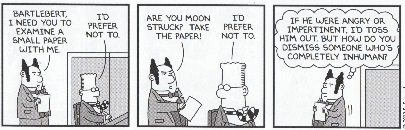
This topic caught my eye because it reminds me of an excellent short story, “Bartleby, the Scrivener: A Story of Wall Street,” by Herman Melville. A scrivener or scribe is a person who drafts legal documents. In Melville’s day, a scrivener wrote out or copied legal documents by hand (which would hurt both your hand and your sanity!). If you’re a fan of classical literature and you haven’t read it, you should check this story out. Or, you could be like Bartleby and say, “I would prefer not to.”

Donna Bradley Burcher | Senior Technical Editor | Symitar®

8985 Balboa Ave. | San Diego, CA 92123 | Ph. 619.278.0432 | Ext: 765432

« Newer Posts - Older Posts »

Categories