Good morning, all.

In honor of my brother’s recent retirement from the San Diego Sheriff’s Department, I have a list of terms (not all of them complimentary) for law enforcement personnel. The list and the definitions come from the Daily Writing Tips website.

20 Slang Terms for Law Enforcement Personnel

A variety of more or less colorful colloquialisms referring to police officers and similar authority figures have developed in American English, sometimes inspired by other languages. Here is a list of such terms.

1. barney: This gently derogatory term refers to Barney Fife, a bumbling small-town deputy sheriff in the classic 1960s sitcom The Andy Griffith Show.

2. bear: This term, from truckers’ slang, alludes to a style of hat worn by some law enforcement personnel—one that resembles the one worn by fire-safety icon Smokey the Bear. (See also Smokey.)

3. the boys in blue: This folksy phrase refers to the frequent use of blue as the color of a police officer’s uniform—and harks back to a time when only men could become police officers.

4. bull: a term prevalent in the first half of the twentieth century, primarily referring to railroad police but pertaining to regular police officers as well and alluding to the aggressiveness of these officials.

5. cop: A truncation of copper from British English usage, referring to someone who cops, or captures.

6. dick: A derogatory abbreviation of detective.

7. federales: Originally a Spanish term for federal police in Mexico, but jocularly used in the United States to refer to police in general.

8. the feds: A truncation of federal, referring to federal law enforcement personnel.

9. five-O: A term for police derived from the title of the television series Hawaii Five-O, about a special police unit by that name.

10. flatfoot: A reference to a police officer, with several possible origins, including the association that police who walked a beat supposedly would get the medical condition of flat feet.

11. fuzz: Originally a British English term referring to felt-covered helmets worn by London police officers, later borrowed into American English.

12. G-man: A term (derived from “government man”) from the mid-twentieth century, referring to FBI agents.

13. gendarmes: Originally a French term for rural police officers, borrowed into American English as jocular slang.

14. gumshoe: A term alluding to soft-soled shoes worn by detectives that are more comfortable than hard-soled shoes and/or enable them to follow suspects surreptitiously.

15. the heat: A reference to the pressure that law enforcement officials apply to suspects.

16. the law: A collective term for law enforcement.

17. the man: A term alluding to the imposing authority of law enforcement personnel.

18. pig: A derogatory term dating back to the 1800s that fell into disuse but was revived during the civil rights era.

19. po-po: A reduplicative term referring to police officers.

20. Smokey: A term for law enforcement personnel, derived from an association of the style of hat worn by some state troopers with the one worn by Smokey the Bear.

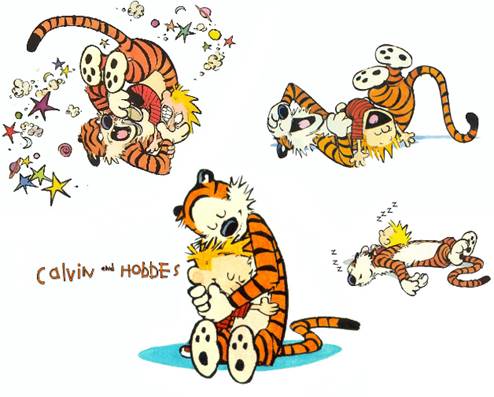
I was a kid when my brother went through the academy, and with or without my permission, he practiced his chokeholds and other submission tactics on me. You can bet I did not play the part of a cooperative perp. This Calvin and Hobbes comic kind of sums up our “practice sessions.”
Donna Bradley Burcher | Senior Technical Editor | Symitar®

8985 Balboa Ave. | San Diego, CA 92123 | Ph. 619.278.0432 | Ext: 765432

Posted by: Jack Henry | October 21, 2016

Editor’s Corner: Suppose

It’s been awhile since we’ve heard from Grammar Girl (Mignon Fogarty). Today I have something from her book, The Grammar Devotional (p. 5). This is definitely a pet peeve that some of you have mentioned to me.

A Supposed Rule: Supposedly Versus Supposably

It would be much easier if I could tell you supposably isn’t a word, but I can’t. It is a word, but the problem is that supposably doesn’t mean the same thing as supposedly and most people use it incorrectly.

The word you usually want is supposedly, which means roughly “assumed to be true” and almost always includes a hint of sarcasm or disbelief:

Supposedly, he canceled our date because of a family emergency.

She supposedly sent the check, but it was lost in the mail.

Supposably means “supposable,” “conceivable,” or “arguably.” It is only a valid word in American English; the British wisely refuse to accept it.

[KC – Apparently, Microsoft® has also refused to accept it, since it is marking is as an incorrect spelling. I think I’m okay with that.]

Note: I’m teaching a class Monday morning on MS Word—about templates and other topics people have asked me about. It’s aimed towards Symitar, but anybody from JHA is welcome. I’m told you just have to look for 60-Minute University on the LMS and register there. I hope to see some of you in class and online! Happy Friday!

Kara Church

Technical Editor, Advisory

619-542-6773 | Ext: 766773

Symitar Documentation Services

NOTICE: This electronic mail message and any files transmitted with it are intended
exclusively for the individual or entity to which it is addressed. The message,
together with any attachment, may contain confidential and/or privileged information.
Any unauthorized review, use, printing, saving, copying, disclosure or distribution
is strictly prohibited. If you have received this message in error, please
immediately advise the sender by reply email and delete all copies.

Posted by: Jack Henry | October 20, 2016

Editor’s Corner: Goody-Two-Shoes

Dear Editrix,

I wonder if you could tell me where the phrase goody two-shoes comes from. It makes so little sense! Do neutral people wear one shoe? Do bad people wear no shoes?

Sincerely,

Benjamin on Battlefield Rd.

Dearest Benjamin,

My first thought was of Adam Ant and his song “Goody Two-Shoes,” but you’re probably too young to remember that.

I did a little digging to find the answer to your question, because your email made me laugh, and I agree—what do two shoes have to do with someone being virtuous? As Merriam-Webster spells and defines it, a Goody-Two-Shoes is “an annoyingly, sentimentally, or affectedly good person; a person who is uncommonly good.”

The history of this term is older than you might expect. It is from a children’s story published in London (1765), titled The History of Little Goody Two-Shoes. John Newbery was the author of this story, which is a variation of Cinderella.

According to Wikipedia:

The fable tells of Goody Two-Shoes, the nickname of a poor orphan girl named Margery Meanwell, who goes through life with only one shoe. When a rich gentleman gives her a complete pair, she is so happy that she tells everyone she has "two shoes." Later, Margery becomes a teacher and marries a rich widower. This earning of wealth serves as proof that her virtuousness has been rewarded, a popular theme in children’s literature of the era.

So there you have it! Good people are rewarded with two shoes, a teaching job, and a good marriage. The rest of us just have to fake it.

Kara Church

Technical Editor, Advisory

619-542-6773 | Ext: 766773

Symitar Documentation Services

NOTICE: This electronic mail message and any files transmitted with it are intended
exclusively for the individual or entity to which it is addressed. The message,
together with any attachment, may contain confidential and/or privileged information.
Any unauthorized review, use, printing, saving, copying, disclosure or distribution
is strictly prohibited. If you have received this message in error, please
immediately advise the sender by reply email and delete all copies.

Posted by: Jack Henry | October 19, 2016

Editor’s Corner: Hanged

Well now, here is a grim lesson for the day. I thought about these words (hanged and hung) when I was writing about the words proved and proven. What I found when I was researching surprised me, and I thought I would share this rule with you. I’m sure many of you already know it, but I found it interesting that the verb changes only for a specific circumstance. Yay for English!

The following article and examples are from the Grammarist website.

Hung is the past tense and past participle of hang in most of that verb’s senses. For instance, yesterday you might have hung a picture on the wall, hung a right turn, and hung your head in sorrow. The exception comes where hang means to put to death by hanging. The past tense and past participle of hang in this sense, and only in this sense, is hanged.

When someone is hung out of malice but with no intent to kill, as described in the example below, hung is the conventional word:

They hung him by chains and tortured him. [Day Press News]

Examples:

Hung

A column of smoke visible from six miles away hung over the scene throughout the afternoon. [NBC Washington]

Two teenage boys that hung on to tree branches for two hours in the middle of Beaver Creek have been rescued. [My Fox Phoenix]

I hung the decorations in our platoon office for everyone to enjoy. [Galesburg Register-Mail]

Hanged

The hangman, who has hanged nine people in his 21 years in prison, has requested anonymity. [BBC News]

A man due to be sentenced tomorrow for murdering his brother has been found hanged in his cell. [Mirror]

Kara Church

Technical Editor, Advisory

619-542-6773 | Ext: 766773

Symitar Documentation Services

NOTICE: This electronic mail message and any files transmitted with it are intended
exclusively for the individual or entity to which it is addressed. The message,
together with any attachment, may contain confidential and/or privileged information.
Any unauthorized review, use, printing, saving, copying, disclosure or distribution
is strictly prohibited. If you have received this message in error, please
immediately advise the sender by reply email and delete all copies.

Posted by: Jack Henry | October 18, 2016

Editor’s Corner: Proved and Proven

The other day one of you asked me about the words proved and proven and if we could discuss their usage. Of course we can!

First, the obvious: both are from the verb to prove, meaning to demonstrate the truth of something, such as a theory. Generally, in American English, proven is used as an adjective. For example, “He’s a proven genius, with an IQ over 145.” Proved is usually the inflected form of the verb, such as “I proved that I could turn water into wine,” said the Mad Hatter.

Here is some additional information, from the Grammarist, where you can also read additional examples of their use.

Both forms are many centuries old. Proven appears in the 15th-century works of Chaucer, for instance. But proved has always been the prevalent inflection ever since prove emerged from its pre-Middle English roots, and only over the last century or so has proven gained significant ground. This doesn’t mean proven is wrong, though. It is a very well-established form, and only a few people from outside North America consider it questionable.

“Whenever I feel sad, depressed, morose, dejected, or glum I remind myself it’s all my parents fault for getting me a Thesaurus for Christmas.” –Matt Oswalt

Kara Church

Technical Editor, Advisory

619-542-6773 | Ext: 766773

Symitar Documentation Services

NOTICE: This electronic mail message and any files transmitted with it are intended
exclusively for the individual or entity to which it is addressed. The message,
together with any attachment, may contain confidential and/or privileged information.
Any unauthorized review, use, printing, saving, copying, disclosure or distribution
is strictly prohibited. If you have received this message in error, please
immediately advise the sender by reply email and delete all copies.

Posted by: Jack Henry | October 17, 2016

Editor’s Corner: Why Do We Study Grammar?

Good morning, crew!

Recently, I read an article in the Parade magazine in my local Sunday newspaper. A reader asked Marilyn Vos Savant why it’s important to be able to identify the parts of speech. Many people ask me why it’s necessary to study grammar at all. I thought that Marilyn’s answer was right on point: we all want to be understood.

Q: You once explained why so much class time is spent on identifying parts of speech, such as whether a verb is reflexive, when no one uses this knowledge in life. Could you expand on the subject for my family?

A: I spent seemingly endless hours diagramming complex sentences in grade school, and I’ll always be thankful for the experience. (Not that I thought so at the time!) You need to learn every rule of grammar because this lays the foundation for high-quality adult communication. And I don’t mean pretentious speech. I mean the ability to express yourself clearly and well. This is much harder than it sounds. [dbb – That’s the truth!]

[dbb – This is the good part.] Less-than-excellent grammar dooms one to a life of being misunderstood. How many times have you said, “No, I meant…”? (And how often have you listened to a person telling you about something for a couple of minutes before you finally figured out what he or she was talking about?) Misplacing even one pronoun can totally confuse a listener. Worse, you usually don’t realize this is happening. Your listeners just get it wrong.

When you’re writing, you are obviously not face-to-face with your audience, and you don’t have the benefit of observing anyone’s confused facial expression, so you may not know that your message was not understood. Lucky for you, you have editors who would be more than happy to review anything you write. Symitarians can use this link to submit any type of business-oriented written correspondence to a Symitar editor. Folks at JHA can use this link.

You may not be interested in diagramming sentences or studying grammar books and articles (although some of us nerds find no end of pleasure in that kind of reading), but you can do the right thing and take the time to express yourself clearly. When communicating with others, especially clients, it should never be acceptable to say, “That’s good enough.”

Donna Bradley Burcher | Senior Technical Editor | Symitar®

8985 Balboa Ave. | San Diego, CA 92123 | Ph. 619.278.0432 | Extension: 765432

Symitar Technical Publications Writing and Editing Requests

NOTICE: This electronic mail message and any files transmitted with it are intended
exclusively for the individual or entity to which it is addressed. The message,
together with any attachment, may contain confidential and/or privileged information.
Any unauthorized review, use, printing, saving, copying, disclosure or distribution
is strictly prohibited. If you have received this message in error, please
immediately advise the sender by reply email and delete all copies.

Posted by: Jack Henry | October 13, 2016

Editor’s Corner: Fossil Words, Part 1

The English language is always changing. Last month, the Oxford University Press made headlines when it added YOLO and fuhgeddaboudit to the Oxford Dictionaries website.

In addition to new words being created, old words are falling into disuse and being forgotten (although they usually escape media mention).

In my next few posts, I am going to talk about a special group of almost-forgotten words called fossil words. Fossil words have not disappeared entirely from the English language, but they are not widely used outside of one or two well-known phrases.

You probably know the word ado (“heightened fuss or concern”). Take a moment to think of a phrase that contains the word ado. Just pick the first one that pops into your head.

There are countless phrases you could have chosen. Merriam-Webster gives the examples “the annoying ado of a political campaign” and “loath to plunge into the holiday ado.”

However, if you’re like most people, you chose “without further ado” or “much ado about nothing.” Ado has been fossilized in these two phrases, and it is rarely used in any other context.

Google News™ can provide a quick snapshot of how people are using words currently. A search for ado shows few recent uses other than “without further ado” and “much ado about nothing”: a Dutch soccer team (ADO Den Haag), a Nigerian city (Ado Ekiti), and an article about dog shelters titled “Mutts Ado About Nothing.”

In my next post, I’ll list 14 more fossil words and warn you about two common spelling traps.

Ben Ritter | Technical Editor | Symitar®
8985 Balboa Avenue | San Diego, CA 92123
619-682-3391 | or ext. 763391 | www.Symitar.com

Symitar Documentation Services

NOTICE: This electronic mail message and any files transmitted with it are intended
exclusively for the individual or entity to which it is addressed. The message,
together with any attachment, may contain confidential and/or privileged information.
Any unauthorized review, use, printing, saving, copying, disclosure or distribution
is strictly prohibited. If you have received this message in error, please
immediately advise the sender by reply email and delete all copies.

Posted by: Jack Henry | October 12, 2016

Editor’s Corner: Phoning it in

The other day, as I was passing through the Education department, I became caught up in a conversation about “phoning it in” and someone asked how that came to mean “to work or perform in an unenthusiastic manner.” I promised my colleagues an answer, but I was surprised to learn that this meaning has been used for a lot longer than I expected.

The following excerpts are from an article from the Visual Thesaurus:

Soon after Alexander Graham Bell patented the telephone in 1876, the name for this new form of communication changed from noun to verb, in order to refer to the act of calling someone by telephone. (People often complain about how nouns get "verbed," but telephoning is perhaps too useful a word to elicit any griping.) Bell himself used the verb early on, describing to the Telegraphic Journal in September 1877 a demonstration of his invention where the audience was able to listen to a concert remotely: "I telephoned the leader of the band and requested him to place the higher cornets nearer the instrument." As Bell’s gadget caught on, both the noun and the verb were rapidly shortened to phone.

The verb phone then underwent a subtle expansion of its meaning, from "calling (someone) by telephone" to "announcing or relaying (something) by telephone."

…The luxury afforded by the telephone of transmitting a message from a distance (rather than having to show up in person) led to all manner of jokes. Among stage actors, a "gag" circulated about an actor with a role so small that he could phone it in. A glimmer of this joke can be found in a February 1938 syndicated newspaper column called "Senator Soaper Says." (Senator Soaper was a pseudonym for Harry V. Wade of the Detroit News.) The column includes a sarcastic comment about Thornton Wilder’s Our Town, which was then a new and controversial play. As our own Shannon Reed recently explained, Wilder explicitly laid out the stage instructions for the play: "No curtain. No scenery." "Now that a Broadway drama has attained hit proportions with no scenery," wrote Senator Soaper, "the next step is to have the actors phone it in."

…By the advent of the television age in the 1950s, phoning it in had drifted away from these jokey images, becoming an established idiom for a rote or uninspired performance. The actress Joan Caulfield used the idiom in an interview with the Washington Post that appeared on Sep. 6, 1953. Caulfield, the article explained, preferred performing on live television rather than on prerecorded broadcasts, because "so many people feel you’re doing the show for them — not ‘phoning it in." The actor Edmond O’Brien expressed a similar sentiment in the Oct. 2, 1960 Los Angeles Times: "There’s a great danger," he said, "of just playing yourself when you’ve been at this trade a while … of just phoning it in."

Phoning it in moved beyond the acting profession to become a widely recognized expression appropriate for any type of ho-hum public performance, from athletics to music to politics.

Kara Church

Technical Editor, Advisory

Symitar Documentation Services

Posted by: Jack Henry | October 11, 2016

Editor’s Corner: Daemons, Demons, and Pandemonium

Hello!

It’s the month of ghouls, goblins, and other frightening creatures—what better time for an excerpt from Words of a Feather: A Humorous Puzzlement of Etymological Pairs, by Murray Suid? Our words for today are mailer-daemon and pandemonium.

When an email that you sent comes back to you from “Mailer-Daemon,” this isn’t the work of the devil—at least not a living, breathing devil. It’s merely a message from a robotic daemon software program alerting you to the fact that there was a problem with the email address.

There are many daemon programs, and if you’re not aware of them, that’s because they are designed to lurk silently—and invisibly—in the background, ready to handle a task if the need should arrive.

If you wonder why such a helpful type of program got such a demonic-sounding name, it is because in the 1960s the innovative computer geniuses at MIT not only were at the cutting edge of information technology, they also knew classical Greek mythology.

Specifically, they understood that in the Greek myths, daemons (pronounced just like demons) were helpful semi-divine beings that stood between the gods and human beings. They were the pagan equivalents of guardian angels. As such, they were the perfect model for digital servants that stood between the geeks and the end users.

But if demons are so “nice,” how did they get demonized? The translators of some versions of the New Testament borrowed the word demon as the name for evil spirits allied with the Devil. It was that sense of the word that John Milton had in mind when, for his poem Paradise Lost, he coined Pandemonium as the name of Satan’s capital city, creating the word from the Greek pan-, “all,” and daimon, “demon,” figuratively, “a home just for demons.” Knowing how evil spirits act when they get together, we can easily imagine how the word pandemonium came to mean chaos and mayhem.

And a big thank you to Dan G. for the following:

Kara Church

Technical Editor, Advisory

Symitar Documentation Services

Posted by: Jack Henry | October 10, 2016

Editor’s Corner: Farther or Further?

Good morning and welcome to another Editor’s Corner.

I have a couple of questions for you today. What’s the deal with the words farther and further? Are they synonyms?

Well, not in the United States. (The story is different in the UK—I’ll explain later.)

Farther and further both relate to distance, and many people use them interchangeably, but here in the U.S., the words have slightly different meanings.

First, I’ll tell you what each word means, and afterward I’ll give you a tip that will help you remember which is which.

· Farther is used to denote physical distance.
Example: My son, who is in the Coast Guard, is getting ready to move even farther away from home.

· Further is used to denote metaphorical or figurative distance.
Example: My husband and I need to think further about where we are going to live now.

There’s a simple mnemonic that helps me remember which word to use: the word farther has far in it. And far relates to physical distance.

In the Queen’s English, further is used for both meanings. So, if you can’t remember which word to use and you’ve forgotten the mnemonic, just lapse into a British accent.

Donna Bradley Burcher | Senior Technical Editor | Symitar®

8985 Balboa Ave. | San Diego, CA 92123 | Ph. 619.278.0432 | Extension: 765432

Symitar Technical Publications Writing and Editing Requests

NOTICE: This electronic mail message and any files transmitted with it are intended
exclusively for the individual or entity to which it is addressed. The message,
together with any attachment, may contain confidential and/or privileged information.
Any unauthorized review, use, printing, saving, copying, disclosure or distribution
is strictly prohibited. If you have received this message in error, please
immediately advise the sender by reply email and delete all copies.

« Newer Posts - Older Posts »

Categories