Posted by: Jack Henry | March 21, 2017

Editor’s Corner: Oxford Comma Legal Drama

Hello, fair Editor’s Cornerians! Several of you have asked about the Oxford (or serial) comma and why we use it. In case you aren’t sure of what I’m talking about, it is the comma in a list that comes right before the conjunction.

For example:

· “He’s expecting his friends, Tyne Daly, and his mom at dinner.”

That seems clear: his mom, Tyne Daly, and his other friends are coming to dinner. Without that comma before the and, I (and many others) argue that the reader might be confused.

· “He’s expecting his friends, Tyne Daly and his mom at dinner.”

In this case, are we talking about several people? Or are Tyne Daly and his mom his only friends coming to dinner?

Here is a legal case, that several of you have sent my way, which shows us why the Oxford comma is a good thing.

From the ABA Journal:

Oxford comma issue benefits drivers in overtime case

Ambiguity caused by lack of a comma in a law on overtime pay has benefited Maine dairy delivery drivers.

The Boston-based 1st U.S. Circuit Court of Appeals pointed out the issue in the first sentence of its March 13 decision (PDF). “For want of a comma, we have this case,” the court said in an opinion by Judge David Barron. The Daily Labor Report, Quartz and FindLaw have stories.

Because the statute was ambiguous, it should be interpreted in favor of the dairy workers who distribute milk but do not pack it, the appeals court found.

The court was asked to interpret a Maine law that requires overtime pay, except for some activities that involve foods, including “packing for shipment or distribution” of the foods. The court was asked to decide whether “packing for shipment or distribution” referred to one activity that involves packing or two separate activities—one that involves packing and the other that involves distribution. If distribution were a separate activity, the workers couldn’t collect overtime.

The statute provided that workers were not entitled to overtime if their jobs involved “the canning, processing, preserving, freezing, drying, marketing, storing, packing for shipment or distribution of: (1) agricultural produce; (2) meat and fish products; and (3) perishable foods.”

Because there was no comma after “packing for shipment,” the drivers argued, “distribution” was not a separate activity. They also provided another grammatical argument: The first items in the list—canning, processing and the like—were gerunds, while the words “shipment” and “distribution” were not. That showed that “distribution,” like the word “shipping,” was an object of the preposition “for”—and was not a separate activity that barred them from collecting overtime.

The drivers’ employer had pointed to a lack of a conjunction before “packing.” The drivers responded with a citation to a book by the late Justice Antonin Scalia and Bryan Garner that says statutory drafters sometimes omit conjunctions in a list in a technique called “asyndeton.”

The appeals court noted the conflicting arguments and sided with the drivers, citing the protective purpose of the overtime law. According to Quartz, “the profoundly nerdy ruling is … a win for anyone who dogmatically defends the serial comma,” which also is known as the Oxford comma.

Kara Church

Technical Editor, Advisory

619-542-6773 | Ext: 766773

Symitar Documentation Services

NOTICE: This electronic mail message and any files transmitted with it are intended
exclusively for the individual or entity to which it is addressed. The message,
together with any attachment, may contain confidential and/or privileged information.
Any unauthorized review, use, printing, saving, copying, disclosure or distribution
is strictly prohibited. If you have received this message in error, please
immediately advise the sender by reply email and delete all copies.

Posted by: Jack Henry | March 20, 2017

Editor’s Corner: Funny Old-fashioned Insults

What better way to start a Monday than with a list of old-fashioned insults? First, a (probably unnecessary) caveat: these words are meant to give you a chuckle not to provide ammunition you can use against your coworkers, friends, family, or even enemies. If you feel the urge to blast one out, remember our JHA motto: Do the right thing.

I got this list from a Dictionary.com slideshow, but they made it clear that you won’t find these words defined in their dictionary because the words are obsolete.

Compared to the invectives we hear today, these words sound like insults a Brownie troop would fling—but they were once considered offensive. I love the whimsical imagery they provide.

· Bedswerver: Shakespeare coined this word to describe an adulterer.

· Fopdoodle: Someone of little significance.

· Gnashnab: An 18th century northern English word, meaning someone who complains all the time.

· Gobermouch: An old Irish term for someone who likes to meddle in other people’s business.

· Klazomaniac: A person WHO CAN ONLY SPEAK BY SHOUTING.

· Scobblelotcher: Someone who avoids hard work like it’s his or her job.

· Snoutband: Someone who always interrupts a conversation to correct or contradict.

· Stampcrab: Someone who’s heavy of foot.

· Whiffle-Whaffle: Someone who wastes a lot of time.

· Zooterkins: Not really an insult, this is something you yell after someone has insulted you.

· Zounderkite: A Victorian word meaning idiot.

Have a fun day.

Donna Bradley Burcher | Senior Technical Editor | Symitar®

8985 Balboa Ave. | San Diego, CA 92123 | Ph. 619.278.0432 | Extension: 765432

Symitar Technical Publications Writing and Editing Requests

NOTICE: This electronic mail message and any files transmitted with it are intended
exclusively for the individual or entity to which it is addressed. The message,
together with any attachment, may contain confidential and/or privileged information.
Any unauthorized review, use, printing, saving, copying, disclosure or distribution
is strictly prohibited. If you have received this message in error, please
immediately advise the sender by reply email and delete all copies.
Posted by: Jack Henry | March 17, 2017

Editor’s Corner: Fetching

One of the lovely women I work with was called fetching the other day, and she remarked how her first thought was that of a dog chasing a ball rather than of looking nice. From there, she wondered about how fetching became a compliment. Today, let’s look at a few words that are complimentary but not standard everyday fare.

· alluring (adj)

"appealing to desires," 1570s, present participle adjective from allure (v.).

· becoming (adj)

"looking well," 1560s, from earlier sense of "fitting" (early 13c.), from present participle of become. Related: Becomingly; becomingness.

· comely (adj)

"beautiful, handsome," c. 1400, probably from Old English cymlic "lovely, splendid, finely made," from cyme "exquisite, glorious, delicate," from West Germanic *kumi- "delicate, feeble" (source also of Old High German chumo "with difficulty," chumig "weak, delicate;" German kaum "hardly, scarcely"). Or. perhaps the modern word is from Middle English bicumelic (c. 1200) "suitable, exquisite," literally "becomely" (compare becoming).

· dapper (adj)

mid-15c., "elegant," from Middle Dutch or Middle Low German dapper "bold, strong, sturdy," later "quick, nimble," from Proto-Germanic *dapraz, perhaps with ironical shift of meaning (source also of Old High German tapfar "heavy," German tapfer "brave"), from PIE root *dheb- "dense, firm, compressed."

· fetching (adj)

1580s, "crafty, scheming," present participle adjective from fetch (v.), in one of its extended senses, here "bring or draw into a desired relation or condition." The sense of "alluring, fascinating" is by 1880, from the verb in the sense "allure, attract, fascinate" (c. 1600). Related: Fetchingly.

For some other related words, you can read more at the Online Etymology Dictionary. I must warn you, a few of the terms aren’t so complimentary!

Kara Church

Technical Editor, Advisory

619-542-6773 | Ext: 766773

Symitar Documentation Services

NOTICE: This electronic mail message and any files transmitted with it are intended
exclusively for the individual or entity to which it is addressed. The message,
together with any attachment, may contain confidential and/or privileged information.
Any unauthorized review, use, printing, saving, copying, disclosure or distribution
is strictly prohibited. If you have received this message in error, please
immediately advise the sender by reply email and delete all copies.

Posted by: Jack Henry | March 16, 2017

Editor’s Corner: Words Added to Merriam-Webster, Part 3

This email is sent on behalf of Jackie Solano.

Today I’ll share some of the food-related terms recently added to Merriam-Webster.

arancini: rounded balls of cooked rice with savory fillings (such as mozzarella cheese) that are coated with bread crumbs and deep-fried

EVOO (abbreviation): extra-virgin olive oil

macaron: a light, often bright colored sandwich cookie consisting of two rounded disks made from a batter of egg whites, sugar, and almond flour surrounding a sweet filling (as of ganache, buttercream, or jam)

santoku: a medium-sized, multipurpose kitchen knife of Japanese origin that has a lightweight blade with a straight or slightly curved cutting edge and a spine that curves downward to the tip

chef’s knife: a large, general-purpose kitchen knife usually 8 to 10 inches long that has a blade curving upward along its length and ending in a narrow point

elderflower: the flower of an elderberry (such as Sambucus nigra) used especially in making wines, liqueurs, and teas

The words artisanal and ginger now include these definitions:

artisanal: creating a product in limited quantities by traditional methods

· an artisanal winery

· an artisanal cheese maker

ginger: a person with red hair (chiefly British)

Jackie Solano | Technical Editor | Symitar®

8985 Balboa Ave. | San Diego, CA 92123 | Ph. 619.542.6711 | Extension: 766711

Symitar Documentation Services

NOTICE: This electronic mail message and any files transmitted with it are intended
exclusively for the individual or entity to which it is addressed. The message,
together with any attachment, may contain confidential and/or privileged information.
Any unauthorized review, use, printing, saving, copying, disclosure or distribution
is strictly prohibited. If you have received this message in error, please
immediately advise the sender by reply email and delete all copies.

Posted by: Jack Henry | March 15, 2017

Editor’s Corner: Ditto

The other night, my husband Ray and I were playing Pokémon and we were talking about a character named Ditto. The next thing I knew, Ray was doing his version of talking to Siri and asked, “Okay, Kara. Where does the word ditto come from?”

I didn’t know the answer, so sue me! I had to look it up, but boy did I find some fun information, and I took a walk down memory lane.

First, the definition from Dictionary.com:

· ditto [dit-oh] /ˈdɪt oʊ/

noun

1. the aforesaid; the above; the same (used in accounts, lists, etc., to avoid repetition). Symbol: ″.

Abbreviation: do.

2. another of the same.

3. Informal. a duplicate; copy.

adverb

4. as already stated; likewise.

verb (used with object), dittoed, dittoing.

5. to make a copy of, using a Ditto machine.

6. to duplicate or repeat the action or statement of (another person).

· ditto marks (noun)

1. Often, ditto marks. two small marks (″) indicating the repetition of something, usually placed beneath the thing repeated.

Second, the etymology from the Online Etymology Dictionary:

1620s, Tuscan dialectal ditto "(in) the said (month or year)," literary Italian detto, past participle of dire "to say," from Latin dicere (see diction). Originally used in Italian to avoid repetition of month names in a series of dates; generalized meaning of "same as above" first recorded in English 1670s.

And lastly, for some of us non-Millennials, the Ditto machine, also known as the spirit duplicator, from Wikipedia:

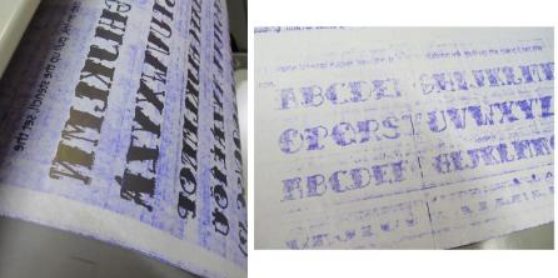
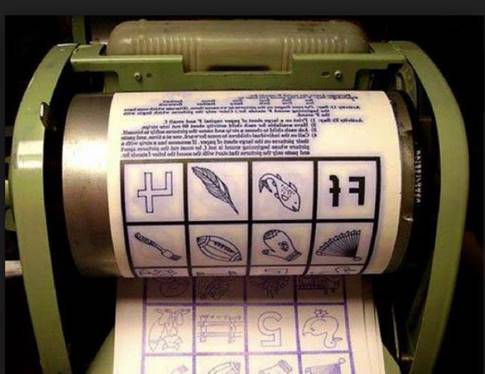
A spirit duplicator (also referred to as a Ditto machine in North America, Banda machine in the UK or Roneo in France and Australia) was a printing method invented in 1923 by Wilhelm Ritzerfeld and commonly used for much of the rest of the 20th century. The term "spirit duplicator" refers to the alcohols which were a major component of the solvents used as "inks" in these machines. The device coexisted alongside the mimeograph.

Spirit duplicators were used mainly by schools, churches, clubs, and other small organizations, such as in the production of fanzines, because of the limited number of copies one could make from an original, along with the low cost and correspondingly low quality of copying.

Here are a couple of photos of the machines and the dittos made from them. Remember the purple color and the smell of freshly dittoed papers?

Kara Church

Technical Editor, Advisory

Symitar Documentation Services

Posted by: Jack Henry | March 14, 2017

Editor’s Corner: However

I remember six years ago, maybe more, Frank W. asked me about starting a sentence with the word however versus connecting two independent clauses with however and a semicolon. For example, is one of these items below incorrect?

· Janine wore a bikini top today. However, the news said it was going to be fifty degrees out.

· Janine wore a bikini top today; however, the news said it was going to be fifty degrees out.

Well, Frank’s retiring soon, and I always try to get back to people with an answer—sometimes it just takes a few years. And who better to give a good, thoughtful explanation than Grammar Girl? Frank, this one’s for you!

Can You Start a Sentence with the Word "However"?

The question I get asked most frequently about however is whether it is OK to use however at the beginning of a sentence, and the answer is yes: it is fine to start a sentence with however. You just need to know when to use a comma and when to use a semicolon.

"However" Without a Comma: Modifier

The comma is important because however is a conjunctive adverb that can be used in two different ways: it can join main clauses and it can modify a clause.

If you use however at the beginning of a sentence and don’t insert a comma, however means “in whatever manner,” “to whatever extent,” or “no matter how.”

For instance, Winston Churchill said, “However beautiful the strategy, you should occasionally look at the results,” and for those of you who like more modern examples, on the TV show House, Dr. Foreman said, “However bad you think you’re going to be in that room, not being there is worse.”

In both those cases, however isn’t playing a role as a conjunction. It’s not joining anything to anything else. It means “no matter how.” “However bad you think you’re going to be” and “No matter how bad you think you’re going to be” mean the same thing. I don’t think anyone has ever disputed starting a sentence with however when it is used that way.

"However" with a Comma: Connector

On the other hand, Strunk and White did say in their book, The Elements of Style, that you shouldn’t start a sentence with however when you mean “nevertheless” or “but.”

They’re referring to sentences such as this one from Charles Dickens’ Nicholas Nickleby, “It is a great deal easier to go down hill than up. However, they kept on, with unabated perseverance,” and this more modern example from the 2009 “Star Trek” movie in which Spock says, “I intend to assist in the effort to reestablish communication with Starfleet. However, if crew morale is better served by my roaming the halls weeping, I will gladly defer to your medical expertise.”

In these examples, however is acting as a connector. It’s providing a transition from the previous sentence to the next sentence.

I know many of you revere Strunk and White, but this is one instance in which nearly all modern style guides have decided that the classic advice is unreasonable. The modern style guides don’t call starting a sentence with however an error. [KC: Emphasis mine.]

Here’s why: when you put a comma after however at the beginning of a sentence, everyone knows it means “nevertheless.” There’s no reason to outlaw a perfectly reasonable use of the word when you can solve the problem with a comma. Some writers have even gone so far as to say it is preferable to start sentences with however instead of burying the word in the middle of a sentence, because putting it at the beginning makes the connection between sentences more clear and therefore makes the text easier to scan.

For even more information on this issue, see Grammar Girl.

Kara Church

Technical Editor, Advisory

619-542-6773 | Ext: 766773

Symitar Documentation Services

NOTICE: This electronic mail message and any files transmitted with it are intended
exclusively for the individual or entity to which it is addressed. The message,
together with any attachment, may contain confidential and/or privileged information.
Any unauthorized review, use, printing, saving, copying, disclosure or distribution
is strictly prohibited. If you have received this message in error, please
immediately advise the sender by reply email and delete all copies.

Posted by: Jack Henry | March 13, 2017

Editor’s Corner: Writing about Numbers AMENDMENT

As a couple of you have already noticed, I accidentally left out a rule. See the red font below.

Thanks to all you eagle eyed readers!

Donna Bradley Burcher | Senior Technical Editor | Symitar®

8985 Balboa Ave. | San Diego, CA 92123 | Ph. 619.278.0432 | Extension: 765432

Symitar Technical Publications Writing and Editing Requests

From: Donna Bradley Burcher
Sent: Monday, March 13, 2017 6:45 AM
To: Donna Bradley Burcher <DBurcher@jackhenry.com>
Subject: Editor’s Corner: Writing about Numbers

Good morning. Today I want to go over JHA and Symitar’s guidelines about how to write about numbers. I know we’ve covered this topic in the past, but it is one that we are asked about often. It is also high on the list of mistakes we see in submitted writing.

I’m going to toss a few rules at you, but hopefully, much of this will be review, so it won’t be overwhelming. This information comes directly from the JHA Style Guide (JHA employees can use the link to view the guide).

Rule 1:

Spell out zero through nine. Use numerals for 10 and greater. Use a numeral with the word percent, even if it is less than 10.

Examples:

· Symitar signed eight clients to its Cruise core processing platform during the past 60 days.

· Respond to the query within 10 business days.

· A 5 percent discount is available.

Rule 2:

Use a numeral if the number identifies a specific item, unit, or value you must enter, even if it is less than 10.

Examples:

· The institution establishes transaction codes 1–99.

· Type 5 and click OK.

Rule 3:

Use a numeral for numbers that are part of a series, if at least one of the numbers is 10 or above.

Examples:

· The children are ages 2, 5, and 12.

· Codes 5–15 are available.

Rule 4:

Use a numeral before a unit of measurement, even if it is nine or below.

Units of measurement include:

· distance

· temperature

· volume

· size

· weight

· points or picas

· bits or bytes

Note: Hours, days, weeks, or any other units of time are not considered units of measurement for this guideline.

Examples:

· I read five pages in the book. (Because the number is nine or below, it is spelled out.)

· I ran 5 miles this week. (Because the number precedes a unit of measurement, it uses a numeral, even though it is nine or below. It is an exception to the rule illustrated by the previous example.)

Have a lovely day today.

Donna Bradley Burcher | Senior Technical Editor | Symitar®

8985 Balboa Ave. | San Diego, CA 92123 | Ph. 619.278.0432 | Extension: 765432

Symitar Technical Publications Writing and Editing Requests

NOTICE: This electronic mail message and any files transmitted with it are intended
exclusively for the individual or entity to which it is addressed. The message,
together with any attachment, may contain confidential and/or privileged information.
Any unauthorized review, use, printing, saving, copying, disclosure or distribution
is strictly prohibited. If you have received this message in error, please
immediately advise the sender by reply email and delete all copies.

Posted by: Jack Henry | March 13, 2017

Editor’s Corner: Writing about Numbers

Good morning. Today I want to go over JHA and Symitar’s guidelines about how to write about numbers. I know we’ve covered this topic in the past, but it is one that we are asked about often. It is also high on the list of mistakes we see in submitted writing.

I’m going to toss a few rules at you, but hopefully, much of this will be review, so it won’t be overwhelming. This information comes directly from the JHA Style Guide (JHA employees can use the link to view the guide).

Rule 1:

Spell out zero through nine. Use numerals for 10 and greater.

Examples:

· Symitar signed eight clients to its Cruise core processing platform during the past 60 days.

· Respond to the query within 10 business days.

· A 5 percent discount is available.

Rule 2:

Use a numeral if the number identifies a specific item, unit, or value you must enter, even if it is less than 10.

Examples:

· The institution establishes transaction codes 1–99.

· Type 5 and click OK.

Rule 3:

Use a numeral for numbers that are part of a series, if at least one of the numbers is 10 or above.

Examples:

· The children are ages 2, 5, and 12.

· Codes 5–15 are available.

Rule 4:

Use a numeral before a unit of measurement, even if it is nine or below.

Units of measurement include:

· distance

· temperature

· volume

· size

· weight

· points or picas

· bits or bytes

Note: Hours, days, weeks, or any other units of time are not considered units of measurement for this guideline.

Examples:

· I read five pages in the book. (Because the number is nine or below, it is spelled out.)

· I ran 5 miles this week. (Because the number precedes a unit of measurement, it uses a numeral, even though it is nine or below. It is an exception to the rule illustrated by the previous example.)

Have a lovely day today.

Donna Bradley Burcher | Senior Technical Editor | Symitar®

8985 Balboa Ave. | San Diego, CA 92123 | Ph. 619.278.0432 | Extension: 765432

Symitar Technical Publications Writing and Editing Requests

NOTICE: This electronic mail message and any files transmitted with it are intended
exclusively for the individual or entity to which it is addressed. The message,
together with any attachment, may contain confidential and/or privileged information.
Any unauthorized review, use, printing, saving, copying, disclosure or distribution
is strictly prohibited. If you have received this message in error, please
immediately advise the sender by reply email and delete all copies.

Posted by: Jack Henry | March 10, 2017

Editor’s Corner: Comma Questions

Dear Editrix,

I’m wondering if you can answer these questions for me about commas.

§ It has been driving me nuts lately that people have been putting a comma after “but.” For example, “I was going to go for a run but, then it started raining.” It is like nails on a chalkboard for me. Is there any case in which putting a comma after “but” makes sense?

§ Is a comma needed before “too”? For example, “I asked about that, too.” I see this used inconsistently.

Sincerely,

Miss B.

Dear Miss B.,

What interesting questions! Let’s start with that comma after the conjunction. Nails on a chalkboard is right! It looks like someone remembered a little something about grammar class, but it wasn’t the correct something. What we have here are two independent clauses joined by a conjunction. While we often see these clauses joined by and, but, or, nor, for, so, and yet, the comma comes before the conjunction. For example: I was walking to the store, but then I decided to ride my unicycle instead.

As for your second question, I am from the school that uses a comma with the word too when it is being used in place of also. I just always figured that was a rule. When I did a little digging; however, I discovered that it is less of a rule and more a matter of style. While many of us learned this as rule, it seems that commas are not required in these instances:

§ I, too, have decided to become a basket weaver. (Though the commas in this case provide emphasis.)

§ Bob said his brother resembled Al Capone, too.

I’d still include the commas, but that’s just me. You are free to forego them if your style is different.

Editrix

NOTICE: This electronic mail message and any files transmitted with it are intended
exclusively for the individual or entity to which it is addressed. The message,
together with any attachment, may contain confidential and/or privileged information.
Any unauthorized review, use, printing, saving, copying, disclosure or distribution
is strictly prohibited. If you have received this message in error, please
immediately advise the sender by reply email and delete all copies.

Posted by: Jack Henry | March 9, 2017

Editor’s Corner: How to Describe Keys, Part 3

Shifty Characters

In my last post, I discussed the 11 special character keys on a standard keyboard. Some readers asked about the other 21 special characters—the ones that share keys with numbers or other characters (like the exclamation point piggybacking on the 1 key).

Good news; it’s actually easier to write about these characters than their non-shifted counterparts. Because these characters always occur in combination with the Shift key, you can usually refer to them using Shift+<symbol> (for example, “Press Shift+!”). You don’t need to worry about the name of the symbol.

Here’s the rule as stated by the Microsoft Manual of Style:

“To show a key combination that includes punctuation that requires use of the Shift key, such as the question mark, add Shift to the combination and give the name or symbol of the shifted key. Using the name of the unshifted key, such as 4 rather than $, could be confusing to users or even wrong.”

Tip: Always spell out the names of the plus and minus signs, hyphen, period, and comma (for example, “Press Shift+Plus Sign”). This is to avoid writing confusing instructions like “Press Shift++” or “Press Ctrl+..”

Ben Ritter | Technical Editor | Symitar®
8985 Balboa Avenue | San Diego, CA 92123
619-682-3391 | or ext. 763391 | www.Symitar.com

Symitar Documentation Services

NOTICE: This electronic mail message and any files transmitted with it are intended
exclusively for the individual or entity to which it is addressed. The message,
together with any attachment, may contain confidential and/or privileged information.
Any unauthorized review, use, printing, saving, copying, disclosure or distribution
is strictly prohibited. If you have received this message in error, please
immediately advise the sender by reply email and delete all copies.

« Newer Posts - Older Posts »

Categories