Posted by: Jack Henry | January 23, 2025

Editor’s Corner: Pear-shaped

Good morning, language lovers!

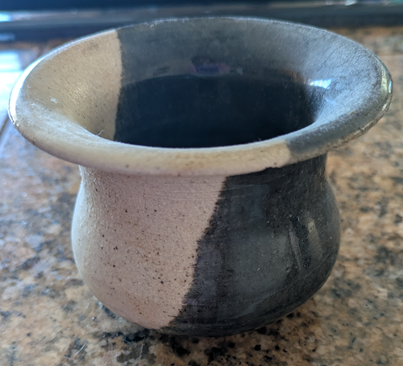
Several months ago, one of you wrote in about the idiom “gone pear-shaped,” and explained how it was from pottery. The meaning of “gone pear-shaped” is that something has gone wrong. It makes sense that it might come from pottery. Goodness knows, I’ve tried to throw a pot, spun the wheel, and ended up with a mug that has a heavy bottom. (Or a vase that’s more of a weapon, or a bowl that is an inch thick at the bottom, with “walls” a quarter-inch thick. Yep, I am sold on “pear-shaped” as describing a situation that has turned out badly.)

I’ve heard people describe women as pear-shaped, in fact just the other day I was watching a show about medieval women’s clothes and the professor said that people considered pear-shaped sexy, so you want it to look like you’re packing heat in the back. (For your off-work time, if you are interested, this historian is hilarious: Eleanor Janega).

I didn’t want to offend anyone with the phrase “pear shaped,” though, so I thought I better check on the pottery comparison and where the phrase comes from.

I found that the actual history of the phrase is unclear. Here is what my searches turned up:

  1. Aviation. From the Royal Air Force. [KC – This is the most popular explanation, but sources disagree about what represents a pear-shaped failure.] Pilots used “pear-shaped” to describe a poorly executed maneuver. Instead of flying in a smooth loop or roll, the pilot’s attempt was wonky. Others say it is from crashing the plane “nose first.”
  2. Pottery. As described above. An item intended to be well-balanced and symmetrical ends lopsided and bottom-heavy.
  3. Ballooning: Some believe it could be related to hot air balloons, where an improperly inflated balloon might resemble a pear shape and not function as intended.

From the Free Dictionary, here is a definition and some examples.

To fail or fall apart.

  • The deal went pear-shaped because of disagreements over the distribution of royalties.
  • Molly’s surprise party went pear-shaped after someone in the office accidentally told her about it.
  • The event will definitely go pear-shaped if our chief donor backs out!

As for the origin, the pottery history gets my vote. I’ve lived it too many times over the years.
Kara Church | Technical Editor, Advisory | Technical Publications

Pronouns: she/her | Call via Teams | jackhenry.com

Editor’s Corner Archives: https://episystechpubs.com/
Posted by: Jack Henry | January 21, 2025

Editor’s Corner: A Piece from Richard Lederer

Good morning, readers! Today’s article is a gift I borrowed from Richard Lederer, the original San Diego verbivore. This is an excerpt from his article from December 7, 2024. For the full version, see:

True confessions of a dyed-in-the-wool verbivore

Carnivores eat meat. Herbivores consume plants. Verbivores devour words. I am such a creature. My whole life I have feasted on words — ogled their appetizing shapes, colors, and textures; swished them around in my mouth; lingered over their many tastes; and felt their juices run down my chin. During my adventures as a fly-by-the-roof-of-the-mouth user-friendly wizard of idiom, I have met thousands of other wordaholics, logolepts, and verbivores — folks who also eat their words. What is there about words that makes a language person love them so?

…Some word people of etymological persuasion are intrigued by the birth and life of words and phrases. They love the fact that when a candidate for office went to the Forum in ancient Roman times, he wore a bleached white toga to symbolize his humility, purity of motive, and candor. The original Latin root, “candidatus”, meant “one who wears white,” from the belief that white was the color of purity and probity. The Latin verb “candere” “to shine, to glow,” parents the English words “candid,” “candor,” “candle,” and “incandescent.”

While many fabrics and garments are colored or printed after they are woven, wool is sometimes dyed before it is ever woven or made into cloth. The color of that wool is through- and-through and impossible to remove completely. So when we say someone is a “dyed-in-the- wool” conservative, liberal, environmentalist, animal-rights supporter, Padres fan, etc., we mean that their beliefs are steadfast and permanent….

Then there are the grammarians, who enjoy trying to transmute the briar patch of pronoun cases, subject-verb agreement, sequence of tenses, and the indicative and subjunctive moods into a manageable garden of delight. Such devotees of correct usage often explore the nuances of confusing word pairs — “lay” vs. “lie” (“lay” means ”to put”; “lie” means “to repose”), and “podium” vs. “lectern” (you stand on a podium; you stand behind a lectern). Other wordaholics experience the joy of lex by prowling the lunatic fringes of language. These recreational word players ponder why we drive in a parkway and park in a driveway and our nose can run and our feet can smell.

Finally, there are the legions of pundits, punheads, and pun pals….

When I say “language,” I mean by and large that glorious, uproarious, notorious, victorious, outrageous, courageous, contagious, stupendous, tremendous, end-over-endous adventure we call the English language. That’s because in matters verbal, I am unabashedly lexist. Just as many would say the Italians do food well and the French do style and fashion well, I believe we English speakers and writers do language well. One might say we do it lexicellently.

Kara Church | Technical Editor, Advisory | Technical Publications

Pronouns: she/her | Call via Teams | jackhenry.com

Editor’s Corner Archives: https://episystechpubs.com/

Posted by: Jack Henry | January 16, 2025

Editor’s Corner: Wrack or Rack?

Dear Editrix,

Have you ever done an article on the phrase, “wracking my brain?”

Sincerely,

Curious Accountant

Dear Curious,

No, I haven’t covered this phrase before, and it looks like there is a lot to cover, so let’s see what English has to offer!

There are two spellings: rack and wrack. While they have been used interchangeably since the 1800s, they are actually different words with different histories. Here is a little information from Merriam-Webster:

…(R)ack is thought to be from the Middle Dutch word recken, meaning “to stretch,” and wrack comes from the Middle English word for a shipwreck, wrak—and (they) do retain different meanings. However, wrack has so often been used as a variant spelling of rack, especially when used in the phrases “(w)rack one’s brain” and “(w)racked with pain,” that many dictionaries now list it as a variant.

M-W says that some style guides, like the New York Times, now say “go with rack,” which will avoid confusion; but then M-W provides information for how to sort between the two, in case you are a stickler (like many of us old-timey editors are). M-W also provides contradictory rules from various style guides. Here is the general set of rules, based on the terms’ etymologies:

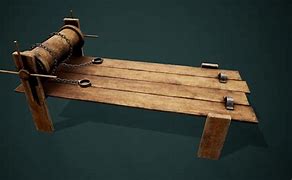
Rack and wrack are often confused, and there are some ways in which one may easily distinguish between the two words. When employing one of them as a noun, you are almost certainly looking for rack. You hang your clothes on a rack, eat a rack of lamb, and, if you are a medieval torture enthusiast, attach someone to a rack to be stretched until bones are broken or joints dislocated.

Some guides have expressed the opinion that since the verb rack comes from an instrument that stretches people (not in a fun way), this word should be used in settings which are related to strain, torture, and stress. And since wrack comes from a background of nautical destruction, this word should be used to indicate either wreckage (storm-wracked) or destruction (wrack and ruin).

If you are one who wants to speed up the change of the language, the article recommends just using the spelling rack for all meanings. I just wanted to give you the history of each so you can make a well-informed decision when you talk about torture or the Titanic.

Hmmm…I don’t think this is what Nordstrom
had in mind when the named their second business.

Kara Church | Technical Editor, Advisory | Technical Publications

Pronouns: she/her | Call via Teams | jackhenry.com

Editor’s Corner Archives: https://episystechpubs.com/

Posted by: Jack Henry | January 14, 2025

Editor’s Corner: Knock on wood

I was looking at some of the questions that I have from you readers, which sit in my file for times like this (when I have a moment to do some research). The questions of the day are:

What do these phrases mean? Where are they from?

  • Knock on wood
  • Touch wood

From Wikipedia:

Knocking on wood (also phrased touching wood) is an apotropaic [KC – “protective magic”] tradition of literally touching, tapping, or knocking on wood, or merely stating that one is doing or intending to do so, to avoid "tempting fate" after making a favorable prediction or boast, or a declaration concerning one’s own death or another unfavorable situation. [KC – I had to laugh at this, “one’s own death or another unfavorable situation,” you know, like a hangnail or running out of toilet paper.]

Here is where I found widely different answers about where the phrase originated and who uses it. Religious sites give credit to Christianity and the “wood” is related to the crucifix. Then, as with numerous Christian customs, historians go back further and relate touching wood to paganism. Two or three of the articles specifically mention Celtic people touching wood to call on the spirits of the trees.

There were a couple of articles, including the one in Wikipedia, that said the phrase is still used in modern language because of a kind of tag called “Tiggy Touchwood,” in which players are safe from being tagged if they are touching wood.”

The phrase or action of “knocking (or touching) wood” appears all over the world. Here are a few of the items from the Wikipedia article:

  • In Azerbaijan and Turkey, when someone hears about a bad thing they usually (along with gently pulling one earlobe) knock on wood thrice to prevent that happening.
  • In Bosnia and Herzegovina, Croatia, Slovenia, Montenegro and Serbia there is also the habit of knocking on wood when saying something positive or affirmative about someone or something and not wanting that to change.
  • In Denmark the saying is 7, 9, 13 / syv, ni, tretten (usually accompanied by knocking under a table), as these numbers have traditionally been associated with magic.
  • In Israel the saying בלי עין הרע‎ b’lí ‘áyin hará’ ("without the evil eye") is said when someone mentions good things happening to themselves or someone else, or even when mentioning a valuable thing they own.
  • In Latin America, it is also tradition to physically knock a wooden object. A variant requires that the object does not have feet (tocar madera sin patas), which rules out chairs, tables and beds.
  • In Spain tocar madera and in France toucher du bois ("to touch wood") is something that you say when you want your luck or a good situation to continue, e.g. Ha ido bien toda la semana y, toco madera, seguirá bien el fin de semana ("It’s been good all week and, touching wood, the weekend will stay good").

There are many more phrases, but they’re all basically a wish for good luck, or a wish against bad luck. Here’s hoping your luck today is good, knock on wood!

Kara Church | Technical Editor, Advisory | Technical Publications

Pronouns: she/her | Call via Teams | jackhenry.com

Editor’s Corner Archives: https://episystechpubs.com/
Posted by: Jack Henry | January 9, 2025

Editor’s Corner: Oodles of Toodles

Hi Kara,

I was at PI12 in Monett a few weeks ago. One night, when we were leaving, one of my team members said “toodle-pip” for goodbye, and of course that meant we hung around 15 more minutes discussing why people, particularly English people, say “toodle-pip”; maybe it’s a more common variety of “toodle-oo.”

It wasn’t long before someone asked me if “toodle-pip” is used in Scotland, and if not, what would the Scots version be. I came up with “cheery-bye” being the Scottish equivalent that carries roughly the same intent, as opposed to “cheerio” which is pretty much universal.

Maybe you’ve got some other happy, friendly ways we say farewell to each other to explore in Editor’s Corner?

Stephen

My dear friend,

First, I need some recommendations for British crime shows I can watch on the telly, preferably ones I could get on Netflix. Second, I don’t have much news for you on this topic, since you and your British brethren have a knack for using the best good-byes.

Here is my collection from several sites, memory, and research. The common thing about them is that they are described as playful, lighthearted, and somewhat informal.

<![if !supportLists]>§ <![endif]>à tout à l’heure [KC – I was told that this is where they think “toodle-oo” comes from. A misunderstanding of the French, which means “see you later,”
or literally, “to everything at the hour.” I couldn’t find anything definitive, but it sounds good to me!]

<![if !supportLists]>§ <![endif]>Adieu

<![if !supportLists]>§ <![endif]>Adios

<![if !supportLists]>§ <![endif]>After a while, crocodile.

<![if !supportLists]>§ <![endif]>Bye-bye

<![if !supportLists]>§ <![endif]>Catch ya on the flip side.

<![if !supportLists]>§ <![endif]>Catch you later.

<![if !supportLists]>§ <![endif]>Cheerio

<![if !supportLists]>§ <![endif]>Cheers

<![if !supportLists]>§ <![endif]>Cheery-bye

<![if !supportLists]>§ <![endif]>Ciao

<![if !supportLists]>§ <![endif]>Later

<![if !supportLists]>§ <![endif]>Later, gator!

<![if !supportLists]>§ <![endif]>Laters

<![if !supportLists]>§ <![endif]>Pip-pip

<![if !supportLists]>§ <![endif]>See ya!

<![if !supportLists]>§ <![endif]>See you

<![if !supportLists]>§ <![endif]>See you later!

<![if !supportLists]>§ <![endif]>Ta ta

<![if !supportLists]>§ <![endif]>Tatty bye

<![if !supportLists]>§ <![endif]>Toodle pip

<![if !supportLists]>§ <![endif]>Toodles

There probably isn’t anything new here for most people. Well, cheery-bye and toodle-pip are new to me. And they sound just as they are described: playful and lighthearted. One list did include “farewell,” but that doesn’t seem either playful or lighthearted.

Thanks for the topic and your input!

Kara Church | Technical Editor, Advisory | Technical Publications

Pronouns: she/her | Call via Teams | jackhenry.com

Editor’s Corner Archives: https://episystechpubs.com/
Posted by: Jack Henry | January 7, 2025

Editor’s Corner: 21-Gun Salute

Dear Editrix,

I have a few questions for you.

§ What is the 21-gun salute?

§ Why 21 guns?

§ When is it used?

Sincerely,

Ammo Annie

Dear Annie,

Interesting questions. I checked the Arlington Cemetery website, the U.S. Army Center of Military History, and Wikipedia.

The salute has a history much older than our country. It is from the 14th century and it is a naval tradition. Back in the day of ships and cannons, a warship signified “its lack of hostile intent by firing its cannons out to sea until all ammunition was spent.” The British generally had seven cannons per vessel, so they’d shoot the seven cannons to signify peace. From the Arlington site:

“Because greater quantities of gunpowder could be stored on dry land, forts could fire three rounds for every one fired at sea — hence the number 21. With the improvement of naval gunpowder, honors rendered at sea increased to 21, as well. The 21-gun salute eventually became the international standard.

In the United States, the custom has changed over time. In 1810, the War Department defined the "national salute" as equal to the number of states in the Union (at the time, 17). This salute was fired by all U.S. military installations on Independence Day and whenever the president visited a military installation. In 1842, the 21-gun salute was designated as the "presidential salute," and in 1875 the United States followed Britain in adopting the 21-gun salute as its international salute.

One question I have after reading this excerpt is: Do we have seven people shoot three times now, or are there 21 people shooting? From what I could gather, we currently fire 21 guns, one human at the end of each. There is a chart on Wikipedia for different countries, including the U.S. and how many guns are used for certain occasions, for example: (from Wikipedia)

In 1842, the United States declared the 21-gun salute as its "Presidential Salute". While the "National Salute" had been formally established as the 21-gun salute, the current tradition holds the salute on Independence Day to be a 50 rounds—one round for each state in the union. This ‘Salute to the Nation’ is fired at noon on 4 July, on U.S. military installations. The U.S. Navy recognizes Presidents’ Day and Memorial Day with a 21-gun salute at 1200.

I’m sure that there are folks out there with more information, but that’s what this civilian could gather. I hope that informs you a little better. I am amazed that the salute has been going on for so long, and that it has remained such a steady tradition.

Thanks for asking the question and leading me to something new!

Kara Church | Technical Editor, Advisory | Technical Publications

Pronouns: she/her | Call via Teams | jackhenry.com

Editor’s Corner Archives: https://episystechpubs.com/
Posted by: Jack Henry | January 2, 2025

Editor’s Corner: Resolutions

Good morning, peeps! Today is another one of those days, where we had a mid-week holiday, and many people are still out enjoying themselves (or nursing hangovers and cleaning up after messy guests).

I read this article about words related to common New Year’s resolutions, and I found some of them interesting. I’m just giving you my favorites, but you can see them all here: 30 Words For The Top 10 New Year’s Resolutions | Dictionary.com

  • wabi-sabi: A Japanese term for a worldview that finds beauty in imperfection. Nobody is perfect, and realizing that fact goes a long way to building stronger relationships.
  • amour-propre: A synonym of self-esteem or self-respect. This word reveals whose opinion matters the most when deciding to lose weight: your own!
  • pecuniary: An adjective that means something involves or is related to money. [KC – This could be a good one to use if you’re hiding “pecuniary difficulties.” It sounds like maybe your pet bird flew away, or you don’t like the taste of asparagus. Definitely odd enough that people won’t ask for
    details.]
  • Top of Form
  • Bottom of Form
  • nomophobia: An unofficial term for the fear of not having a mobile phone. Many of us have come to depend on our phones, which means a social media update is often just a thumb press away. [KC – I had to look for more details on this term because I know “phobia” is “fear of” but I couldn’t remember any Greek prefix “nomo.” It turns out it stands for “no mobile.”
    Fear of no phone access? I regard that as a glorious time to relax and enjoy the magic of true peace.]
  • JOMO: This term, which means “joy of missing out,” refers to being so happy about your own life that you don’t worry about what other people are doing.
  • meraki: A Greek word that means to do something with passion and pleasure. [KC – Fascinating! There is a new restaurant/event space in our neighborhood with this name. It’s hosted by a group of Italians, sounds like a Japanese word, but it’s Greek (from Turkish). I wonder what the food is like? It used to be the Moose Lodge!]
  • arbejdsglæde: A Danish word that means “happiness at work.” [KC – I’ll take their word for it.]
  • crapulous: An adjective that describes something as being related to overindulgence in drinking. Given to or characterized by gross excess in drinking or eating. [KC – I think this sounds like the perfect word for how you feel after a day or night of excessive drinking. “Don’t speak so loudly, Madge, I’m feeling crapulous today.”]

May your resolutions hold true and may your 2025 be spectacular, not crapular!

Happy New Year from Sylvie, too!

Kara Church | Technical Editor, Advisory | Technical Publications

Pronouns: she/her | Call via Teams | jackhenry.com

Editor’s Corner Archives: https://episystechpubs.com/
Posted by: Jack Henry | December 31, 2024

Editor’s Corner: Happy New Year!

It’s that time of the year: the end! I have a selection of Words of the Year 2024, from three different sites: Merriam-Webster, Dictionary.com, and Oxford University Press.

Merriam-Webster

polarization

We define polarization as “division into two sharply distinct opposites; especially, a state in which the opinions, beliefs, or interests of a group or society no longer range along a continuum but become concentrated at opposing extremes.”

Polarization, and the verb polarize, date back to the early 1800s, when they first described light waves. That physical meaning of polarize—“to cause to vibrate in a definite pattern”—led to the political and cultural meaning that helps define the world today.

The polar in polarization is from Latin polaris, which describes the Earth’s poles. Polaris is also a name for the North Star. [KC – That’s a nicer place to end this definition rather than in politics.]

Dictionary.com

demure

The word demure experienced a meteoric rise in usage in 2024. Between January and the end of August, this term saw a nearly 1200% increase in usage in digital web media alone. This sharp rise is mainly attributed to TikToker Jools Lebron’s popularization of the phrase “very demure, very mindful” in a series of videos posted to the platform in early August. [KC – If you go to Dictionary.com, there still may be a copy of Jools’ TikTok video, which I
found sweet and hilarious.]

Though the term demure has traditionally been used to describe those who are reserved, quiet, or modest, a new usage has spread through social media — one used to describe refined and sophisticated appearance or behavior in various contexts, such as at work or on a plane. This increased focus on public appearance and behavior comes at a time when employees are increasingly returning to offices after hybrid remote work following the pandemic.

Oxford University Press

Brain rot

Brain rot is defined as “the supposed deterioration of a person’s mental or intellectual state, especially viewed as the result of overconsumption of material (now particularly online content) considered to be trivial or unchallenging. Also: something characterized as likely to lead to such deterioration”.

Our experts noticed that ‘brain rot’ gained new prominence this year as a term used to capture concerns about the impact of consuming excessive amounts of low-quality online content, especially on social media. The term increased in usage frequency by 230% between 2023 and 2024.

The first recorded use of ‘brain rot’ was found in 1854 in Henry David Thoreau’s book Walden, which reports his experiences of living a simple lifestyle in the natural world.

So, there you have them. A few words of this year to sum up politics, TikTok presence, and the result of watching too much of both. I’m going to go for Jools Lebron’s use of demure as my favorite.

I wish you all a very peaceful, joyful, and happy new year. Since that feels a little dull, I’m going to make an AI card to celebrate.

Kara Church | Technical Editor, Advisory | Technical Publications

Pronouns: she/her | Call via Teams | jackhenry.com

Editor’s Corner Archives: https://episystechpubs.com/

Posted by: Jack Henry | December 27, 2024

Editor’s Corner: Chatelaine

Good morning, folks! I accidentally skipped yesterday’s message, so here it is today.

I hope that you got everything you wished for if you are one who exchanges gifts during the holidays. I had just one thing that I wanted, and I got it for myself. My husband and I made a deal a few years ago that we wouldn’t buy a bunch of things and try to guess what the other person wanted. We have what we need and if we don’t, we talk about it and make a plan…or just buy it.

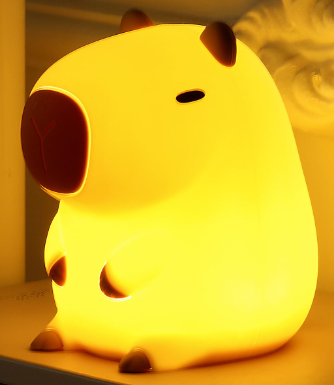
But this year, my sweet husband surprised me. He got me this, and I adore it!

It is a soft capybara night light! You squeeze it and it turns on; you squeeze it again and it gets brighter; you squeeze it once more and it turns off! It is a thing of joy.

I know, I know. It has nothing to do with grammar or English or new words. Trust me, I’m getting to today’s topic. This “gift” is something that my mom asked for. The email went something like this:

Kara,

I find this absolutely fascinating and I want one.

Mom

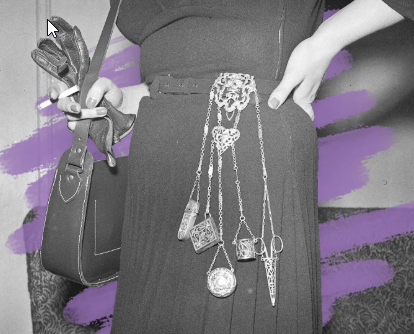
She attached this photo:

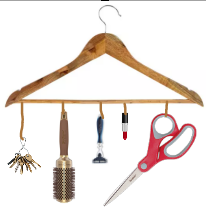
Chatelaine

I’m assuming my mom was referring to the chatelaine the woman is wearing, not the cigarette in her hand. So, what is a chatelaine?

From History Facts:
“Long before pockets became commonplace, humans had other resourceful ways to carry everyday essentials. Wearable pouches such as belt bags date back more than 5,000 years, and as early as ancient Roman times, people wore brooches that had hooks for hanging personal grooming tools. Similar items were used for carrying keys throughout the medieval period and beyond; by the 18th century, the tool had evolved into an elaborate piece that came to be known as a “chatelaine,” a word derived from French, referring to the keeper of a castle.”

Of course, the woman in the photo is also carrying a purse, but you can see she has a bunch of other things on her chatelaine. I see scissors, what looks like a watch, and who knows what else? If that were my mom, one of those would be holding lipstick.

When my husband and I were in Amsterdam, we went to the Museum of Bags and Purses, looking for a time-filler. It was amazing, and I remember many the chatelaines and small purses they had on display. COVID closed the museum, but the preceding link shows some of the collection, including these cool little gadgets. I’ll see what I can do with creating a likeness and sending it to my mom. Here’s what I have so far:

Kara Church | Technical Editor, Advisory | Technical Publications

Pronouns: she/her | Call via Teams | jackhenry.com

Editor’s Corner Archives: https://episystechpubs.com/

Posted by: Jack Henry | December 24, 2024

Editor’s Corner:

Good morning!

Is there anybody out there? I hear an echo when I shout, “Happy Holidays!”

I don’t have an official Editor’s Corner today. I have an idea for one, but I think I’ll leave it for next week. Right now, I simply wanted to take a moment to wish each of you joy, peace, and happiness today and in the new year. Whether you are celebrating Christmas, Kwanza, Hanukkah, the winter solstice, or something you made up, I hope you have a lovely holiday.

Thank you for reading, sending in your questions, offering ideas, and being part of our exploration of the English language.

Have a lovely day off tomorrow.

Kara

Editor’s Corner Archives: https://episystechpubs.com/

« Newer Posts - Older Posts »

Categories