Good morning, folks. Today I have more for you from Ireland. I’m skipping ahead to the last place that we visited: a great town called Kilkenny (kill=church, kenny=Kenneth). I loved this place. It had a castle, a farmer’s market, gorgeous medieval streets and churches, an interesting history, and a dog café where I chatted with a couple of dog lovers by the river.

Threatening clouds above the Nore River
We borrowed umbrellas (“brellies”) from the hotel and walked up to the town’s castle. We opted for a guided tour so that we could see the old moat (now underground) and the original building material they discovered when saving the castle from disrepair.

Kilkenny Castle, from the garden side (photo from the internet) Built in 1195.
But this Editor’s Corner is actually for something in the castle that I learned about. First, is the term “drawing room.” I am not sure if this is true, but the guide showed us a room called the “withdrawing room.” It was a room off of the dining room where women would “withdraw” after dinner, to leave the men to smoke and gamble. Eventually it was referred to as a “drawing room.” I thought it sounded more feasible than it being a room of cozy couches and chairs where women would go to sketch after dinner.
The second term is “pole screens.” Pole screens were in “withdrawing” or drawing rooms, and other rooms with fireplaces. They were popular in the 1700s and later when fireplaces were the main source of heat. Their primary purpose was to shield people from the heat and glare of the fire. First, a couple of photos:
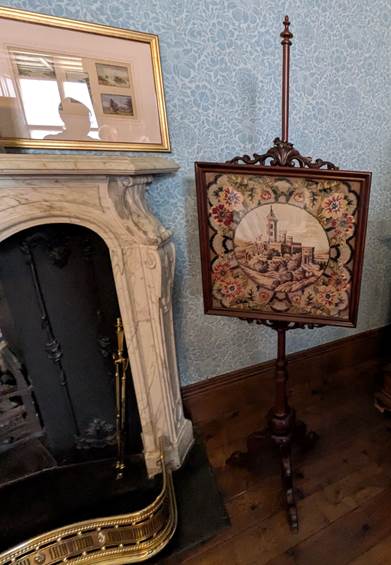
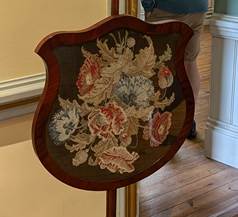
And a description of pole screens from Hammond-Harwood House:
Unlike many historic objects that have a modern-day equivalent, the pole screen provides a snapshot of a specific era. Ornamental yet practical, these screens deflected heat from your face as you sat near the fire. They could be adjusted depending on the height of the individual user. They began growing in popularity in the mid-18th century and were named for the vertical pole the screen was placed on. Typical forms have a small screen in the shape of a square, oval, or shield attached to the pole, which is placed on tripod feet. The screens themselves were decorated with embroidery, paint, or occasionally lacquer….
Pole screens were transportable art, generally placed at the center of the home, the hearth, where social interactions occurred especially in the cooler months. These items were considered status symbols that showed skill, dedication, and femininity.
Kara Church | Technical Editor, Advisory | Technical Publications
Pronouns: she/her | Call via Teams | jackhenry.com
Editor’s Corner Archives: https://episystechpubs.com/
 Editor's Corner
Leave a comment