At Dublin airport, my husband and I decided to start our vacation frugally by taking the bus into town. We were told it was about 30 minutes, and to get out when the driver called “George’s Key.” We watched out of the windows as we neared town.
I decided to look at my map. Dublin has a river running through it, called the Liffey, and it looked like we were following it along. On my map, I saw the names of all these quays. I wondered what a quay was (in my head still saying “quay,” to rhyme with “day”). I was shocked from my reverie when I heard “George’s (something).” I ran to the front of the bus and said, “Is this George’s Quay?” Only I rhymed it with “day” again. The driver looked at me a bit disgusted and said, “George’s key!”
We grabbed our suitcases and jumped off the bus. I just stood there repeating “quay is key, quay is key.” Ray looked at me like I should’ve slept on the flight over. I couldn’t get to a dictionary fast enough.
So, as I mentioned the other day, the word has three pronunciations. You can hear them here, but they are ˈkē, ˈkā, and ˈkwā. In Ireland it is the first.
Here is a view from a quay where we are having coffee, looking across to the other side of the river. The white bridge is the Ha’penny Bridge and the Merchant’s Arch is a pub.
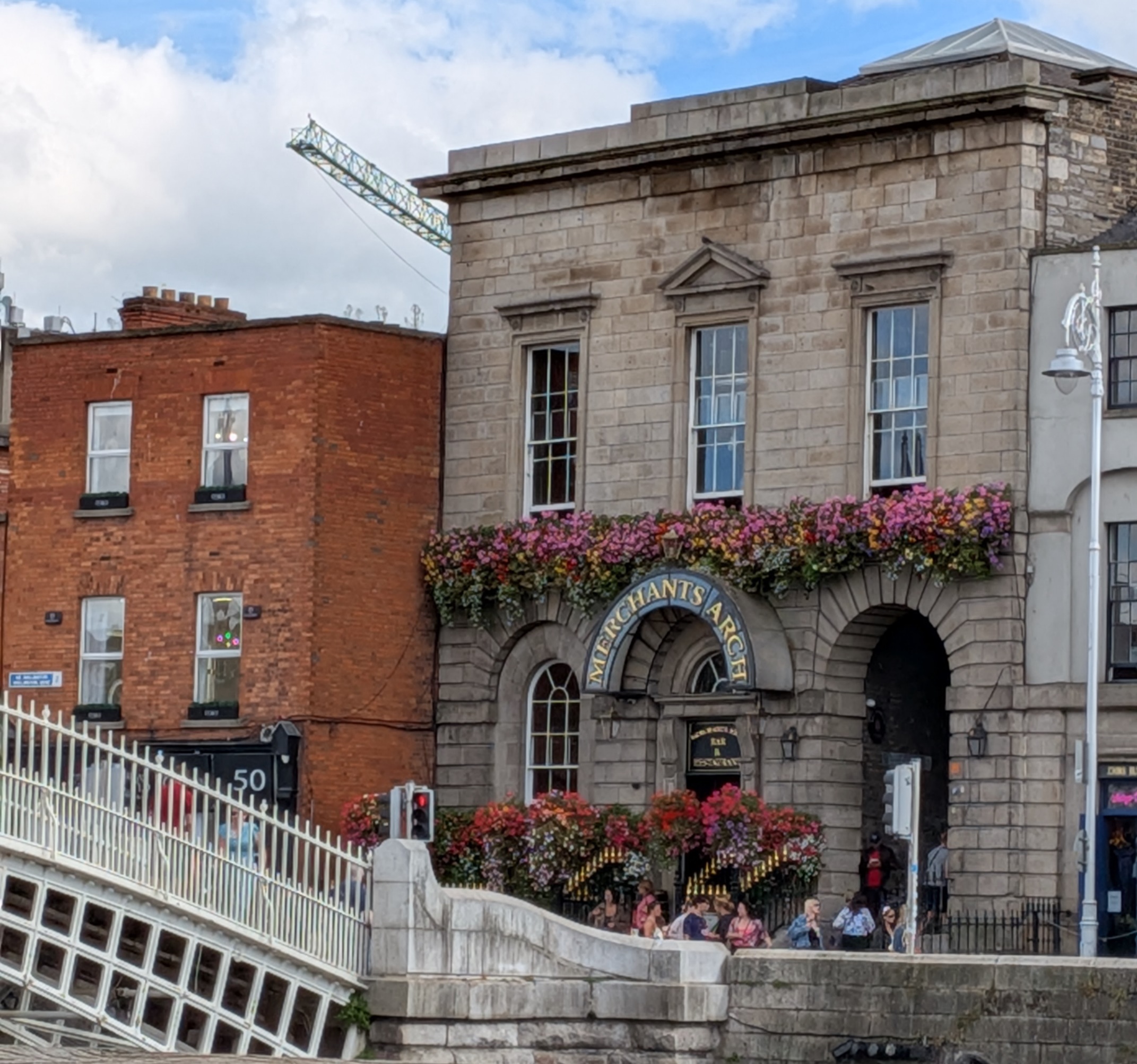
Here is a small tidbit of some Dublin quays:
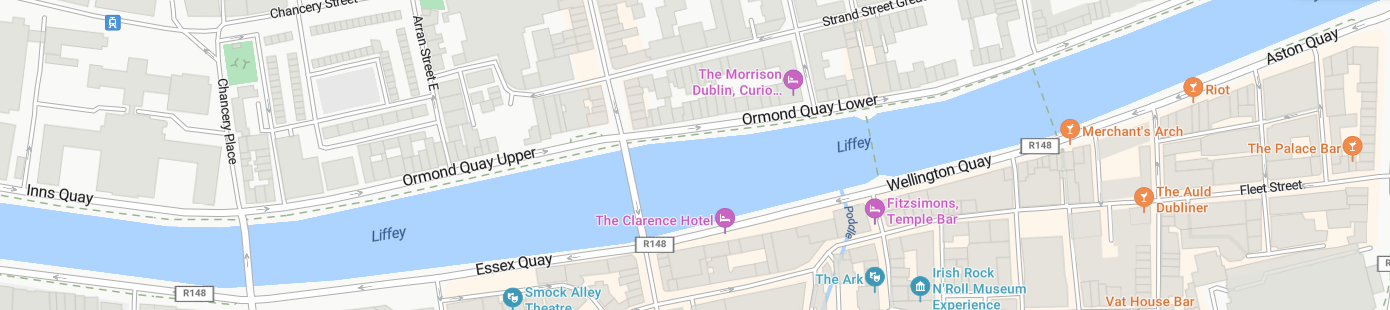
But what is a quay? I thought maybe it was like a dock, or a landing. There are boats along the river, but where I am sitting is more of a walkway for pedestrians that cut out of the river wall. The following information was provided by AI, when I asked what the difference is:
Quay
A dock is a general term for any structure where boats are tied up, while a pier is a raised structure that extends from the shore into the water for access and recreation. A quay is a solid, stable platform built parallel to the shoreline, often used for commercial loading and unloading of ships. The specific terminology can vary significantly by region and cultural context.
Here’s a more detailed breakdown:
· Dock
· Function: A place to moor and tie up boats, often for smaller-scale, personal use. Docks can also be floating structures that rise and fall with the water level.
· Construction: Can be a pier, a wharf, or even a floating platform.
· Usage: Commonly used in U.S. English as a broad term for any boat mooring.
· Pier
· Function: An elevated structure built to extend from the shore into the water, providing a landing place for boats or serving as a walkway for recreation like walking or fishing.
· Construction: Typically supported by pilings that allow water to flow underneath.
· Usage: Can be used for commercial or recreational activities.
· Quay
· Function: A solid, embankment-like structure designed to provide a secure, stable area for ships to dock alongside the shore for commercial loading and unloading of cargo.
· Construction: Usually built from concrete or stone and rests on filled land.
· Usage: Common in British English and other Commonwealth countries.
Key Differentiating Factors
· Orientation:
A quay runs parallel to the shore, a pier extends out into the water, and a dock can refer to a specific area within a larger structure.
· Construction:
Quays are solid and built on filled land, while piers are raised structures with open space underneath. Docks can be either.
· Purpose:
Piers are often for access or recreation, while quays are primarily for commercial loading and unloading.
I know, probably more than you cared to know, but I bet money if you go to Ireland, you aren’t going ask where George’sˈkwā is, you’ll ask for the ˈkē, like a pro.
Kara Church | Technical Editor, Advisory | Knowledge Enablement
Pronouns: she/her | Call via Teams | jackhenry.com
Editor’s Corner Archives: https://episystechpubs.com/
 Editor's Corner
Leave a comment