With all the recent chatter about AI, I was wondering, “What can AI do for me?” I needed ideas and inspiration for Editor’s Corner. I have a couple of questions from readers, which I’ll get to soon, but today I asked AI to provide me with 100 terms with surprising backgrounds and etymologies.
Copilot® choked. I thought I broke it, but about five minutes after I typed my question and said “please,” I got my list. It was not 100 words—it was about 25 words repeated four times. Thanks, AI!
I recognized several of the words from other lists I’d seen. But then I saw “gargoyle,” and it won my heart. Here are a few of the words and their etymologies. As soon as I had my list, I did my due diligence and verified the words at the Online Etymology Dictionary.
Enjoy!
gargoyle (n.)
"grotesque carved waterspout," connected to the gutter of a building to throw down water clear of the wall… "carved mouth of a rain spout, a gargoyle," from Old French gargole, gargoule "throat;" also "carved downspout," in the form of a serpent or some other fanciful shape, also from Medieval Latin gargola, gargulio (see gargle (v.)).
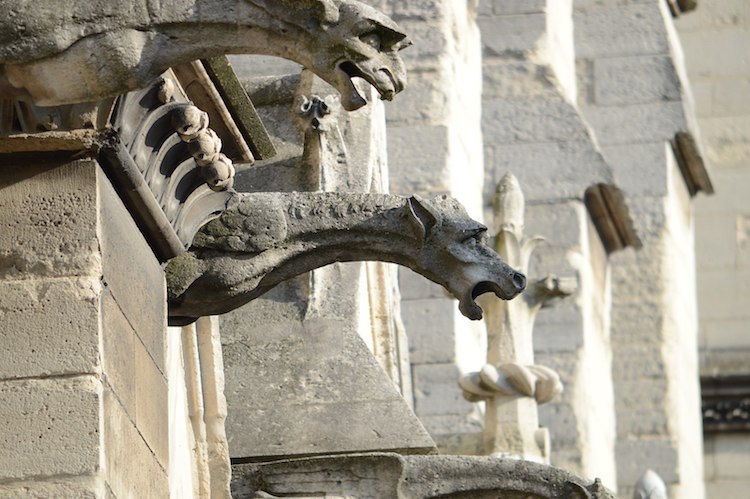
Two gargoyles from Notre Dame.
nightmare (n.)
c. 1300, "an evil female spirit afflicting men (or horses) in their sleep with a feeling of suffocation," "goblin that causes nightmares, incubus." The meaning shifted mid-16c. from the incubus to the suffocating sensation it causes. Sense of "any bad dream" is recorded by 1829; that of "very distressing experience" is from 1831.
[KC – I don’t love that nightmares were originally from evil
females afflicting men, but I do love that these spirits also inflicted
horses. Who on earth decided that? I understand that dogs might have nightmares, but I’ve never seen a horse sleeping, so I cannot confirm or deny that statement.]
alibi (n.)
1743, "a plea of having been elsewhere when an action took place," from Latin alibi (adv.) "elsewhere, somewhere else."
disaster (n.)
"anything that befalls of ruinous or distressing nature; any unfortunate event," especially a sudden or great misfortune, 1590s, from French désastre (1560s), from Italian disastro, literally "ill-starred," from dis-, here merely pejorative, equivalent to English mis- "ill" + astro "star, planet," from Latin astrum, from Greek astron "star".
The sense is astrological, of a calamity blamed on an unfavorable position of a planet, and "star" here is probably meant in the astrological sense of "destiny, fortune, fate." Compare Medieval Latin astrum sinistrum "misfortune," literally "unlucky star," and English ill-starred.
Hmm. Unlucky stars and nightmares. What is on AI’s “mind”? I think I’ll stick with my own ideas and imagination and see what comes my way.
Kara Church | Technical Editor, Advisory | Knowledge Enablement
Pronouns: she/her | Call via Teams | jackhenry.com
Editor’s Corner Archives: https://episystechpubs.com/
 Editor's Corner
Leave a comment