Good morning, folks!
Since I’ve kinda been on a Halloween kick lately, I thought I’d continue with something I don’t think I’ve covered before.
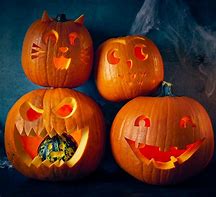
I was reading the history of something or other yesterday, and I stumble on pumpkins. Nope, I’m not going to talk about the history of pumpkins, but I am going to talk about where we got the word jack-o’-lantern from. (Usually, it’s defined as an illuminated face carved into a pumpkin.)
First, just the basics: vegetable carving. Who doesn’t love carving a vegetable? According to this article from History.com, “the practice of carving ghoulish faces on vegetables may have roots in Ireland, where large turnips served as early canvasses.” The people would carve out the turnips and put candles in them to light them up. “Irish immigrants brought the tradition to America, home of the pumpkin, and it became a part of Halloween festivities.”
That is the custom of vegetable carving and lighting, but that’s not all we borrowed from the Irish. We borrowed the name “jack-o’-lantern” from an Irish folk tale about a man named “Stingy Jack.” Here is an edited version of his story (for space).
The Legend of Stingy Jack
Stingy Jack invited the devil to have a drink with him. True to his name, Stingy Jack didn’t want to pay for his drink, so he convinced the devil to turn himself into a coin that Jack could use to buy their drinks. Once the devil did so, Jack decided to keep the money and put it into his pocket next to a silver cross, which prevented the devil from changing back into his original form.
Jack eventually freed the Devil, under the condition that he would not bother Jack for one year and that, should Jack die, he would not claim his soul. The next year, Jack again tricked the devil into climbing into a tree to pick a piece of fruit. While he was up in the tree, Jack carved a sign of the cross into the tree’s bark so that the devil could not come down until the devil promised Jack not to bother him for 10 more years.
Soon after, Jack died. As the legend goes, god would not allow such an unsavory figure into heaven. The devil, upset by the trick Jack had played on him and keeping his word not to claim his soul, would not allow Jack into hell. He sent Jack into the dark night with only a burning coal to light his way. Jack put the coal into a carved-out turnip and has been roaming the Earth with it ever since. The Irish began to refer to this ghostly figure as “Jack of the Lantern,” and then, simply “Jack O’Lantern.”
In Ireland and Scotland, people began to make their own versions of Jack’s lanterns by carving scary faces into turnips and placing them into windows or near doors to frighten away Stingy Jack and other wandering evil spirits.
So this (Stingy) Jack of the Lantern, eventually became Jack o’ lantern, and then jack-o’-lantern, and we Americans decided to use our own favorite carving model, the pumpkin.
There is more information out there about how this tradition became a Halloween standard, but this was the best explanation I found for the word jack-o’-lantern.

Kara Church | Technical Editor, Advisory | Technical Publications
Pronouns: she/her | Call via Teams | jackhenry.com
Editor’s Corner Archives: https://episystechpubs.com/
 Editor's Corner
Leave a comment