Most days I wake up feeling a little tired but happy to greet the new day. It seems like almost anything is possible when you’re just getting started. And then your spouse walks into the office and says something like, “You should do an Editor’s Corner on the meaning of Cc, Bcc, and ditto machines! Some of my younger coworkers don’t know what they are.”
Then, I just feel old.
Well, my friends. If you were brought up never knowing a typewriter or ditto machine, I’m here to give you a little bit of history about the writing-related terms my hubby mentioned.
Let’s start with Cc and Bcc. Cc stands for “carbon copy” and Bcc stands for “blind carbon copy.” You might have heard the terms explained as “blind courtesy copy” and “courtesy copy,” but those are newer definitions used for folks that don’t understand the reference to carbon.
The references to carbon come from the days when a typist would put several pieces of paper together, with a piece of carbon paper between each blank paper. That way, they could type once, but end up with several carbon copies of the note or letter.
The blind carbon copy was a version of the message that was generated for “an additional recipient, without the primary recipient being aware.” (Blind carbon copy – Wikipedia)
The article in Wikipedia further explains how we use the address field in email:
To: Primary recipients
Cc: Carbon copy to secondary recipients—other interested parties
Bcc: Blind carbon copy to tertiary recipients who receive the message. The primary and secondary recipients cannot see the tertiary recipients. Depending on email software, the tertiary recipients may only see their own email address in Bcc, or they may see the email addresses of all primary and secondary recipients but will not see other tertiary recipients.
It is common practice to use the Bcc: field when addressing a very long list of recipients, or a list of recipients who should not (necessarily) know each other, e.g., in mailing lists.
There are many reasons to use Bcc, but that is for a different topic. For those of you who have only used the Microsoft® version of Cc and Bcc, here is a picture of the carbon sheets that used to go between the papers in the typewriter:

And then there is the term “ditto.” This term is probably older than you think. According to the Online Etymology Dictionary, it is from the 1620s.
ditto: “In the month of the same name," Tuscan dialectal ditto "(in) the said (month or year)," literary Italian detto, past participle of dire "to say," from Latin dicere "speak, tell, say.”
Italians used the word to avoid repetition of month names in a series of dates, and in this sense it was picked up in English. Its generalized meaning of "the aforesaid, the same thing, same as above" is attested in English by 1670s.
Here are some more definitions and examples from Merriam-Webster:
ditto
adverb:as before or aforesaid : in the same manner
—used to indicate that a previous statement also applies to something or someone else
"I’m ready for a break." "Ditto." [=so am I]
verb: to restate in support or agreement : echo
A resident dittoed the council members’ comments.—Gwen Davis
noun: a thing mentioned previously
—used to avoid repeating a word; often symbolized by inverted commas or apostrophes
Mr. Thomas Potter, then, was a clerk in the city, and Mr. Robert Smithers was a ditto in the same …—Charles Dickens
adjective: having the same characteristics : similar
It’s a ditto day …, with no change in the numbers of confirmed, probable, active or recovered cases …—thespinoff.co.nz
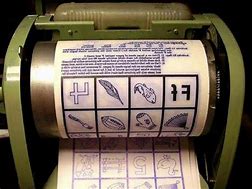
And here is a ditto machine, using something similar to the carbon papers that typists used. The copies from these machines were generally purple, though they could be green or red or other colors. And because of the fluid used with them, they had a very distinct smell when Sister Mary brought them back to the classroom!
Kara Church | Technical Editor, Advisory | Technical Publications
Pronouns: she/her | Call via Teams | jackhenry.com
Editor’s Corner Archives: https://episystechpubs.com/
 Editor's Corner
Leave a comment